
'%20fill='%23a9976d'/%3e%3cpath%20id='Path_251'%20data-name='Path%20251'%20d='M8,35a1,1,0,0,1,1-1H23a1,1,0,0,1,0,2H9A1,1,0,0,1,8,35Z'%20transform='translate(-8%20-22)'%20fill='%23a9976d'/%3e%3cpath%20id='Path_252'%20data-name='Path%20252'%20d='M9,22a1,1,0,0,0,0,2h8a1,1,0,0,0,0-2Z'%20transform='translate(-8%20-16)'%20fill='%23a9976d'/%3e%3c/svg%3e)
'%20fill='%23a9976d'/%3e%3c/g%3e%3c/svg%3e)
'%3e%3cg%20id='Ellipse_27'%20data-name='Ellipse%2027'%20transform='translate(813%20250)'%20fill='none'%20stroke='%23ccac89'%20stroke-width='1'%3e%3ccircle%20cx='16'%20cy='16'%20r='16'%20stroke='none'/%3e%3ccircle%20cx='16'%20cy='16'%20r='15.5'%20fill='none'/%3e%3c/g%3e%3cg%20id='facebook'%20transform='translate(824.105%20258.296)'%3e%3cpath%20id='Path_243'%20data-name='Path%20243'%20d='M8.894.111V2.556H7.441a1.361,1.361,0,0,0-1.074.333,1.534,1.534,0,0,0-.278,1v1.75H8.8L8.441,8.38H6.089v7.028H3.255V8.38H.894V5.639H3.255V3.62A3.582,3.582,0,0,1,4.218.949,3.5,3.5,0,0,1,6.783,0,15.317,15.317,0,0,1,8.894.111Z'%20transform='translate(0%200)'%20fill='%23ccac89'/%3e%3c/g%3e%3c/g%3e%3c/svg%3e)

'%3e%3cg%20id='Ellipse_29'%20data-name='Ellipse%2029'%20transform='translate(901%20250)'%20fill='none'%20stroke='%23ccac89'%20stroke-width='1'%3e%3ccircle%20cx='16'%20cy='16'%20r='16'%20stroke='none'/%3e%3ccircle%20cx='16'%20cy='16'%20r='15.5'%20fill='none'/%3e%3c/g%3e%3cg%20id='link-45deg'%20transform='translate(902.607%20253.105)'%3e%3cg%20id='Group_479'%20data-name='Group%20479'%20transform='translate(7.393%205.896)'%3e%3cpath%20id='Path_241'%20data-name='Path%20241'%20d='M10.246,17.821,8.507,19.56a3.8,3.8,0,0,0,5.378,5.378L16.2,22.62a3.8,3.8,0,0,0-1.05-6.12l-.743.743a1.27,1.27,0,0,0-.2.252,2.535,2.535,0,0,1,1.091,4.23L12.99,24.042A2.536,2.536,0,0,1,9.4,20.455l1.005-1a5.093,5.093,0,0,1-.162-1.631Z'%20transform='translate(-7.393%20-12.02)'%20fill='%23ccac89'/%3e%3cpath%20id='Path_242'%20data-name='Path%20242'%20d='M18.236,9.327a3.8,3.8,0,0,0,1.05,6.12l.982-.984a2.535,2.535,0,0,1-1.136-4.241L21.448,7.9a2.536,2.536,0,1,1,3.587,3.587l-1.005,1a5.1,5.1,0,0,1,.162,1.631l1.739-1.739A3.8,3.8,0,1,0,20.553,7.01Z'%20transform='translate(-13.011%20-5.896)'%20fill='%23ccac89'/%3e%3c/g%3e%3c/g%3e%3c/g%3e%3c/svg%3e)
◤文.圖 / 看見台灣基金會編輯群
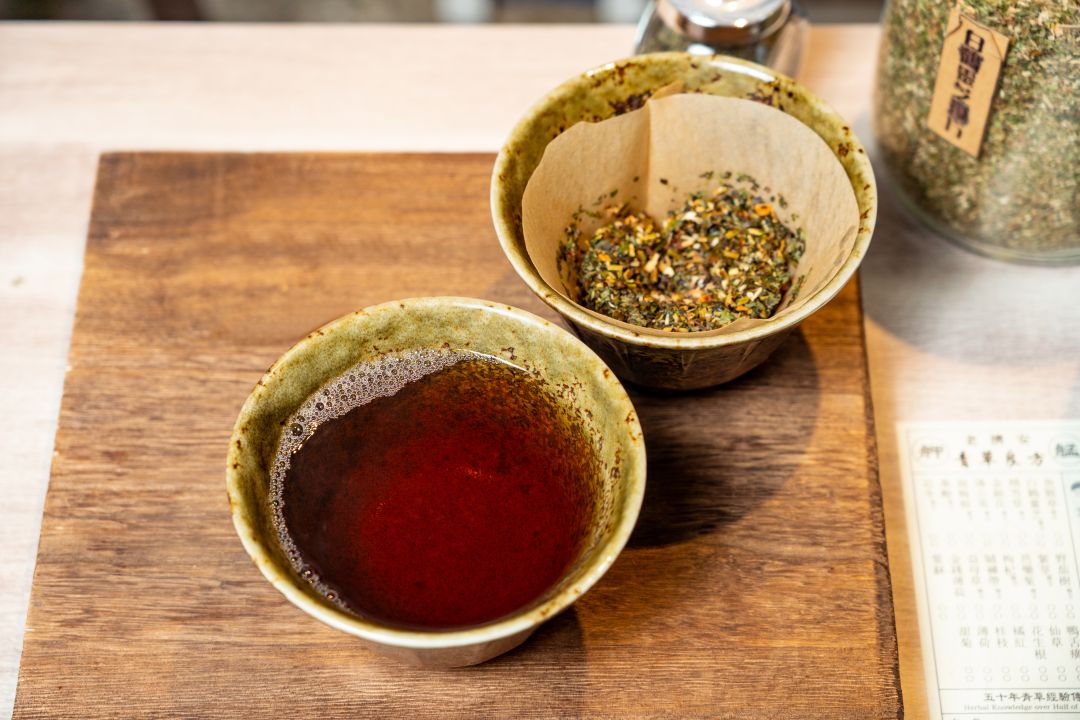
台灣氣候濕熱,民眾易中暑或體內積熱。早年因醫療資源匱乏,先民遂就地取材,以魚腥草、仙草、半枝蓮、苦茶根等青草熬煮成茶,用以清熱解毒、消暑退火。這杯蘊含「藥食同源」智慧的青草茶,便在台北最早發展的區域──艋舺(今萬華)落地生根。
位於萬華西昌街224巷的「青草巷」,因聚集販售青草藥材而得名,歷史已逾百年。 清領時期,艋舺是商旅匯聚、信仰活動興盛。隨著龍山寺香火鼎盛、街市繁榮,青草店林立於廟埕周邊,成為進香信眾與在地居民的重要依靠。當時因疾病頻仍、醫療不發達,居民多仰賴龍山寺的藥籤與口傳偏方,再至青草店購藥煎煮,青草巷因而有了「救命街」之稱,其中「四知青草店」有超過130年歷史,為當地知名傳統青草店。其店名「四知」,典出東漢名臣楊震「天知、地知、你知、我知」之說,意在強調店家的誠信經營與藥材品質。
產業式微與文化再生的實踐
青草巷不僅是藥材集散地,更是信仰與常民生活的交會場域。青草茶既是勞動者消暑的日常飲品,也陪伴著往來的香客,完成一段身心修復的旅程。此地的飲食文化,蘊含著庶民對健康與信仰的雙重寄託。
然而,隨著1990年代全民健保上路,醫療資源普及,加上手搖飲崛起,青草產業逐漸式微。青草巷曾一度沒落,直至近年經台北市政府進行空間整修與文化振興,並於2015年登錄為市定歷史建築後,才重新獲得大眾關注。業者也積極轉型,從販售青草藥材轉向以青草茶飲為主力,推出茶包、青草冰棒、凍飲,甚至跨界與咖啡結合,成功吸引年輕族群,這些轉型成為文化再生的具體實踐。