
'%20fill='%23a9976d'/%3e%3cpath%20id='Path_251'%20data-name='Path%20251'%20d='M8,35a1,1,0,0,1,1-1H23a1,1,0,0,1,0,2H9A1,1,0,0,1,8,35Z'%20transform='translate(-8%20-22)'%20fill='%23a9976d'/%3e%3cpath%20id='Path_252'%20data-name='Path%20252'%20d='M9,22a1,1,0,0,0,0,2h8a1,1,0,0,0,0-2Z'%20transform='translate(-8%20-16)'%20fill='%23a9976d'/%3e%3c/svg%3e)
'%20fill='%23a9976d'/%3e%3c/g%3e%3c/svg%3e)
台灣苦茶油──山林間孕育出的珍貴食用油
'%3e%3cg%20id='Ellipse_27'%20data-name='Ellipse%2027'%20transform='translate(813%20250)'%20fill='none'%20stroke='%23ccac89'%20stroke-width='1'%3e%3ccircle%20cx='16'%20cy='16'%20r='16'%20stroke='none'/%3e%3ccircle%20cx='16'%20cy='16'%20r='15.5'%20fill='none'/%3e%3c/g%3e%3cg%20id='facebook'%20transform='translate(824.105%20258.296)'%3e%3cpath%20id='Path_243'%20data-name='Path%20243'%20d='M8.894.111V2.556H7.441a1.361,1.361,0,0,0-1.074.333,1.534,1.534,0,0,0-.278,1v1.75H8.8L8.441,8.38H6.089v7.028H3.255V8.38H.894V5.639H3.255V3.62A3.582,3.582,0,0,1,4.218.949,3.5,3.5,0,0,1,6.783,0,15.317,15.317,0,0,1,8.894.111Z'%20transform='translate(0%200)'%20fill='%23ccac89'/%3e%3c/g%3e%3c/g%3e%3c/svg%3e)

'%3e%3cg%20id='Ellipse_29'%20data-name='Ellipse%2029'%20transform='translate(901%20250)'%20fill='none'%20stroke='%23ccac89'%20stroke-width='1'%3e%3ccircle%20cx='16'%20cy='16'%20r='16'%20stroke='none'/%3e%3ccircle%20cx='16'%20cy='16'%20r='15.5'%20fill='none'/%3e%3c/g%3e%3cg%20id='link-45deg'%20transform='translate(902.607%20253.105)'%3e%3cg%20id='Group_479'%20data-name='Group%20479'%20transform='translate(7.393%205.896)'%3e%3cpath%20id='Path_241'%20data-name='Path%20241'%20d='M10.246,17.821,8.507,19.56a3.8,3.8,0,0,0,5.378,5.378L16.2,22.62a3.8,3.8,0,0,0-1.05-6.12l-.743.743a1.27,1.27,0,0,0-.2.252,2.535,2.535,0,0,1,1.091,4.23L12.99,24.042A2.536,2.536,0,0,1,9.4,20.455l1.005-1a5.093,5.093,0,0,1-.162-1.631Z'%20transform='translate(-7.393%20-12.02)'%20fill='%23ccac89'/%3e%3cpath%20id='Path_242'%20data-name='Path%20242'%20d='M18.236,9.327a3.8,3.8,0,0,0,1.05,6.12l.982-.984a2.535,2.535,0,0,1-1.136-4.241L21.448,7.9a2.536,2.536,0,1,1,3.587,3.587l-1.005,1a5.1,5.1,0,0,1,.162,1.631l1.739-1.739A3.8,3.8,0,1,0,20.553,7.01Z'%20transform='translate(-13.011%20-5.896)'%20fill='%23ccac89'/%3e%3c/g%3e%3c/g%3e%3c/g%3e%3c/svg%3e)
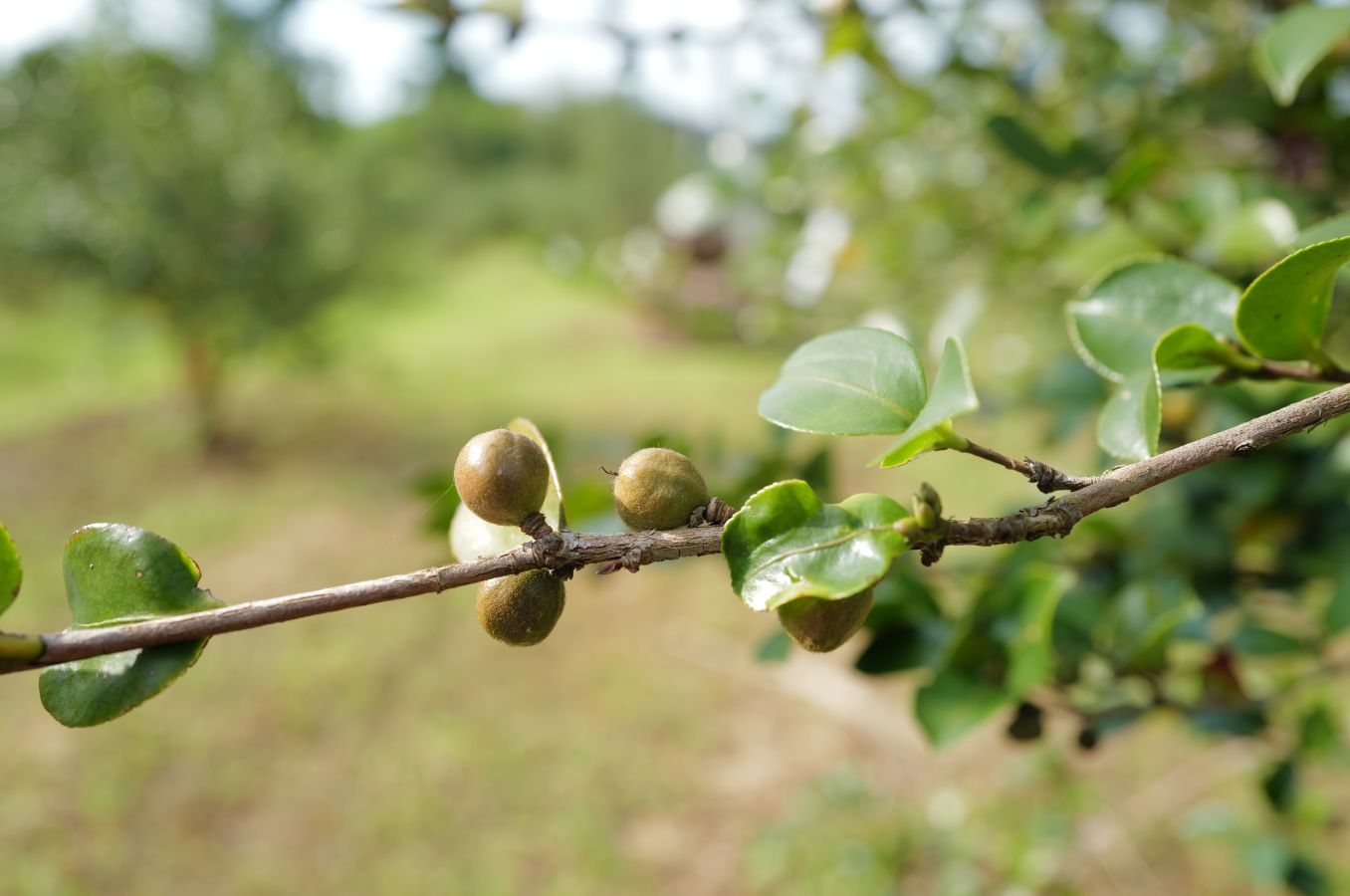
◤文.圖 / 看見台灣基金會編輯群
灣栽種的油茶樹主要分為兩類:一是原生種小果油茶(Camellia brevistyla,短柱山茶),多生長於低海拔山坡地;另一是大果油茶(Camellia oleifera),適應於較高海拔的山區環境。
其中台灣原生種小果油茶需4年開始開花結實,7年才能穩定盛產,果實成熟需約300天,每10公斤生果(含果殼)約可乾燥成4.2公斤茶籽,再榨出約1公斤茶油,產油極其稀少。
根據2023年農業部資料,目前台灣油茶種植面積約1,600公頃,主要分布於中北部與東部山區,包括新北、桃竹苗、南投信義與花蓮富里等地。日本時代油茶樹曾作為造林樹種廣泛種植,1945年前後種植面積已達3,000公頃。隨著農業轉型,苦茶油曾一度式微,直到近年健康與食安意識提升,才重新受到矚目。
▋不只食用,更是保養品
苦茶油製作過程繁複,需待果實成熟後採收,經曝曬、脫殼、壓榨、過濾等多道工序,才能得到清澈透亮的油品,其色澤呈金黃色帶微綠。苦茶果外殼略帶苦味,但榨出的油卻無苦澀,反而帶有淡淡植物香氣。其營養價值可媲美橄欖油,且具兩大優勢:其一,單元不飽和脂肪酸比例更高;其二,發煙點約252℃,高於橄欖油,更符合台灣熱炒料理的烹飪需求。此外,苦茶油富含約80%單元不飽和脂肪酸(油酸)、約10%多元不飽和脂肪酸,並含有維生素A、E及茶多酚等,具有抗氧化等效益。
苦茶油在傳統家庭常被視為營養價值高的滋養品,特別是病後調養與產後護理的傳統滋補油品。後來逐漸融入日常飲食,發展出茶油雞、茶油拌麵線與茶油拌飯等家常料理。而在當代,業者更進一步開發茶油皂、護膚油等產品,延伸到生活保養領域。
如今,各地小農團體以自然農法復育油茶林,如苗栗、台東等地,嘉義梅山茶油合作社更以「冷壓、純榨、無添加」工法,成功拓展國際市場,外銷日本、美國與澳洲。