


◤Text and Images / iSee Taiwan Foundation Editorial Team
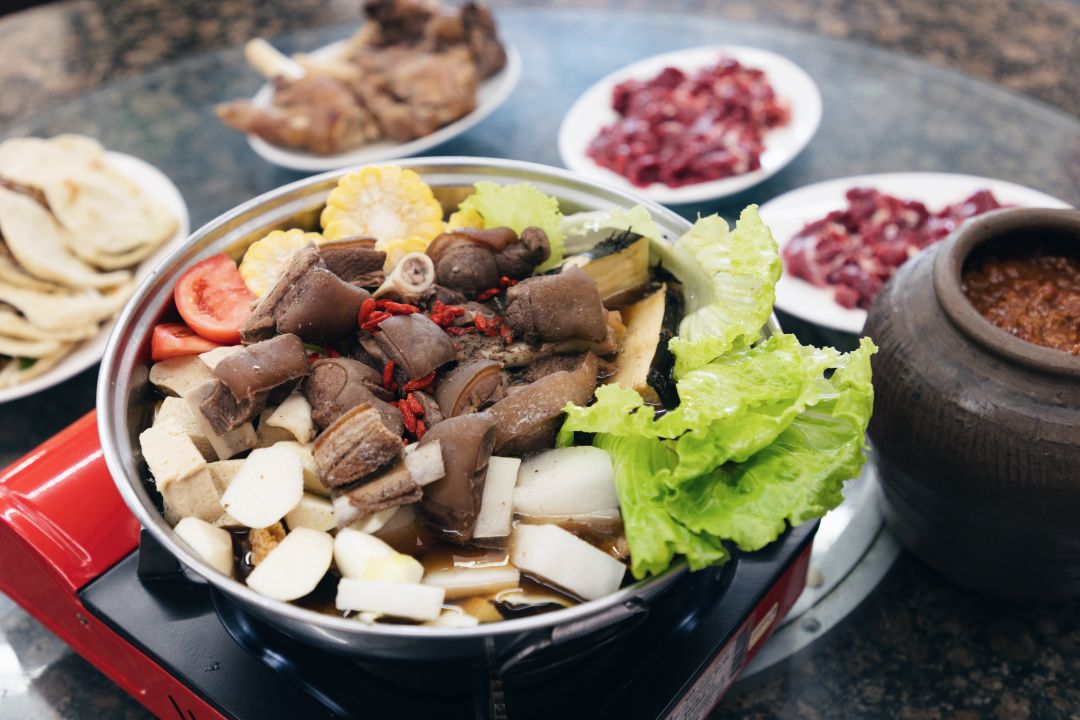
In Taiwan, mutton hot pot is more than a dish; it is a deeply ingrained expression of jinbu—the cultural practice of fortifying the body through food. When cold season arrives, a fragrant herb-infused mutton hot pot offers the ultimate comfort. The dish traces its roots to southern Taiwan, with Gangshan in Kaohsiung City and Xihu in Changhua County standing as the most celebrated centers. During the Japanese colonial period, street vendors already sold mutton-based fare—soups, thick broths, and stir-fried mutton—though the hot pot format had yet to emerge. It was not until the 1970s that yang rou lu gained widespread popularity, eventually becoming the defining dish of winter nourishment.
In traditional Chinese medicine (TCM), mutton is considered warming in nature, benefiting qi, tonifying the kidneys, and dispelling internal cold. Slow-simmered with herbs such as dong quai, codonopsis (tangshen), ginger, wolfberries, and astragalus (huangqi), the broth becomes a potent tonic—particularly suited to those with constitutionally cold or deficient body types, and to the elderly. The addition of spices like tsao ko (Amomum tsao-ko) neutralizes gaminess and stimulates the appetite, embodying the time-honored principle that food and medicine share the same source.
A Fuller Feast: The Many Faces of Mutton Hot Pot
The appeal of yang rou lu extends well beyond its rich, herb-laden broth. It lies equally in the dish's capacity to absorb diverse ingredients and culinary ingenuity. The long-established Shuiwei Zhangjia restaurant in Hsinchu City, for instance, sources its mutton from Beigang in Yunlin County, where the animals are raised on natural pasture—yielding meat that is firm in texture and mild in aroma. Some establishments insist on charcoal slow-cooking, lending the broth a subtle, rustic smokiness. Meanwhile, newer operators have boldly incorporated maqaw (mountain pepper), an indigenous Taiwanese spice, infusing the traditional broth with a bright, lemony heat.
Yang rou lu thus carries forward Taiwan's deep-rooted tradition of food-as-medicine while reflecting the vitality and diversity of contemporary Taiwanese cuisine. The dish is also beginning to find its footing internationally: several Taiwanese brands and products have entered global markets by participating in international food expos and obtaining certifications such as Halal accreditation, opening new opportunities—particularly within Muslim-majority markets.