
'%20fill='%23a9976d'/%3e%3cpath%20id='Path_251'%20data-name='Path%20251'%20d='M8,35a1,1,0,0,1,1-1H23a1,1,0,0,1,0,2H9A1,1,0,0,1,8,35Z'%20transform='translate(-8%20-22)'%20fill='%23a9976d'/%3e%3cpath%20id='Path_252'%20data-name='Path%20252'%20d='M9,22a1,1,0,0,0,0,2h8a1,1,0,0,0,0-2Z'%20transform='translate(-8%20-16)'%20fill='%23a9976d'/%3e%3c/svg%3e)
'%20fill='%23a9976d'/%3e%3c/g%3e%3c/svg%3e)
'%3e%3cg%20id='Ellipse_27'%20data-name='Ellipse%2027'%20transform='translate(813%20250)'%20fill='none'%20stroke='%23ccac89'%20stroke-width='1'%3e%3ccircle%20cx='16'%20cy='16'%20r='16'%20stroke='none'/%3e%3ccircle%20cx='16'%20cy='16'%20r='15.5'%20fill='none'/%3e%3c/g%3e%3cg%20id='facebook'%20transform='translate(824.105%20258.296)'%3e%3cpath%20id='Path_243'%20data-name='Path%20243'%20d='M8.894.111V2.556H7.441a1.361,1.361,0,0,0-1.074.333,1.534,1.534,0,0,0-.278,1v1.75H8.8L8.441,8.38H6.089v7.028H3.255V8.38H.894V5.639H3.255V3.62A3.582,3.582,0,0,1,4.218.949,3.5,3.5,0,0,1,6.783,0,15.317,15.317,0,0,1,8.894.111Z'%20transform='translate(0%200)'%20fill='%23ccac89'/%3e%3c/g%3e%3c/g%3e%3c/svg%3e)

'%3e%3cg%20id='Ellipse_29'%20data-name='Ellipse%2029'%20transform='translate(901%20250)'%20fill='none'%20stroke='%23ccac89'%20stroke-width='1'%3e%3ccircle%20cx='16'%20cy='16'%20r='16'%20stroke='none'/%3e%3ccircle%20cx='16'%20cy='16'%20r='15.5'%20fill='none'/%3e%3c/g%3e%3cg%20id='link-45deg'%20transform='translate(902.607%20253.105)'%3e%3cg%20id='Group_479'%20data-name='Group%20479'%20transform='translate(7.393%205.896)'%3e%3cpath%20id='Path_241'%20data-name='Path%20241'%20d='M10.246,17.821,8.507,19.56a3.8,3.8,0,0,0,5.378,5.378L16.2,22.62a3.8,3.8,0,0,0-1.05-6.12l-.743.743a1.27,1.27,0,0,0-.2.252,2.535,2.535,0,0,1,1.091,4.23L12.99,24.042A2.536,2.536,0,0,1,9.4,20.455l1.005-1a5.093,5.093,0,0,1-.162-1.631Z'%20transform='translate(-7.393%20-12.02)'%20fill='%23ccac89'/%3e%3cpath%20id='Path_242'%20data-name='Path%20242'%20d='M18.236,9.327a3.8,3.8,0,0,0,1.05,6.12l.982-.984a2.535,2.535,0,0,1-1.136-4.241L21.448,7.9a2.536,2.536,0,1,1,3.587,3.587l-1.005,1a5.1,5.1,0,0,1,.162,1.631l1.739-1.739A3.8,3.8,0,1,0,20.553,7.01Z'%20transform='translate(-13.011%20-5.896)'%20fill='%23ccac89'/%3e%3c/g%3e%3c/g%3e%3c/g%3e%3c/svg%3e)
◤文.圖/看見台灣基金會編輯群
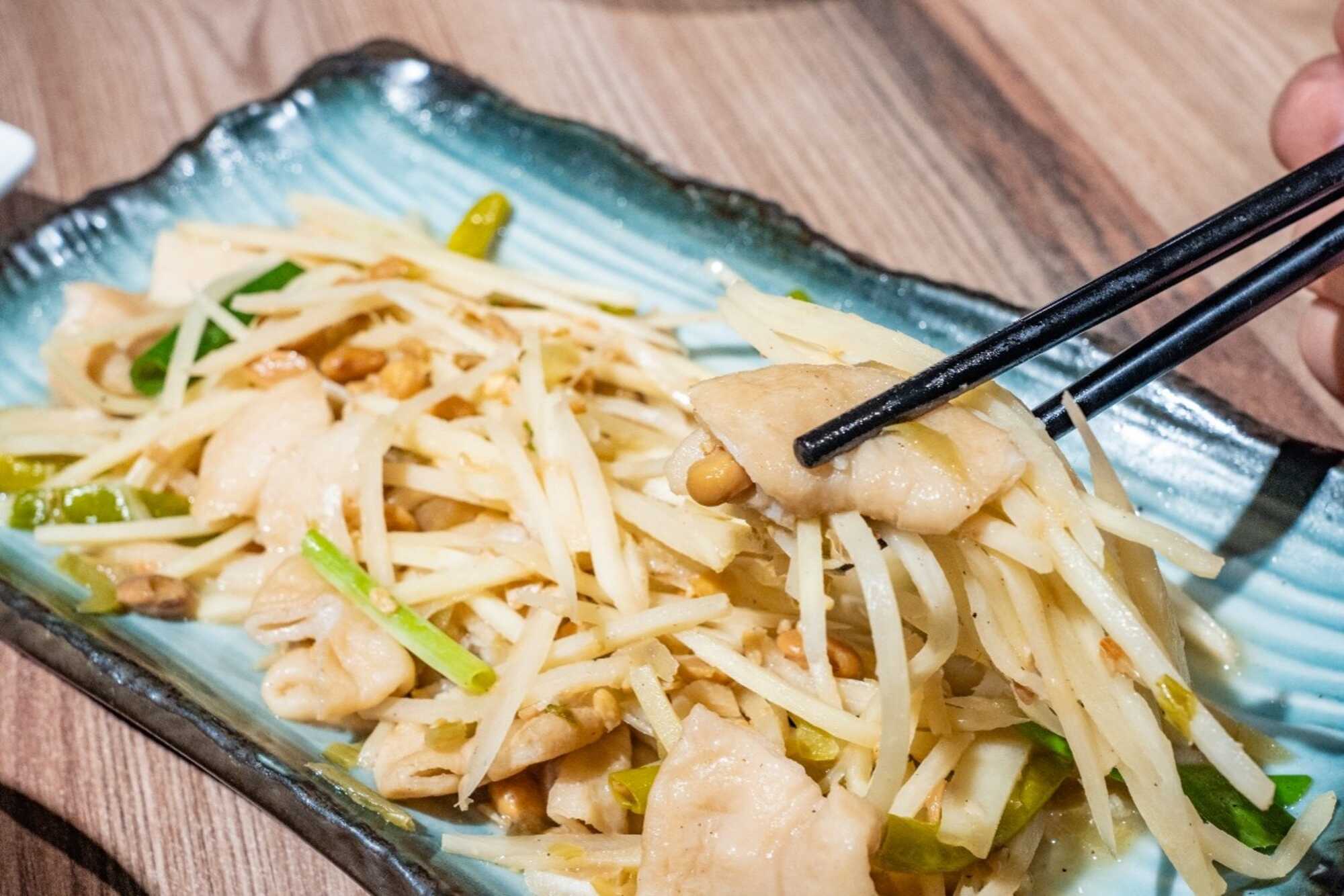
薑絲炒大腸是台灣常見的客家料理。早年農業社會物資有限,豬肉多在節慶或過年時才較有機會吃到;豬隻不同部位分別入菜,也呈現珍惜食物、物盡其用的生活態度。較難處理的大腸經過清洗、汆燙與快炒,也成為餐桌上的佳餚。
料理好吃與否,關鍵先在大腸的清理與火候。大腸須翻面去除多餘油脂及黏液,洗淨後汆燙、切段;嫩薑則切成細絲,保留清脆口感。起油鍋爆香薑絲、蒜頭,再放入大腸,以旺火迅速翻炒,最後沿鍋邊淋入白醋、米醋或烏醋,使酸氣隨熱度揚起。有些店家也會加入醬油、米豆醬、蒜苗或略微勾芡;共同講究的是大腸脆而不韌,薑絲清香帶辛,醋味鮮明卻不嗆喉。
從歌謠看見客家日常美食
薑絲炒大腸常被列入客家「四炆四炒」。「炆」指慢火燉煮,「炒」則是大火快炒;常見說法之一,四炒包括客家小炒、薑絲炒大腸、鴨血炒韭菜,以及豬肺炒鳳梨木耳。
客家傳統歌謠〈病子歌〉中唱到:「(女)正月裡來新年時,娘今病子沒人知;(男)阿伯問娘愛食什麼?(女)愛食豬腸炒薑絲。」歌中描寫懷孕婦人想吃薑絲炒大腸,或許因這道菜酸香鮮明,較能引起食欲,而從這段歌詞也可看出,這道菜早已融入客家人的日常生活與家庭記憶。
對初次品嘗的人而言,豬大腸、薑絲與醋的組合或許強烈而陌生;對熟悉客家菜的人來說,那股迎面而來的酸香,連結的是節慶吃豬肉、善用食材與一家人圍桌共食的生活經驗。從客庄宴席、家庭餐桌到今日的餐館,薑絲炒大腸持續以爽脆、辛香而鮮明的滋味,訴說台灣客家飲食珍惜食材、順應生活的深厚底蘊。