
'%20fill='%23a9976d'/%3e%3cpath%20id='Path_251'%20data-name='Path%20251'%20d='M8,35a1,1,0,0,1,1-1H23a1,1,0,0,1,0,2H9A1,1,0,0,1,8,35Z'%20transform='translate(-8%20-22)'%20fill='%23a9976d'/%3e%3cpath%20id='Path_252'%20data-name='Path%20252'%20d='M9,22a1,1,0,0,0,0,2h8a1,1,0,0,0,0-2Z'%20transform='translate(-8%20-16)'%20fill='%23a9976d'/%3e%3c/svg%3e)
'%20fill='%23a9976d'/%3e%3c/g%3e%3c/svg%3e)
太陽餅─餅皮要超過百層,才是名餅
地方探索
主題探索
中部
文化美食
分享
'%3e%3cg%20id='Ellipse_27'%20data-name='Ellipse%2027'%20transform='translate(813%20250)'%20fill='none'%20stroke='%23ccac89'%20stroke-width='1'%3e%3ccircle%20cx='16'%20cy='16'%20r='16'%20stroke='none'/%3e%3ccircle%20cx='16'%20cy='16'%20r='15.5'%20fill='none'/%3e%3c/g%3e%3cg%20id='facebook'%20transform='translate(824.105%20258.296)'%3e%3cpath%20id='Path_243'%20data-name='Path%20243'%20d='M8.894.111V2.556H7.441a1.361,1.361,0,0,0-1.074.333,1.534,1.534,0,0,0-.278,1v1.75H8.8L8.441,8.38H6.089v7.028H3.255V8.38H.894V5.639H3.255V3.62A3.582,3.582,0,0,1,4.218.949,3.5,3.5,0,0,1,6.783,0,15.317,15.317,0,0,1,8.894.111Z'%20transform='translate(0%200)'%20fill='%23ccac89'/%3e%3c/g%3e%3c/g%3e%3c/svg%3e)

'%3e%3cg%20id='Ellipse_29'%20data-name='Ellipse%2029'%20transform='translate(901%20250)'%20fill='none'%20stroke='%23ccac89'%20stroke-width='1'%3e%3ccircle%20cx='16'%20cy='16'%20r='16'%20stroke='none'/%3e%3ccircle%20cx='16'%20cy='16'%20r='15.5'%20fill='none'/%3e%3c/g%3e%3cg%20id='link-45deg'%20transform='translate(902.607%20253.105)'%3e%3cg%20id='Group_479'%20data-name='Group%20479'%20transform='translate(7.393%205.896)'%3e%3cpath%20id='Path_241'%20data-name='Path%20241'%20d='M10.246,17.821,8.507,19.56a3.8,3.8,0,0,0,5.378,5.378L16.2,22.62a3.8,3.8,0,0,0-1.05-6.12l-.743.743a1.27,1.27,0,0,0-.2.252,2.535,2.535,0,0,1,1.091,4.23L12.99,24.042A2.536,2.536,0,0,1,9.4,20.455l1.005-1a5.093,5.093,0,0,1-.162-1.631Z'%20transform='translate(-7.393%20-12.02)'%20fill='%23ccac89'/%3e%3cpath%20id='Path_242'%20data-name='Path%20242'%20d='M18.236,9.327a3.8,3.8,0,0,0,1.05,6.12l.982-.984a2.535,2.535,0,0,1-1.136-4.241L21.448,7.9a2.536,2.536,0,1,1,3.587,3.587l-1.005,1a5.1,5.1,0,0,1,.162,1.631l1.739-1.739A3.8,3.8,0,1,0,20.553,7.01Z'%20transform='translate(-13.011%20-5.896)'%20fill='%23ccac89'/%3e%3c/g%3e%3c/g%3e%3c/g%3e%3c/svg%3e)
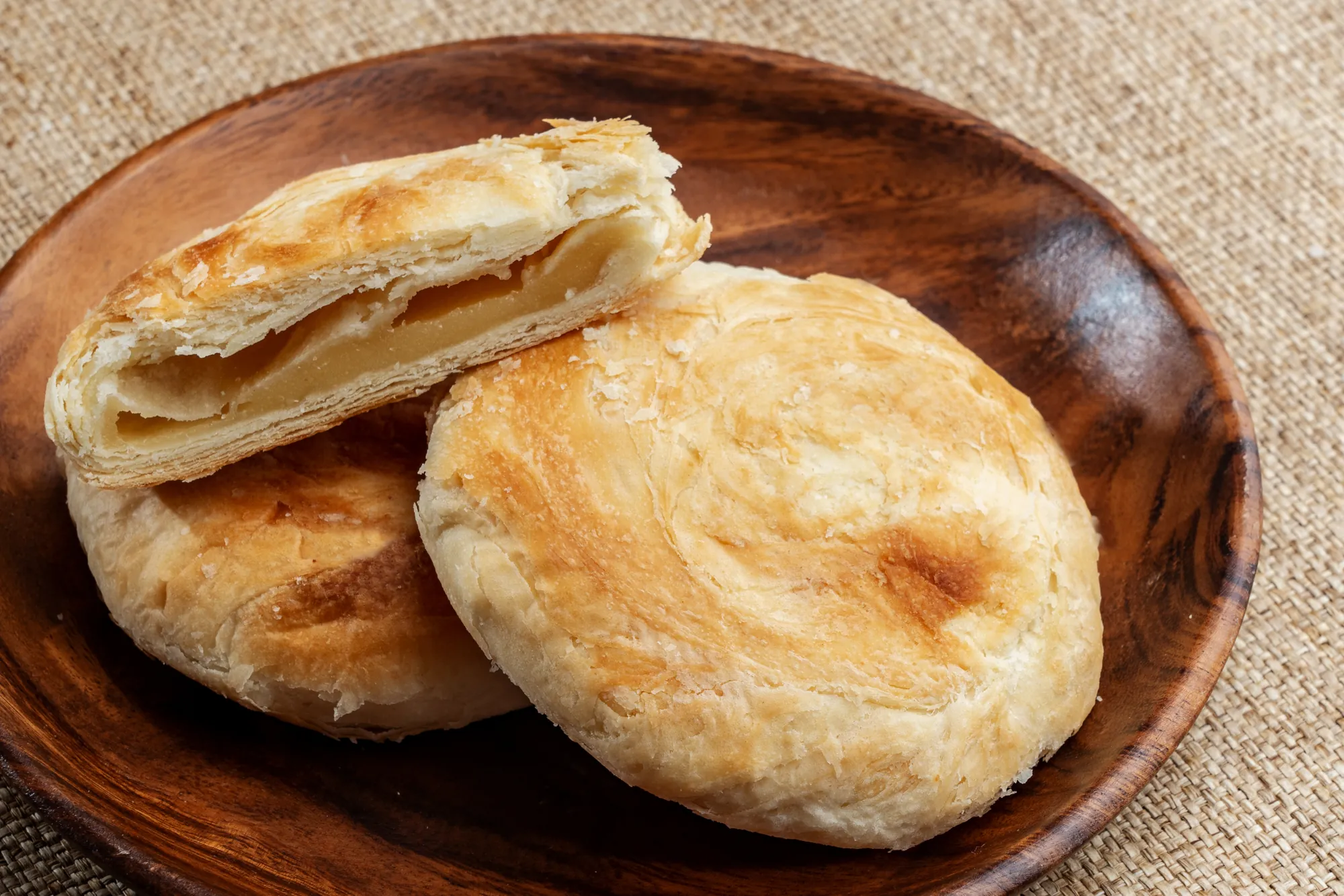
台中名產太陽餅,內餡為麥芽糖,但厲害的是餅皮,名店的做工精細,最多可達上百層,比紙還薄,摸起來有彈性,吃起來酥脆甜蜜。
◤文.圖/看見台灣基金會編輯群
這
原本是台中地方仕紳的點心及饋贈親友的伴手禮,不僅現在台灣多家商店都有賣,而且名氣早已遠揚海外。
1982年,太陽餅是日本餻餅博覽會的台灣代表;2005年,時任台中市長的胡志強,帶著太陽餅及鳳梨酥上飛機,出國參加世界市長論壇大會;2024年在德國登場的台灣形象展,太陽餅也在場。
民間會開玩笑講:「太陽餅裡面沒有太陽,老婆餅裡面沒有老婆。」沒有太陽的太陽餅,其實前身是奶油酥餅,或稱做椪餅或麥芽糖餅。台中在地文史工作者考據,因奶油酥餅太大,漸漸改良至現在小圓餅狀,方便食用。
▋車掌小姐在車上行銷太陽餅
太陽餅源起於台中市神岡區的望族林家,1855年開設店鋪,但一直要到近百年後的1953年,林氏宗親林紹崧成立太陽堂,正式為家族點心取了個響叮噹的名字「太陽餅」,這塊迷你麥芽糖餅才真正開始走紅。
1950年代,駐台美軍喜吃麵食,餅類投其所好,台灣交通亦逐漸完善,車掌小姐們在車上推廣太陽餅做為伴手禮,這種可口小點,漸漸成為揚名全台的點心。
太陽餅主要原料為中筋、低筋麵粉、豬油、奶油、糖與麥芽膏等等。業者們更研發出各種不同餡料,例如珍珠奶茶太陽餅到鳳梨酥太陽餅,並外銷國外,讓台中名產太陽餅走上國際。
探索更多
高粱酒─世界烈酒競賽常勝軍
高粱酒的部分紀念酒款在收藏界中展現其投資價值,至少5000元一瓶,上萬的也有。而且是台灣白酒市占率最高的酒。
山葵─阿里山上的台灣綠金傳奇
山葵,原生於日本及俄羅斯遠東地區,日語音讀為「わさび(Wasabi)」,台灣常以擬音「哇沙米」稱之。
白蘿蔔─吉祥蔬菜,語意:好彩頭
蘿蔔在中國栽種歷史悠長,北魏時期(約533至544年)成書的《齊民要術》即已對蘿蔔的種植有一定的了解;台灣栽種白蘿蔔的歷史,推估應隨先民來台時引入,歷經清領及日治時期,已成為庶民餐桌上不可或缺的食物。