
'%20fill='%23a9976d'/%3e%3cpath%20id='Path_251'%20data-name='Path%20251'%20d='M8,35a1,1,0,0,1,1-1H23a1,1,0,0,1,0,2H9A1,1,0,0,1,8,35Z'%20transform='translate(-8%20-22)'%20fill='%23a9976d'/%3e%3cpath%20id='Path_252'%20data-name='Path%20252'%20d='M9,22a1,1,0,0,0,0,2h8a1,1,0,0,0,0-2Z'%20transform='translate(-8%20-16)'%20fill='%23a9976d'/%3e%3c/svg%3e)
'%20fill='%23a9976d'/%3e%3c/g%3e%3c/svg%3e)
綠豆──品種上千,你吃過幾種
地方探索
主題探索
南部
文化美食
分享
'%3e%3cg%20id='Ellipse_27'%20data-name='Ellipse%2027'%20transform='translate(813%20250)'%20fill='none'%20stroke='%23ccac89'%20stroke-width='1'%3e%3ccircle%20cx='16'%20cy='16'%20r='16'%20stroke='none'/%3e%3ccircle%20cx='16'%20cy='16'%20r='15.5'%20fill='none'/%3e%3c/g%3e%3cg%20id='facebook'%20transform='translate(824.105%20258.296)'%3e%3cpath%20id='Path_243'%20data-name='Path%20243'%20d='M8.894.111V2.556H7.441a1.361,1.361,0,0,0-1.074.333,1.534,1.534,0,0,0-.278,1v1.75H8.8L8.441,8.38H6.089v7.028H3.255V8.38H.894V5.639H3.255V3.62A3.582,3.582,0,0,1,4.218.949,3.5,3.5,0,0,1,6.783,0,15.317,15.317,0,0,1,8.894.111Z'%20transform='translate(0%200)'%20fill='%23ccac89'/%3e%3c/g%3e%3c/g%3e%3c/svg%3e)

'%3e%3cg%20id='Ellipse_29'%20data-name='Ellipse%2029'%20transform='translate(901%20250)'%20fill='none'%20stroke='%23ccac89'%20stroke-width='1'%3e%3ccircle%20cx='16'%20cy='16'%20r='16'%20stroke='none'/%3e%3ccircle%20cx='16'%20cy='16'%20r='15.5'%20fill='none'/%3e%3c/g%3e%3cg%20id='link-45deg'%20transform='translate(902.607%20253.105)'%3e%3cg%20id='Group_479'%20data-name='Group%20479'%20transform='translate(7.393%205.896)'%3e%3cpath%20id='Path_241'%20data-name='Path%20241'%20d='M10.246,17.821,8.507,19.56a3.8,3.8,0,0,0,5.378,5.378L16.2,22.62a3.8,3.8,0,0,0-1.05-6.12l-.743.743a1.27,1.27,0,0,0-.2.252,2.535,2.535,0,0,1,1.091,4.23L12.99,24.042A2.536,2.536,0,0,1,9.4,20.455l1.005-1a5.093,5.093,0,0,1-.162-1.631Z'%20transform='translate(-7.393%20-12.02)'%20fill='%23ccac89'/%3e%3cpath%20id='Path_242'%20data-name='Path%20242'%20d='M18.236,9.327a3.8,3.8,0,0,0,1.05,6.12l.982-.984a2.535,2.535,0,0,1-1.136-4.241L21.448,7.9a2.536,2.536,0,1,1,3.587,3.587l-1.005,1a5.1,5.1,0,0,1,.162,1.631l1.739-1.739A3.8,3.8,0,1,0,20.553,7.01Z'%20transform='translate(-13.011%20-5.896)'%20fill='%23ccac89'/%3e%3c/g%3e%3c/g%3e%3c/g%3e%3c/svg%3e)
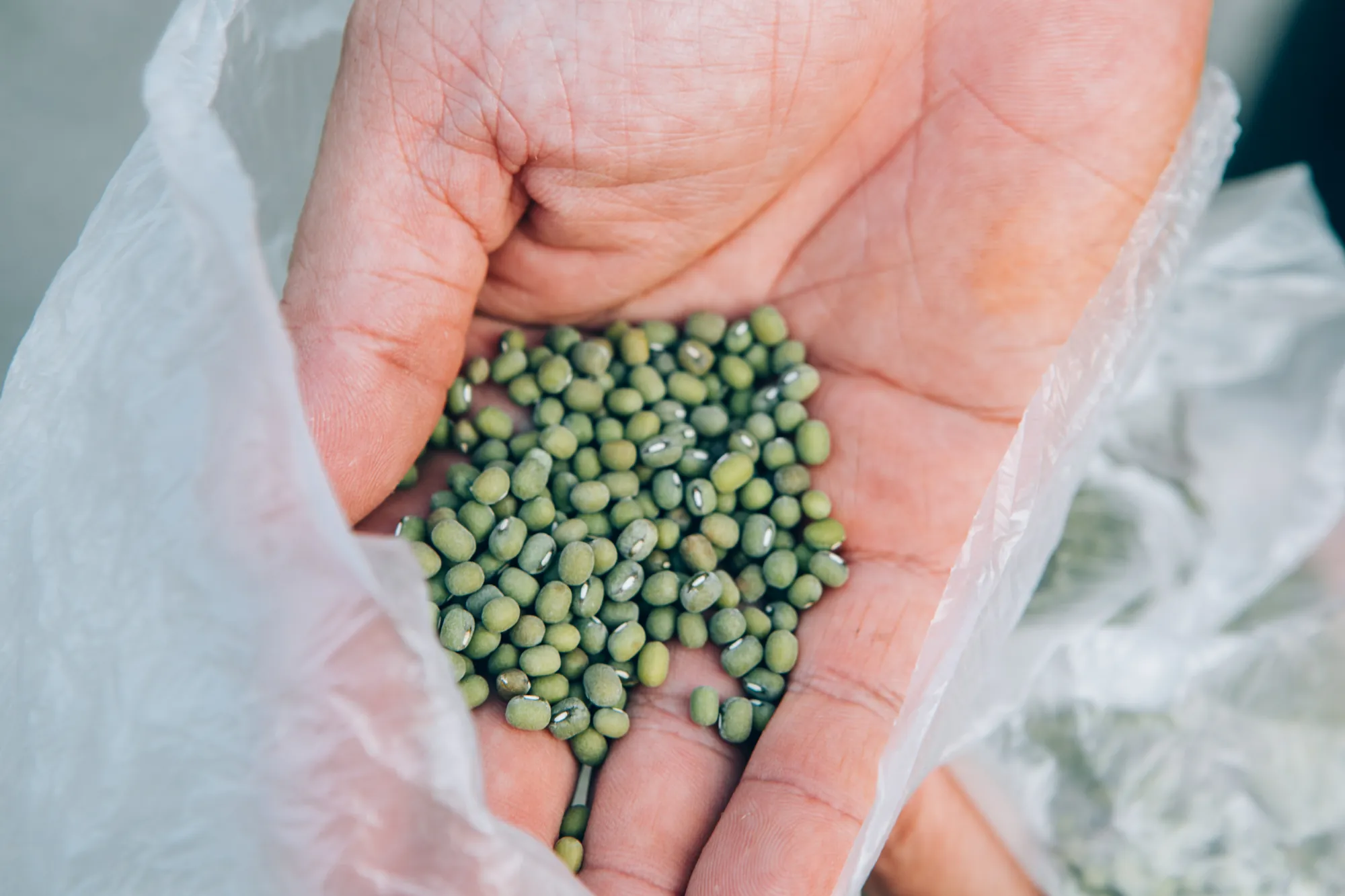
綠豆無論是做甜點、冰品、糕點皆受歡迎,綠豆芽則是CP值很高、颱風天菜價飆漲時的最佳救援蔬菜。然而,它的品種多到驚人,有上千種;民眾常食用的,十根手指頭就數得完。
◤文.圖/看見台灣基金會編輯群
無
論是綠豆湯、綠豆饌、綠豆冰沙、綠豆糕、綠豆薏仁,想要煮出口感綿密又有清香的綠豆美食,只有本土產綠豆才做得到。產地集中於嘉南平原的台南、嘉義等地。
綠豆原產於印度,馴化後傳至世界各地,台灣栽種綠豆的歷史頗早,清領時期康熙59年(1720年)完成的《台灣縣誌》已經有提到綠豆:「性涼能解毒。色綠,故名。磨粉如麵,名曰粉心,用以作糕餅甚佳。」
更早,在古籍《湘山野綠》中即有對宋真宗的記載:「真宗深念稼穡,聞占城稻耐旱、西天(今北印度地區)綠豆子多而粒大,各遣使以珍貨求其種。」
▋本土產粉綠豆豆香明顯,綿密、口感好
綠豆為蝶形花亞科豇豆屬植物,味甘性涼,能清熱去火。台灣的綠豆主要種植於嘉南平原,1970年代為裁種高峰。但由於採收費工耗時(主要依賴人工),加上進口綠豆極為便宜,如今台灣的綠豆改以進口為主。
本土產綠豆以外皮呈黃綠、顆粒相對較小的粉綠豆為主要品種,多以小農契作方式耕種。粉綠豆烹煮時間短、較易熟透,綿密沙沙的口感又好,而且豆香明顯,最適合直接烹煮享用。
探索更多
鳳梨─台灣鳳梨品種,世界第一
無論是鮮果、加工食品,或是鳳梨酥,台灣鳳梨正以它的獨特風味,征服全球市場。
肉圓─南蒸北炸,互別苗頭
台灣諸多小吃源起不可考,但肉圓由彰化人范萬居所創的說法廣被接受,所以彰化肉圓有一定的地位。有名的彰化肉圓排隊店比比皆是,網評破萬的不在少數。
淡水老街──河港發展出的庶民飲食風景
舊稱「滬尾」的淡水,自1858年開港後成為文化交匯點。這裡的美食以「阿給」(源自日語油豆腐)為靈魂,結合緊實鐵蛋與酥脆魚酥,展現了港口城市便於攜帶的飲食智慧。