


◤Text and Images / iSee Taiwan Foundation Editorial Team
In 2009, the travel website VirtualTourist ranked pig's blood cake first among the world's 10 most unusual foods; yet to Taiwanese, it is as ordinary as the air, a familiar sight at hotpot, braised snacks stalls, and fried-chicken stalls.
In central and southern Taiwan, pig's blood cake is often simply called "rice blood" in Chinese., a name that states its origins plainly: a processed rice food made by combining animal blood with glutinous rice. In traditional Minnan farming society, people were thrifty and loath to waste the blood of slaughtered poultry and livestock, so they mixed it with glutinous rice and steamed it, extending the use of ingredients while adding some protein and iron. Duck blood was used in earlier days; later, for reasons of cost and availability, pig's blood gradually became standard. This way of combining animal blood with glutinous rice crossed the strait with Fujian immigrants, and the form of pig's blood cake common in Taiwan's night markets today spread gradually after the war.
As for Taiwan's first pig's blood cake, media accounts trace it to the early postwar years around "Zhutukou" (the old slaughterhouse quarter) in Dalongdong, Taipei, where a group of youngsters took the unwanted pig's blood from the slaughterhouse and, on a sudden inspiration, mixed it with glutinous rice and steamed it to eat-forming the prototype of today's national snack.
Many Ways to Enjoy It-A Versatile Addition to Hotpot and Braised Dishes
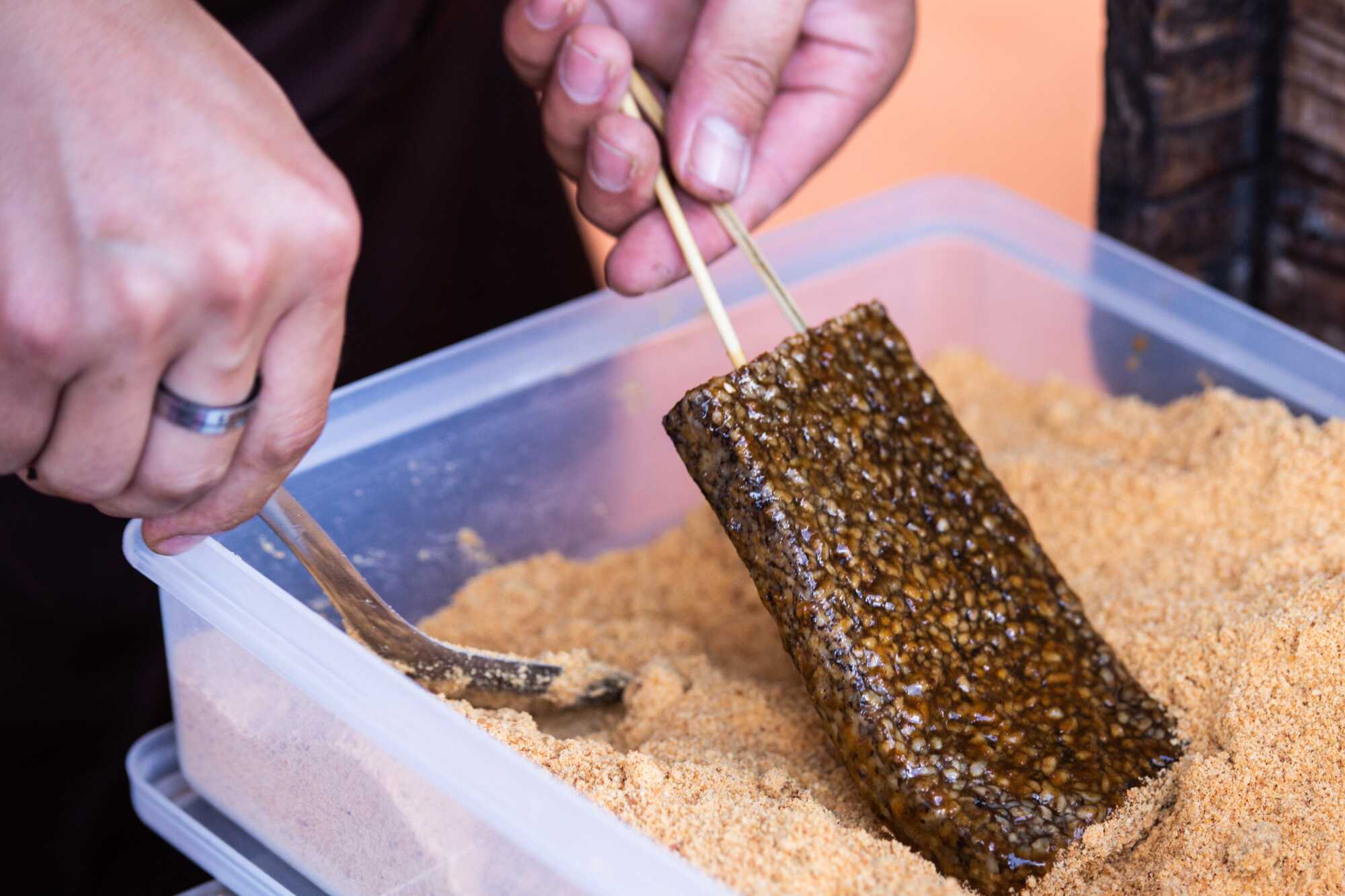
Northern and southern Taiwan each have their own ways of eating it. A common northern style is to steam it, then dip it in sauce and coat it in peanut powder and cilantro, adding chili to taste; central and southern styles are more varied-the pig's blood cake is cut into chunks and paired with sauces such as sweet chili sauce or thick soy sauce, and it is often slow-simmered in hotpot or braised snacks pots to soak up flavor. Cooking methods vary too: steamed, it is chewy and tooth-sticking; deep-fried, it is crisp outside and soft inside, and dusted with pepper and paired with Basil, it takes on yet another flavor. In fact, foods like pig's blood cake are no Taiwanese monopoly-Korea has soondae (blood sausage), Britain has black pudding, and Spain has morcilla (blood sausage)-showing that combinations of animal blood with grains, starch, or fat exist the world over.
This ordinary skewer of pig's blood cake is not just a street food easily grabbed at a night market but a memory of the land, brought forth together by thrift, invention, and everyday life. When foreign travelers cast a startled glance its way, Taiwanese simply take a nonchalant bite and keep strolling the market, as if eating the most natural of home-style flavors.