
'%20fill='%23a9976d'/%3e%3cpath%20id='Path_251'%20data-name='Path%20251'%20d='M8,35a1,1,0,0,1,1-1H23a1,1,0,0,1,0,2H9A1,1,0,0,1,8,35Z'%20transform='translate(-8%20-22)'%20fill='%23a9976d'/%3e%3cpath%20id='Path_252'%20data-name='Path%20252'%20d='M9,22a1,1,0,0,0,0,2h8a1,1,0,0,0,0-2Z'%20transform='translate(-8%20-16)'%20fill='%23a9976d'/%3e%3c/svg%3e)
'%20fill='%23a9976d'/%3e%3c/g%3e%3c/svg%3e)
肉鬆─成吉思汗的秘密軍糧?
主題探索
文化美食
分享
'%3e%3cg%20id='Ellipse_27'%20data-name='Ellipse%2027'%20transform='translate(813%20250)'%20fill='none'%20stroke='%23ccac89'%20stroke-width='1'%3e%3ccircle%20cx='16'%20cy='16'%20r='16'%20stroke='none'/%3e%3ccircle%20cx='16'%20cy='16'%20r='15.5'%20fill='none'/%3e%3c/g%3e%3cg%20id='facebook'%20transform='translate(824.105%20258.296)'%3e%3cpath%20id='Path_243'%20data-name='Path%20243'%20d='M8.894.111V2.556H7.441a1.361,1.361,0,0,0-1.074.333,1.534,1.534,0,0,0-.278,1v1.75H8.8L8.441,8.38H6.089v7.028H3.255V8.38H.894V5.639H3.255V3.62A3.582,3.582,0,0,1,4.218.949,3.5,3.5,0,0,1,6.783,0,15.317,15.317,0,0,1,8.894.111Z'%20transform='translate(0%200)'%20fill='%23ccac89'/%3e%3c/g%3e%3c/g%3e%3c/svg%3e)

'%3e%3cg%20id='Ellipse_29'%20data-name='Ellipse%2029'%20transform='translate(901%20250)'%20fill='none'%20stroke='%23ccac89'%20stroke-width='1'%3e%3ccircle%20cx='16'%20cy='16'%20r='16'%20stroke='none'/%3e%3ccircle%20cx='16'%20cy='16'%20r='15.5'%20fill='none'/%3e%3c/g%3e%3cg%20id='link-45deg'%20transform='translate(902.607%20253.105)'%3e%3cg%20id='Group_479'%20data-name='Group%20479'%20transform='translate(7.393%205.896)'%3e%3cpath%20id='Path_241'%20data-name='Path%20241'%20d='M10.246,17.821,8.507,19.56a3.8,3.8,0,0,0,5.378,5.378L16.2,22.62a3.8,3.8,0,0,0-1.05-6.12l-.743.743a1.27,1.27,0,0,0-.2.252,2.535,2.535,0,0,1,1.091,4.23L12.99,24.042A2.536,2.536,0,0,1,9.4,20.455l1.005-1a5.093,5.093,0,0,1-.162-1.631Z'%20transform='translate(-7.393%20-12.02)'%20fill='%23ccac89'/%3e%3cpath%20id='Path_242'%20data-name='Path%20242'%20d='M18.236,9.327a3.8,3.8,0,0,0,1.05,6.12l.982-.984a2.535,2.535,0,0,1-1.136-4.241L21.448,7.9a2.536,2.536,0,1,1,3.587,3.587l-1.005,1a5.1,5.1,0,0,1,.162,1.631l1.739-1.739A3.8,3.8,0,1,0,20.553,7.01Z'%20transform='translate(-13.011%20-5.896)'%20fill='%23ccac89'/%3e%3c/g%3e%3c/g%3e%3c/g%3e%3c/svg%3e)
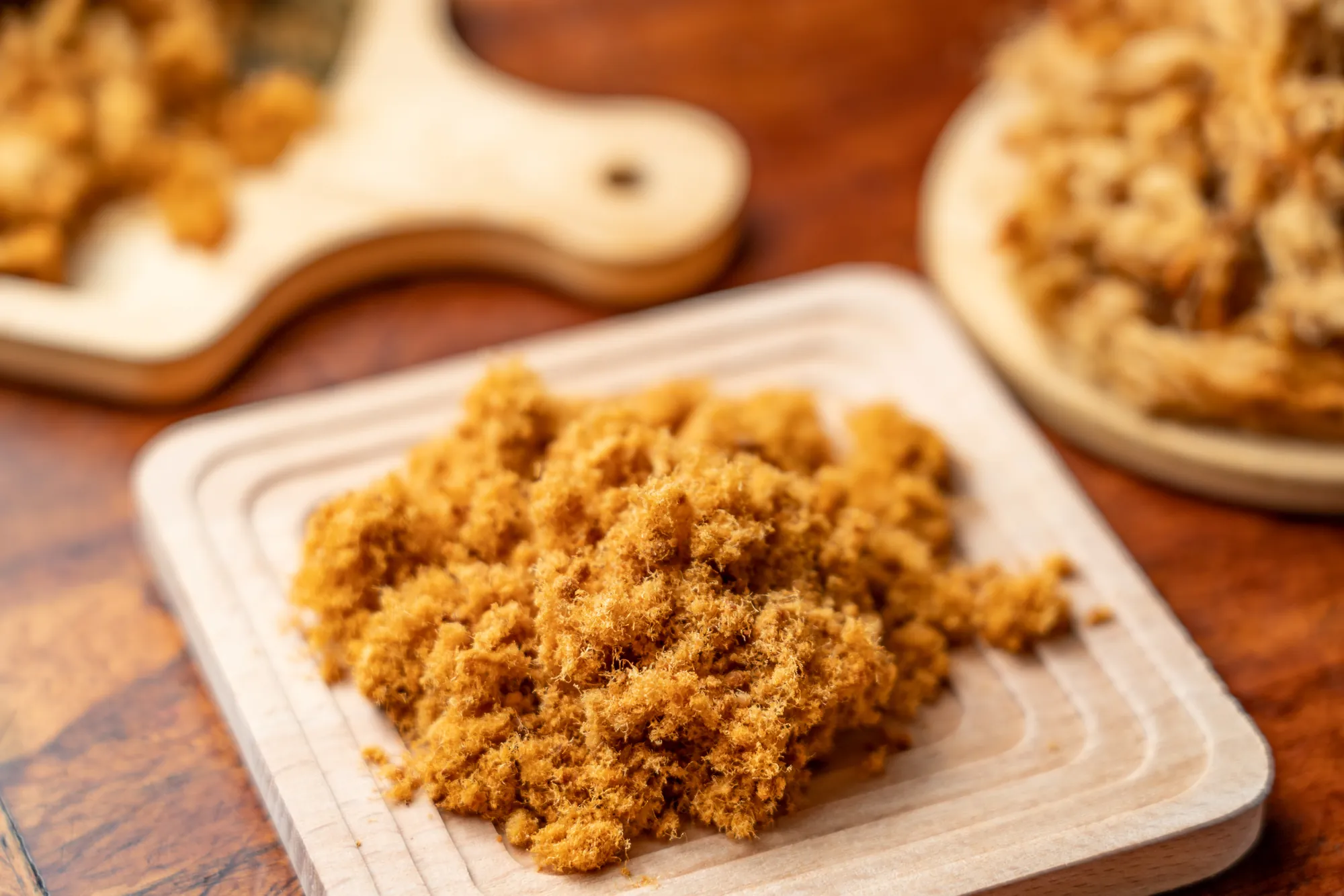
肉鬆在包含東南亞的大華人世界是日常食品,《世界食物博覽》(World Atlas of Food)表示,應是源於中國。源於中國大致可信,2011年,大陸江蘇省的太倉肉鬆甚至通過非物質文化遺產的申請。
◤文.圖/看見台灣基金會編輯群
肉鬆或稱肉酥、肉絨,通常是用豬瘦肉、魚肉或雞肉製成。肉鬆在加工製程中,不耐熱的維生素會被破壞,脂肪、蛋白質與礦物質等營養則幾乎不會流失,且肉鬆口感鬆脆鮮美,因此台灣常將其與米粥、饅頭等搭配,滋味豐富。
▋肉鬆有三種型態
肉鬆是台灣常見的加工品,早期作法是將肉塊滷熟後手撕,現今做法則是機器捶打碾碎肉塊,因此前者口感扎實、後者則較蓬鬆。肉鬆的製法大同小異,常見的加工流程為肉塊高溫烹煮後,透過機器捶打破壞肉的纖維,加入調味小火滷煮到乾,維持小火翻炒入味,就能讓肉鬆乾燥蓬鬆又保有口感。
肉鬆製品分為三大類,第一種肉纖維較長,口感疏鬆有彈性,申請為非物質文化遺產的屬這一類;第二種纖維較短,含油量較高,口感酥脆,稱油酥肉鬆;第三種是肉鬆粉,在油酥肉鬆中加入豆粉或豆類蛋白,入口即化。有的會另外加入芝麻、海苔點綴口味。
探索更多
小籠湯包─源自江南勝江南
麵食原流行於中國北方,然而往南方發展後,樣子便秀氣起來。江南吃食首重細巧,包子饅頭一旦過了長江,身形頓時顯得玲瓏。
小麥─第二大糧食穀物,自給率千分之三
在只見稻田、幾乎見不到小麥田的台灣,麵粉卻是台灣民眾穀物糧食的第二名,因此麵粉原料小麥超過9成必須進口。根據2023年農業部統計,國產小麥年產量只有區區4000公噸,占全年用量約千分之三。
木瓜─米其林必嘗台灣美味:木瓜牛奶
從清朝的「番木瓜」到外銷日本的台農品種,台灣木瓜透過改良與精緻栽培,成功打造口感香甜的風味,也為機能食品開創更多可能。