


◤Text and Images / iSee Taiwan Foundation Editorial Team
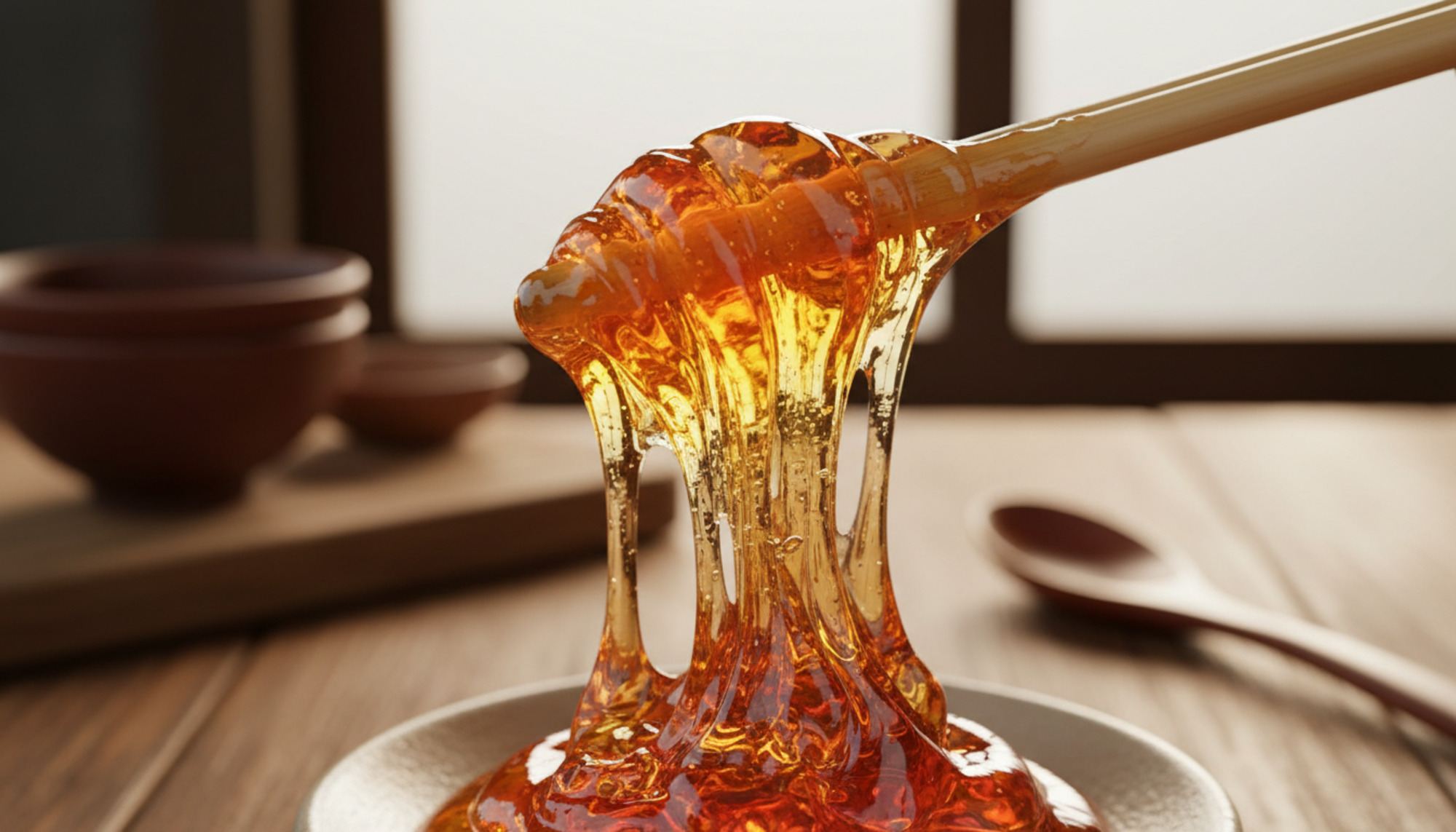
Maltose, or malt paste, is traditionally made by sprouting wheat, mixing the malt with steamed glutinous rice, and mixing the malt with steamed glutinous rice so that enzymes convert the starches into sugars. The mixture is then filtered, and the resulting liquid is simmered over low heat until it thickens into a paste. The liquid is filtered, then simmered over a low flame until it thickens. What looks like a spoonful of translucent golden sugar is the product of sprouting, saccharification, filtering, and slow cooking. The result is not a crystalline sugar but a glossy, viscous syrup. Too much heat and it scorches; too little stirring and it sticks to the bottom. Maltose is a sweetness earned through time.
For many Taiwanese, the most familiar way to eat it has nothing to do with refined pastries-it's two bamboo chopsticks at a night market stall. The vendor lifts a clump from a large jar and hands it to a child, who slowly winds and pulls the strands until they grow thick, then tucks the whole thing between two crackers. One bite delivers the crunch of the cracker, the stickiness of the paste, and a faint malt fragrance-a shared memory from after school, from the steps of a temple.
Old shops and sugar craft keep a century of sweetness alive
Maltose also serves as the material for folk sugar arts: blowing and pulling. A sugar-blowing artisan heats the paste until soft, shapes it into a hollow tube, places it in a mold, and blows it into form. Goldfish, zodiac animals, flowers, birds, and figures take shape within minutes. The craft demands precise heat, a steady hand, and speed; the paste hardens once it cools, yet if it's too soft it won't hold a shape. Encountered now only at old streets and folk festivals, the art has become all the more precious for its rarity.
The flavor of maltose has also found its way into Taiwanese poetry. Hsinchu poet Yeh Chi-tang, in his poem "Yi"(飴, "Malt Candy") , describes wheat's new shoots as fragrant as osmanthus, with peanuts lending the candy an uncommon depth of flavor. Even an old gourmand who has lost his teeth, he writes, cannot resist a bite-sticky as it may be. The subject of the poem-maltose, made from wheat and glutinous rice-takes many forms, from peanut candy to strands wound around a bamboo skewer.
In local legacy shops, maltose lives on as both a souvenir and an everyday sweet. Chuang De Tang in Douliu, Yunlin County, claims a handcrafted maltose lineage traceable to 1906, according to the shop's own records. Weng Yu-mei's shop on Xinzhuang's temple street traces its roots to the 27th year of the Qing dynasty's Guangxu reign (1901), according to the proprietors and local reporting. At its peak, Xinzhuang's maltose industry supported more than ten production facilities in the surrounding area; as the industry shifted, most have since closed.
The shops that still tend their fires and their sugar fragrance today are doing more than selling jars of maltose. They are keeping a local sweetness alive-from the child winding maltose around chopsticks to the cracker sandwich of a school-day afternoon, all of it slowly carried forward in that sticky, amber sweetness.