
'%20fill='%23a9976d'/%3e%3cpath%20id='Path_251'%20data-name='Path%20251'%20d='M8,35a1,1,0,0,1,1-1H23a1,1,0,0,1,0,2H9A1,1,0,0,1,8,35Z'%20transform='translate(-8%20-22)'%20fill='%23a9976d'/%3e%3cpath%20id='Path_252'%20data-name='Path%20252'%20d='M9,22a1,1,0,0,0,0,2h8a1,1,0,0,0,0-2Z'%20transform='translate(-8%20-16)'%20fill='%23a9976d'/%3e%3c/svg%3e)
'%20fill='%23a9976d'/%3e%3c/g%3e%3c/svg%3e)
碗粿─台南派勢力最大
地方探索
主題探索
南部
文化美食
分享
'%3e%3cg%20id='Ellipse_27'%20data-name='Ellipse%2027'%20transform='translate(813%20250)'%20fill='none'%20stroke='%23ccac89'%20stroke-width='1'%3e%3ccircle%20cx='16'%20cy='16'%20r='16'%20stroke='none'/%3e%3ccircle%20cx='16'%20cy='16'%20r='15.5'%20fill='none'/%3e%3c/g%3e%3cg%20id='facebook'%20transform='translate(824.105%20258.296)'%3e%3cpath%20id='Path_243'%20data-name='Path%20243'%20d='M8.894.111V2.556H7.441a1.361,1.361,0,0,0-1.074.333,1.534,1.534,0,0,0-.278,1v1.75H8.8L8.441,8.38H6.089v7.028H3.255V8.38H.894V5.639H3.255V3.62A3.582,3.582,0,0,1,4.218.949,3.5,3.5,0,0,1,6.783,0,15.317,15.317,0,0,1,8.894.111Z'%20transform='translate(0%200)'%20fill='%23ccac89'/%3e%3c/g%3e%3c/g%3e%3c/svg%3e)

'%3e%3cg%20id='Ellipse_29'%20data-name='Ellipse%2029'%20transform='translate(901%20250)'%20fill='none'%20stroke='%23ccac89'%20stroke-width='1'%3e%3ccircle%20cx='16'%20cy='16'%20r='16'%20stroke='none'/%3e%3ccircle%20cx='16'%20cy='16'%20r='15.5'%20fill='none'/%3e%3c/g%3e%3cg%20id='link-45deg'%20transform='translate(902.607%20253.105)'%3e%3cg%20id='Group_479'%20data-name='Group%20479'%20transform='translate(7.393%205.896)'%3e%3cpath%20id='Path_241'%20data-name='Path%20241'%20d='M10.246,17.821,8.507,19.56a3.8,3.8,0,0,0,5.378,5.378L16.2,22.62a3.8,3.8,0,0,0-1.05-6.12l-.743.743a1.27,1.27,0,0,0-.2.252,2.535,2.535,0,0,1,1.091,4.23L12.99,24.042A2.536,2.536,0,0,1,9.4,20.455l1.005-1a5.093,5.093,0,0,1-.162-1.631Z'%20transform='translate(-7.393%20-12.02)'%20fill='%23ccac89'/%3e%3cpath%20id='Path_242'%20data-name='Path%20242'%20d='M18.236,9.327a3.8,3.8,0,0,0,1.05,6.12l.982-.984a2.535,2.535,0,0,1-1.136-4.241L21.448,7.9a2.536,2.536,0,1,1,3.587,3.587l-1.005,1a5.1,5.1,0,0,1,.162,1.631l1.739-1.739A3.8,3.8,0,1,0,20.553,7.01Z'%20transform='translate(-13.011%20-5.896)'%20fill='%23ccac89'/%3e%3c/g%3e%3c/g%3e%3c/g%3e%3c/svg%3e)
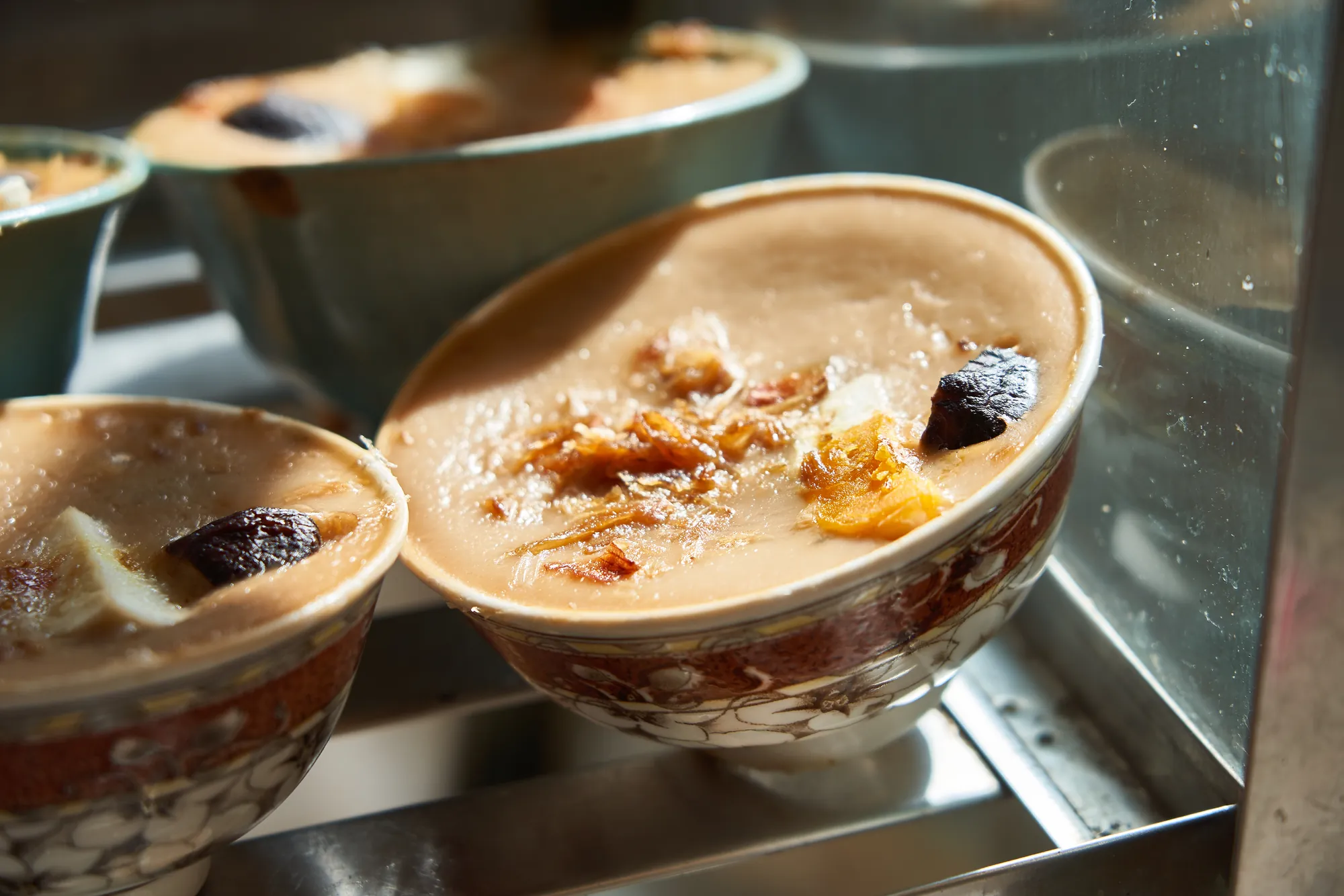
碗粿為盛行於台灣、大陸華南、粵東等地的傳統米食,因製作過程需放置於碗中成型而得名,使用在來米(適宜製作加工米食的硬秈稻米)為主原料;若以新米製作,碗粿口感偏軟糊,故一般會使用儲放一年以上「陳化」的舊米製作,有的甚至會使用兩、三年的舊米,這樣碗粿口感較為Q彈。
◤文.圖/看見台灣基金會編輯群
跟
粽子一樣,台灣的碗粿主要分南、北兩派,黑碗粿及白碗粿二種。南部派勢力較大。以台南為主的南部碗粿,作法為將肉燥加入米漿中,以溫熱水拌勻後加入醬油調味兼著色,再倒入有香菇、蛋黃、豬肉塊的碗中炊煮,其粿體色澤較深,故稱為黑碗粿。
▋必比登名店用溫體豬、火燒蝦
在台南小吃大街國華街上的「一味品碗粿」,入選2022年米其林必比登,只賣碗粿及虱目魚羹,使用肉燥、溫體豬、火燒蝦及自製秘醬。
圓山飯店曾示範過料理國宴碗粿,秘訣包括:在來米粉中加入太白粉、將部分拌料澆上米漿蒸15分鐘,先入味,放入剩餘拌料,再蒸10分鐘,美觀兼二次入味。
北台灣碗粿承襲客家「水粄」製作方式,直接將在來米漿炊蒸定型,再鋪上炒香的菜脯、豆乾、蒜末、碎肉等,粿體純白,故稱為白碗粿。碗粿除鹹食外,客家水粄另有甜碗粿版本,以米漿加入黑糖蒸熟。
碗粿首重其Q彈的口感,由於剛炊蒸好的碗粿仍偏溼軟,因而傳統上不會馬上食用,需先放涼,或甚至放至翌日才食用,稱作「隔夜粿」。
探索更多
蚵仔煎─帝王食品,平民吃法
台灣最強小吃的是哪一款?鐵定眾說紛紜。2007年台灣經濟部商業司舉辦的「外國人台灣美食排行No.1票選活動」,蚵仔煎榮登首位。
蚵仔麵線─台灣麵線家族的老大
麵線是台灣的經典小吃,而且流派形成一個非常大型的家族,麵體主要分麵線糊、清麵線兩種。但所加上的關鍵配料相當多元,蚵仔、大腸、肉羹、丸子是台灣常見的,其中,蚵仔麵線是老大,大腸麵線為老二。
果乾─台三線客家莊是主力產區
果乾為以日曬、烘乾等方法去除水份之水果。台灣素有「水果王國」之美名,以地利與氣候之便,出產之水果種類繁多,風味亦佳,若遇豐年,果品收穫量豐碩、無法盡售,出於惜物愛物之精神,將水果烘乾後,不僅能延長水果的食用期限,果乾更因加熱造成糖份濃縮,風味更顯鮮甜可口。