


◤Text and Images / iSee Taiwan Foundation Editorial Team
The history of the Huwei Sugar Factory dates to 1906, when the Dai-Nippon Sugar Manufacturing Company (Dai-Nippon Seito Kabushiki Kaisha) established the Huwei Sugar Manufacturing Plant in what is now Huwei Township, Yunlin County, launching the area's modern sugar industry. The first processing plant went into operation in 1909, followed by a second in 1912, steadily expanding production capacity. By 1924, following further equipment upgrades, the factory's total crushing capacity reached 4,900 metric tons per day-making it the highest-capacity sugar mill in Taiwan at the time and cementing Huwei's identity as the island's "sugar capital."
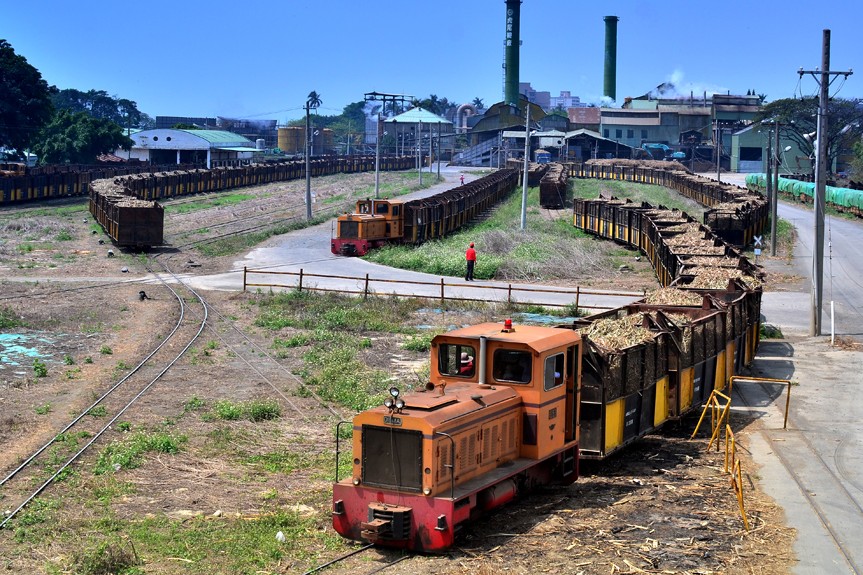
To transport sugarcane from the fields, the factory laid a narrow-gauge railway with a track width of 762 millimeters. Known colloquially as the gōo-hun-tshia, these lines ran on tracks roughly half the width of standard rail lines. Radiating outward from the sugar factory like spokes from a hub, they carried not only sugarcane and packaged sugar but also, on select routes, passengers-serving as a local transit lifeline for communities across central and southern Taiwan in earlier decades.
From Industrial Lifeline to Cultural Asset
Records of Taiwan's early sugar industry reach back further still. Yu Yonghe, a Qing-dynasty traveler who visited Taiwan in 1697 to collect sulfur, described sugar production in his travelogue Small Sea Travel Diaries: "The place where cane juice is boiled into sugar is called a tng-pōo." He also captured the landscape of sugarcane fields and processing sites in verse, noting that cane shoots left over after pressing were fed to oxen-a vivid reminder that nothing went to waste. These accounts attest to the considerable scale of cane cultivation and sugar production in Taiwan during the Qing-governed period.
Mechanized sugar production accelerated rapidly in the early twentieth century. Under Japanese governance, large-scale factories and an island-wide railway network were established. By the late 1930s, annual sugar output had surpassed one million metric tons, reaching approximately 1.419 million metric tons in 1939. Sugar was among Taiwan's most significant export commodities for decades. After the Second World War, the industry was taken over by the Taiwan Sugar Corporation, founded in 1946, which became a crucial source of foreign exchange earnings. As the industrial landscape shifted, most factories gradually ceased operations; today, only the Huwei and Shanhua sugar factories continue to produce cane sugar.
Production typically runs from December through late March or early April, with exact dates adjusted each year. During this period, the gōo-hun-tshia makes daily runs between Huwei and Dongshi, ferrying harvested cane from collection points along the line to the factory for processing. Modern machinery has taken on much of the loading and milling work, yet the century-old railway system continues to operate.
Today, the gōo-hun-tshia is more than a production tool-it is a living piece of industrial heritage. Rolling through the same landscape it has traversed for over a hundred years, it embodies the convergence of eras and stands as a testament to the remarkable continuity of Taiwan's sugar industry.