
'%20fill='%23a9976d'/%3e%3cpath%20id='Path_251'%20data-name='Path%20251'%20d='M8,35a1,1,0,0,1,1-1H23a1,1,0,0,1,0,2H9A1,1,0,0,1,8,35Z'%20transform='translate(-8%20-22)'%20fill='%23a9976d'/%3e%3cpath%20id='Path_252'%20data-name='Path%20252'%20d='M9,22a1,1,0,0,0,0,2h8a1,1,0,0,0,0-2Z'%20transform='translate(-8%20-16)'%20fill='%23a9976d'/%3e%3c/svg%3e)
'%20fill='%23a9976d'/%3e%3c/g%3e%3c/svg%3e)
小米─本是原住民主要糧食,在台超過5000年
主題探索
文化美食
分享
'%3e%3cg%20id='Ellipse_27'%20data-name='Ellipse%2027'%20transform='translate(813%20250)'%20fill='none'%20stroke='%23ccac89'%20stroke-width='1'%3e%3ccircle%20cx='16'%20cy='16'%20r='16'%20stroke='none'/%3e%3ccircle%20cx='16'%20cy='16'%20r='15.5'%20fill='none'/%3e%3c/g%3e%3cg%20id='facebook'%20transform='translate(824.105%20258.296)'%3e%3cpath%20id='Path_243'%20data-name='Path%20243'%20d='M8.894.111V2.556H7.441a1.361,1.361,0,0,0-1.074.333,1.534,1.534,0,0,0-.278,1v1.75H8.8L8.441,8.38H6.089v7.028H3.255V8.38H.894V5.639H3.255V3.62A3.582,3.582,0,0,1,4.218.949,3.5,3.5,0,0,1,6.783,0,15.317,15.317,0,0,1,8.894.111Z'%20transform='translate(0%200)'%20fill='%23ccac89'/%3e%3c/g%3e%3c/g%3e%3c/svg%3e)

'%3e%3cg%20id='Ellipse_29'%20data-name='Ellipse%2029'%20transform='translate(901%20250)'%20fill='none'%20stroke='%23ccac89'%20stroke-width='1'%3e%3ccircle%20cx='16'%20cy='16'%20r='16'%20stroke='none'/%3e%3ccircle%20cx='16'%20cy='16'%20r='15.5'%20fill='none'/%3e%3c/g%3e%3cg%20id='link-45deg'%20transform='translate(902.607%20253.105)'%3e%3cg%20id='Group_479'%20data-name='Group%20479'%20transform='translate(7.393%205.896)'%3e%3cpath%20id='Path_241'%20data-name='Path%20241'%20d='M10.246,17.821,8.507,19.56a3.8,3.8,0,0,0,5.378,5.378L16.2,22.62a3.8,3.8,0,0,0-1.05-6.12l-.743.743a1.27,1.27,0,0,0-.2.252,2.535,2.535,0,0,1,1.091,4.23L12.99,24.042A2.536,2.536,0,0,1,9.4,20.455l1.005-1a5.093,5.093,0,0,1-.162-1.631Z'%20transform='translate(-7.393%20-12.02)'%20fill='%23ccac89'/%3e%3cpath%20id='Path_242'%20data-name='Path%20242'%20d='M18.236,9.327a3.8,3.8,0,0,0,1.05,6.12l.982-.984a2.535,2.535,0,0,1-1.136-4.241L21.448,7.9a2.536,2.536,0,1,1,3.587,3.587l-1.005,1a5.1,5.1,0,0,1,.162,1.631l1.739-1.739A3.8,3.8,0,1,0,20.553,7.01Z'%20transform='translate(-13.011%20-5.896)'%20fill='%23ccac89'/%3e%3c/g%3e%3c/g%3e%3c/g%3e%3c/svg%3e)
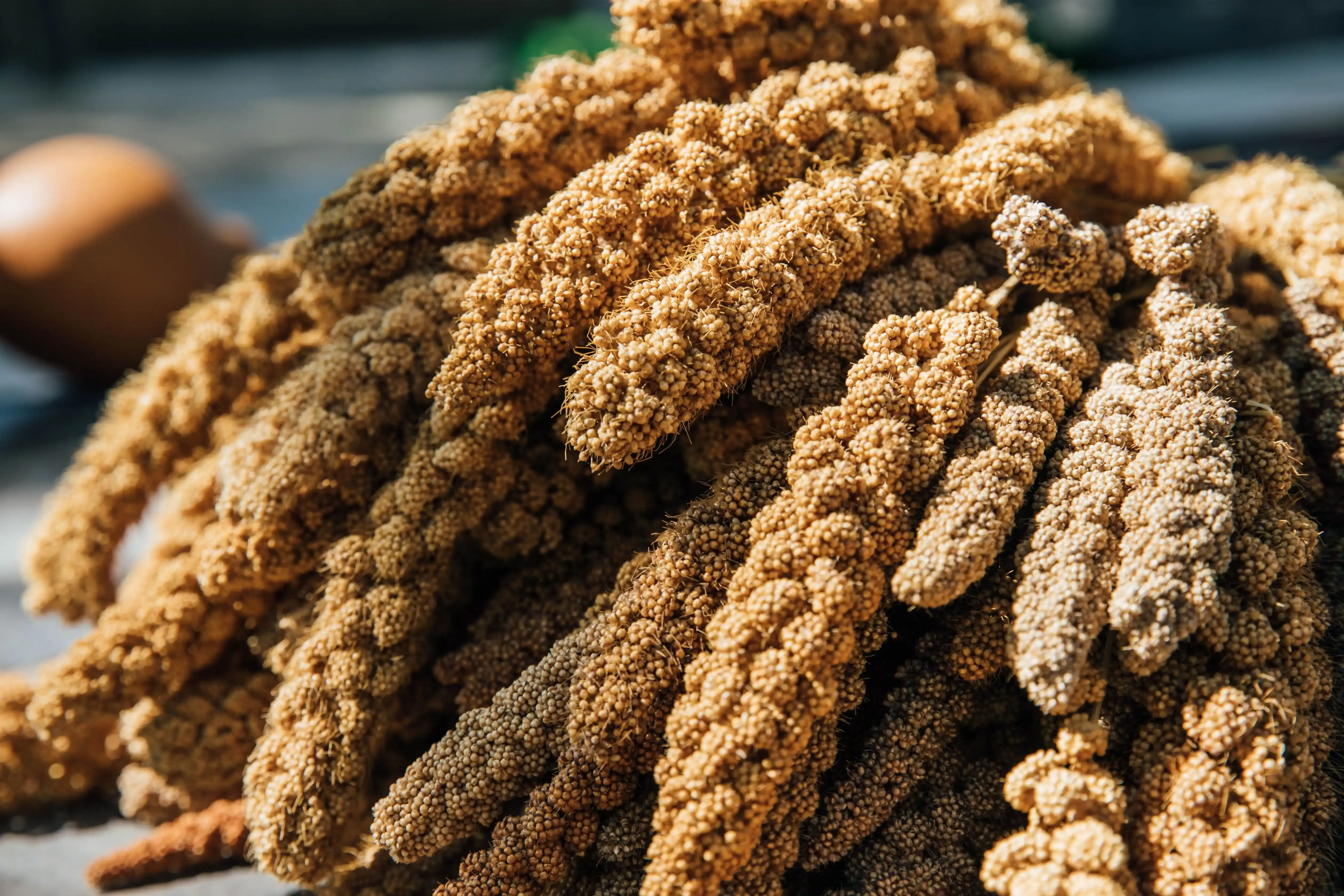
小米,原產於中國,在台灣原住民部落栽培歷史悠久。從台南善化區南關里東遺址出土的碳化種子顯示,距今5000年前的新石器時代就有種植小米的農業活動,品種超過300個。
◤文.圖/看見台灣基金會編輯群
原
住民將小米視為收穫祭典上不可缺少的聖物,目前許多部落仍保有「豐年祭」、「小米祭」等儀式,感謝上天帶來農作物的豐收。小米也象徵財富,當布農族人曬小米時,如果曬得愈多,代表家族愈富有。
小米是台灣原住民族早期的主要糧食作物。不同族群、部落間也有各自的傳統小米料理,例如:排灣、魯凱、卑南族有小米粽「abai(阿粨)」,布農族則有大鍋小米飯。
在原住民族群中,小米不能獨享而必須共享,最常見的就是釀成小米酒,或是做成小米粽,分享給親朋好友。
▋部落青年返鄉,找回岌岌可危的小米文化
隨著現代化農業發展及生活條件改變,原住民的主要糧食被其他作物取代,小米耕種者高齡化、播種不易、需由人力除草、鳥害嚴重……也使小米種植愈來愈艱難,2022年全台小米栽培面積不到100公頃。
近年來興起部落青年返鄉創生風潮,將傳統農耕智慧結合現代農耕技術,以農事體驗、小農市集、在地音樂會等活動喚起大眾對原住民小米文化的重視;小米田導覽、作物工作坊也成為全球旅人造訪台灣深度旅遊的選項。
也有部落青年從美食著手,例如以小米取代麵粉為原料的「小米甜甜圈」,炸好後撒上糖粉,外酥內Q的口感就像是炸麻糬,成為原住民飲食文化創新代表。
探索更多
月桃──從端午粽葉「變身」全能生活資源
從端午節的粽葉清香,到原住民族日常生活的多元運用,月桃不僅是台灣常見的原生植物,更承載著節氣、信仰與飲食文化的多重意涵。
薑絲炒大腸──大火炒出客家酸香滋味
嫩薑的辛香、醋的酸勁與豬大腸的爽脆,在旺火翻炒間交織成鮮明滋味。薑絲炒大腸不只展現客家人善用食材的生活智慧,也從客庄餐桌走入歌謠,成為台灣客家飲食的重要記憶。
海石花──潮間海草變夏日清涼凍飲
澎湖夏天的清涼記憶,常從一杯石花凍開始。潮汐、日曬與熬煮,把海邊採回的紅藻,轉化成滑嫩消暑的在地甜品,也保留島嶼居民順應海洋的生活智慧。