
'%20fill='%23a9976d'/%3e%3cpath%20id='Path_251'%20data-name='Path%20251'%20d='M8,35a1,1,0,0,1,1-1H23a1,1,0,0,1,0,2H9A1,1,0,0,1,8,35Z'%20transform='translate(-8%20-22)'%20fill='%23a9976d'/%3e%3cpath%20id='Path_252'%20data-name='Path%20252'%20d='M9,22a1,1,0,0,0,0,2h8a1,1,0,0,0,0-2Z'%20transform='translate(-8%20-16)'%20fill='%23a9976d'/%3e%3c/svg%3e)
'%20fill='%23a9976d'/%3e%3c/g%3e%3c/svg%3e)
'%3e%3cg%20id='Ellipse_27'%20data-name='Ellipse%2027'%20transform='translate(813%20250)'%20fill='none'%20stroke='%23ccac89'%20stroke-width='1'%3e%3ccircle%20cx='16'%20cy='16'%20r='16'%20stroke='none'/%3e%3ccircle%20cx='16'%20cy='16'%20r='15.5'%20fill='none'/%3e%3c/g%3e%3cg%20id='facebook'%20transform='translate(824.105%20258.296)'%3e%3cpath%20id='Path_243'%20data-name='Path%20243'%20d='M8.894.111V2.556H7.441a1.361,1.361,0,0,0-1.074.333,1.534,1.534,0,0,0-.278,1v1.75H8.8L8.441,8.38H6.089v7.028H3.255V8.38H.894V5.639H3.255V3.62A3.582,3.582,0,0,1,4.218.949,3.5,3.5,0,0,1,6.783,0,15.317,15.317,0,0,1,8.894.111Z'%20transform='translate(0%200)'%20fill='%23ccac89'/%3e%3c/g%3e%3c/g%3e%3c/svg%3e)

'%3e%3cg%20id='Ellipse_29'%20data-name='Ellipse%2029'%20transform='translate(901%20250)'%20fill='none'%20stroke='%23ccac89'%20stroke-width='1'%3e%3ccircle%20cx='16'%20cy='16'%20r='16'%20stroke='none'/%3e%3ccircle%20cx='16'%20cy='16'%20r='15.5'%20fill='none'/%3e%3c/g%3e%3cg%20id='link-45deg'%20transform='translate(902.607%20253.105)'%3e%3cg%20id='Group_479'%20data-name='Group%20479'%20transform='translate(7.393%205.896)'%3e%3cpath%20id='Path_241'%20data-name='Path%20241'%20d='M10.246,17.821,8.507,19.56a3.8,3.8,0,0,0,5.378,5.378L16.2,22.62a3.8,3.8,0,0,0-1.05-6.12l-.743.743a1.27,1.27,0,0,0-.2.252,2.535,2.535,0,0,1,1.091,4.23L12.99,24.042A2.536,2.536,0,0,1,9.4,20.455l1.005-1a5.093,5.093,0,0,1-.162-1.631Z'%20transform='translate(-7.393%20-12.02)'%20fill='%23ccac89'/%3e%3cpath%20id='Path_242'%20data-name='Path%20242'%20d='M18.236,9.327a3.8,3.8,0,0,0,1.05,6.12l.982-.984a2.535,2.535,0,0,1-1.136-4.241L21.448,7.9a2.536,2.536,0,1,1,3.587,3.587l-1.005,1a5.1,5.1,0,0,1,.162,1.631l1.739-1.739A3.8,3.8,0,1,0,20.553,7.01Z'%20transform='translate(-13.011%20-5.896)'%20fill='%23ccac89'/%3e%3c/g%3e%3c/g%3e%3c/g%3e%3c/svg%3e)
◤文.圖/看見台灣基金會編輯群
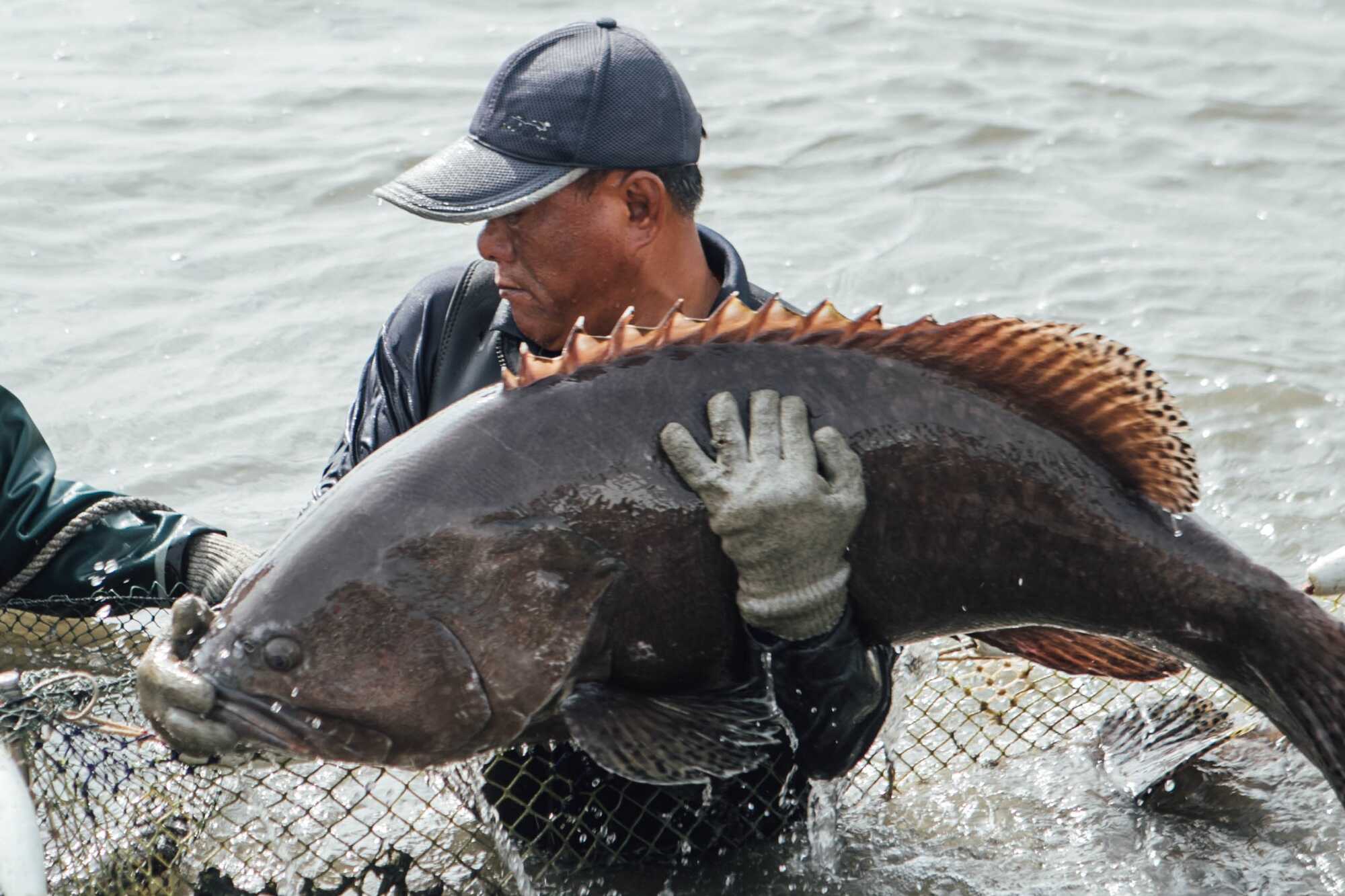
龍膽石斑的正式中文名為鞍帶石斑(Epinephelus lanceolatus),是石斑魚中體型最大的種類,因而有「斑王」或「石斑之王」之稱。魚肉厚實而富有彈性,魚皮含有膠原蛋白,烹煮後口感黏糯。過去多見於婚宴與年節聚餐,如今隨分切、冷凍及小包裝產品普及,也逐漸走進家庭餐桌。
台灣養殖龍膽石斑的重要成就,在於率先突破人工繁殖與魚苗量產。1996年,台灣以養殖龍膽石斑作為種魚,育成約2萬尾魚苗,翌年再生產約25萬尾。2019年,國際期刊《Aquaculture》相關研究與後續報告也指出,龍膽石斑的大規模種苗生產最早由台灣達成,確立台灣在此魚種人工繁殖史上的先驅地位。
全魚利用,發展多元料理
這項成果來自長期技術累積,農業部水產試驗所的研究人員掌握種魚成熟、人工催產、排卵、受精與孵化條件,並持續突破仔魚開口餌料、活存率及病毒感染等難題,建立健康種魚篩選、乾淨餌料、育苗用水處理與生物安全管理。近年水產試驗所更運用水溫、光照週期及賀爾蒙,使種魚能在非產季成熟,提高種苗生產的調度能力。現今多國也已發展相關技術,但台灣憑藉率先量產、完整分工與持續研發,仍是亞洲石斑繁養殖技術的重要國家。
龍膽石斑可依不同部位採用適合的料理方式。帶皮魚肉適合清蒸;厚切魚排可香煎、鹽烤或味噌燒;魚片適合涮火鍋、煮粥及煮湯;魚皮可涼拌或滷煮,魚頭與魚骨則能熬製高湯。三杯龍膽石斑以麻油、米酒、醬油與九層塔烹煮魚塊;蒜子石斑鍋、石斑魚粥與椒鹽魚下巴,則展現不同部位各具特色的料理方式。
從率先量產魚苗,到建立育苗、防疫、繁殖調控與加工利用體系,龍膽石斑見證台灣將高難度魚種發展為成熟產業的技術成果,也讓原本多見於宴席的高檔魚鮮,逐漸走進日常餐桌。