
'%20fill='%23a9976d'/%3e%3cpath%20id='Path_251'%20data-name='Path%20251'%20d='M8,35a1,1,0,0,1,1-1H23a1,1,0,0,1,0,2H9A1,1,0,0,1,8,35Z'%20transform='translate(-8%20-22)'%20fill='%23a9976d'/%3e%3cpath%20id='Path_252'%20data-name='Path%20252'%20d='M9,22a1,1,0,0,0,0,2h8a1,1,0,0,0,0-2Z'%20transform='translate(-8%20-16)'%20fill='%23a9976d'/%3e%3c/svg%3e)
'%20fill='%23a9976d'/%3e%3c/g%3e%3c/svg%3e)
跟著《臺灣漫遊錄》吃美食:米苔目—我應該叫米篩目,昔日的小確幸
主題探索
文化美食
分享
'%3e%3cg%20id='Ellipse_27'%20data-name='Ellipse%2027'%20transform='translate(813%20250)'%20fill='none'%20stroke='%23ccac89'%20stroke-width='1'%3e%3ccircle%20cx='16'%20cy='16'%20r='16'%20stroke='none'/%3e%3ccircle%20cx='16'%20cy='16'%20r='15.5'%20fill='none'/%3e%3c/g%3e%3cg%20id='facebook'%20transform='translate(824.105%20258.296)'%3e%3cpath%20id='Path_243'%20data-name='Path%20243'%20d='M8.894.111V2.556H7.441a1.361,1.361,0,0,0-1.074.333,1.534,1.534,0,0,0-.278,1v1.75H8.8L8.441,8.38H6.089v7.028H3.255V8.38H.894V5.639H3.255V3.62A3.582,3.582,0,0,1,4.218.949,3.5,3.5,0,0,1,6.783,0,15.317,15.317,0,0,1,8.894.111Z'%20transform='translate(0%200)'%20fill='%23ccac89'/%3e%3c/g%3e%3c/g%3e%3c/svg%3e)

'%3e%3cg%20id='Ellipse_29'%20data-name='Ellipse%2029'%20transform='translate(901%20250)'%20fill='none'%20stroke='%23ccac89'%20stroke-width='1'%3e%3ccircle%20cx='16'%20cy='16'%20r='16'%20stroke='none'/%3e%3ccircle%20cx='16'%20cy='16'%20r='15.5'%20fill='none'/%3e%3c/g%3e%3cg%20id='link-45deg'%20transform='translate(902.607%20253.105)'%3e%3cg%20id='Group_479'%20data-name='Group%20479'%20transform='translate(7.393%205.896)'%3e%3cpath%20id='Path_241'%20data-name='Path%20241'%20d='M10.246,17.821,8.507,19.56a3.8,3.8,0,0,0,5.378,5.378L16.2,22.62a3.8,3.8,0,0,0-1.05-6.12l-.743.743a1.27,1.27,0,0,0-.2.252,2.535,2.535,0,0,1,1.091,4.23L12.99,24.042A2.536,2.536,0,0,1,9.4,20.455l1.005-1a5.093,5.093,0,0,1-.162-1.631Z'%20transform='translate(-7.393%20-12.02)'%20fill='%23ccac89'/%3e%3cpath%20id='Path_242'%20data-name='Path%20242'%20d='M18.236,9.327a3.8,3.8,0,0,0,1.05,6.12l.982-.984a2.535,2.535,0,0,1-1.136-4.241L21.448,7.9a2.536,2.536,0,1,1,3.587,3.587l-1.005,1a5.1,5.1,0,0,1,.162,1.631l1.739-1.739A3.8,3.8,0,1,0,20.553,7.01Z'%20transform='translate(-13.011%20-5.896)'%20fill='%23ccac89'/%3e%3c/g%3e%3c/g%3e%3c/g%3e%3c/svg%3e)
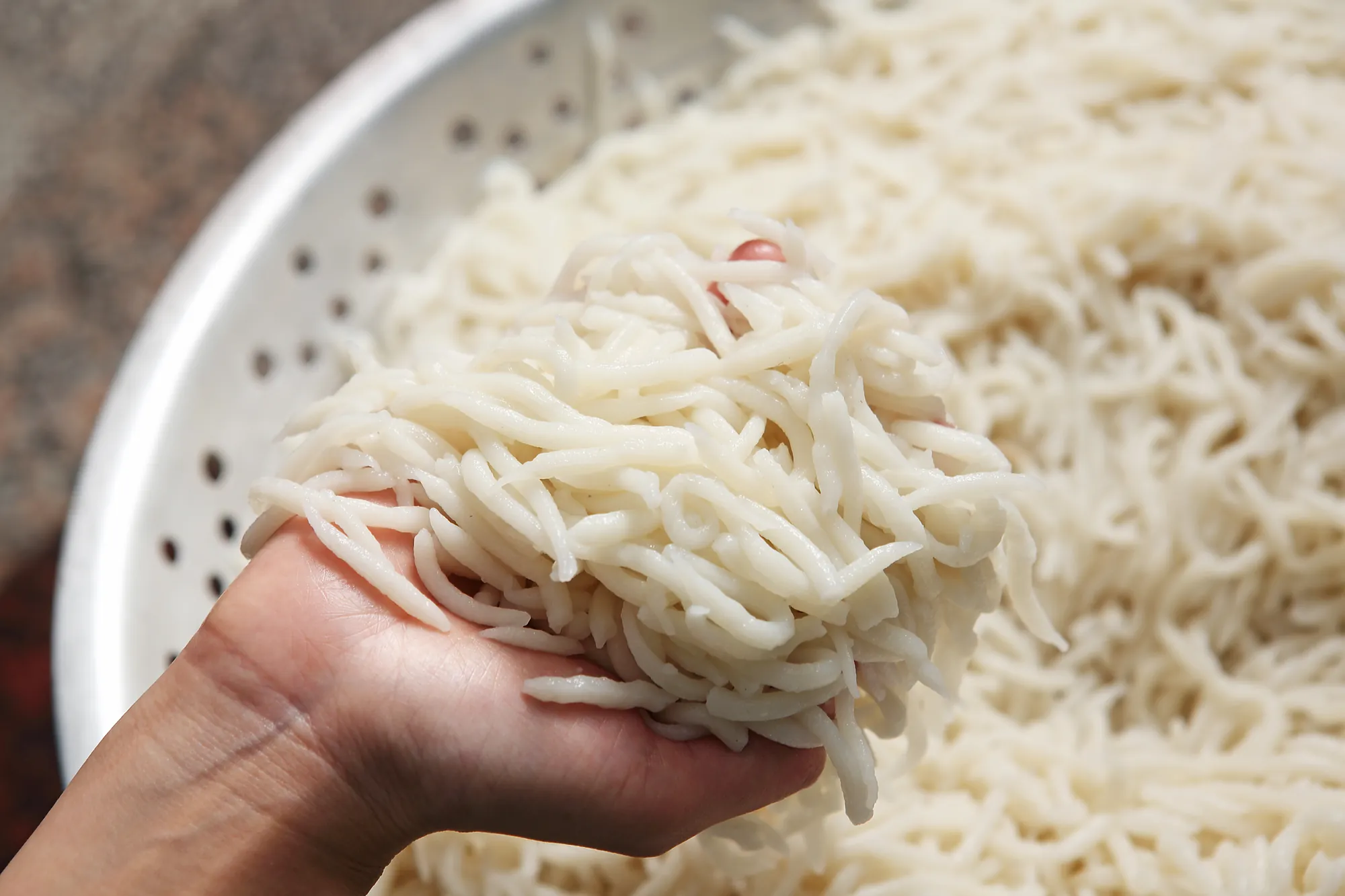
米苔目是許多台灣人成長記憶中的日常滋味,隨著《臺灣漫遊錄》引發對台灣古早味的關注,米苔目也再次成為人們回望地方飲食文化的重要線索。
◤文.圖/看見台灣基金會編輯群
米
苔目源於客家經典的粄食。將在來米泡水磨成漿後,加入太白粉和成米糰,再將米糰倒在竹製的「米篩目板」、鐵片、或有孔洞的瓢器上,用力搓揉後米糰就會從孔洞濾出,變成圓柱狀的白色米條。所以這樣篩出來的米製食品,正確名字應該是「米篩目」。
從前人力來回滾動摩擦篩出米苔目的方法,耗時又耗體力,近年來多以機器直接擠壓成型。
米苔目伴隨著台灣務農時期的每一個打拚時光。農家在插秧與收割時節特別忙碌,一天除了早、中、晚三餐外,還會在早上8~9點,以及下午4點左右再吃一次點心,補充體力,有時稀飯配醬菜、有時就是將米做成各種變化,例如:鹹粿或是米苔目。
▋鹹食口齒芳香,甜食沁涼舒暢
台灣的米苔目,可甜也可鹹。鹹食,也就是農夫們的吃法,最常熬煮一鍋大骨湯,加入米苔目、油蔥酥、韭菜、香菇、蝦米或肉燥,清淡又夠味。除了農夫,也是尋常的常民小吃,清早拉板車運送蔬果到市場交易、孫子玩了滿身汗回家找阿嬤,這時來一碗可口的米苔目熱食充飢,很滿足。
在燥熱的夏天,米苔目搖身一變成為甜食,碗裡的米苔目和綠豆、仙草、粉圓、粉粿……等配料加入糖水和冰塊,或是用刨冰機搖出綿密的刨冰,就是一道沁涼的古早味甜點,昔時的「小確幸」。
一條條雪白晶瑩、QQ軟軟的米苔目,抓住了台灣人的胃,也承載著台灣人的美好記憶。
探索更多
糕潤──層層堆起鷄籠中元祭的普度心意
從漳泉械鬥後的族群和解,到供桌上層層堆起的糕潤塔,鷄籠中元祭不僅寄託對亡者的追思,也保存了基隆宗親輪值、港口生活與傳統糕餅交織而成的地方記憶。
鴨─升級版的品牌鴨問市
家禽中,鴨肉不及雞肉普及,在一般的大超市中很難買到。然而,特定食材卻非牠不可:冬天進補要吃薑母鴨;蛋黃酥、皮蛋要用鴨蛋;炒菜中的各種「金沙」系列也是非鴨不可。
新竹東門市場──從沒落到登上米其林殿堂
一度沒落的新竹東門市場,在清華大學師生與自治會長的協力推動下,為老市場注入了嶄新的創意與美食活力。如今,這裡不僅是新舊攤販共存的文化地標,更有米粉攤摘下米其林必比登推薦,讓東門市場恢復昔日榮光。