
'%20fill='%23a9976d'/%3e%3cpath%20id='Path_251'%20data-name='Path%20251'%20d='M8,35a1,1,0,0,1,1-1H23a1,1,0,0,1,0,2H9A1,1,0,0,1,8,35Z'%20transform='translate(-8%20-22)'%20fill='%23a9976d'/%3e%3cpath%20id='Path_252'%20data-name='Path%20252'%20d='M9,22a1,1,0,0,0,0,2h8a1,1,0,0,0,0-2Z'%20transform='translate(-8%20-16)'%20fill='%23a9976d'/%3e%3c/svg%3e)
'%20fill='%23a9976d'/%3e%3c/g%3e%3c/svg%3e)
'%3e%3cg%20id='Ellipse_27'%20data-name='Ellipse%2027'%20transform='translate(813%20250)'%20fill='none'%20stroke='%23ccac89'%20stroke-width='1'%3e%3ccircle%20cx='16'%20cy='16'%20r='16'%20stroke='none'/%3e%3ccircle%20cx='16'%20cy='16'%20r='15.5'%20fill='none'/%3e%3c/g%3e%3cg%20id='facebook'%20transform='translate(824.105%20258.296)'%3e%3cpath%20id='Path_243'%20data-name='Path%20243'%20d='M8.894.111V2.556H7.441a1.361,1.361,0,0,0-1.074.333,1.534,1.534,0,0,0-.278,1v1.75H8.8L8.441,8.38H6.089v7.028H3.255V8.38H.894V5.639H3.255V3.62A3.582,3.582,0,0,1,4.218.949,3.5,3.5,0,0,1,6.783,0,15.317,15.317,0,0,1,8.894.111Z'%20transform='translate(0%200)'%20fill='%23ccac89'/%3e%3c/g%3e%3c/g%3e%3c/svg%3e)

'%3e%3cg%20id='Ellipse_29'%20data-name='Ellipse%2029'%20transform='translate(901%20250)'%20fill='none'%20stroke='%23ccac89'%20stroke-width='1'%3e%3ccircle%20cx='16'%20cy='16'%20r='16'%20stroke='none'/%3e%3ccircle%20cx='16'%20cy='16'%20r='15.5'%20fill='none'/%3e%3c/g%3e%3cg%20id='link-45deg'%20transform='translate(902.607%20253.105)'%3e%3cg%20id='Group_479'%20data-name='Group%20479'%20transform='translate(7.393%205.896)'%3e%3cpath%20id='Path_241'%20data-name='Path%20241'%20d='M10.246,17.821,8.507,19.56a3.8,3.8,0,0,0,5.378,5.378L16.2,22.62a3.8,3.8,0,0,0-1.05-6.12l-.743.743a1.27,1.27,0,0,0-.2.252,2.535,2.535,0,0,1,1.091,4.23L12.99,24.042A2.536,2.536,0,0,1,9.4,20.455l1.005-1a5.093,5.093,0,0,1-.162-1.631Z'%20transform='translate(-7.393%20-12.02)'%20fill='%23ccac89'/%3e%3cpath%20id='Path_242'%20data-name='Path%20242'%20d='M18.236,9.327a3.8,3.8,0,0,0,1.05,6.12l.982-.984a2.535,2.535,0,0,1-1.136-4.241L21.448,7.9a2.536,2.536,0,1,1,3.587,3.587l-1.005,1a5.1,5.1,0,0,1,.162,1.631l1.739-1.739A3.8,3.8,0,1,0,20.553,7.01Z'%20transform='translate(-13.011%20-5.896)'%20fill='%23ccac89'/%3e%3c/g%3e%3c/g%3e%3c/g%3e%3c/svg%3e)
◤文/看見台灣基金會編輯群
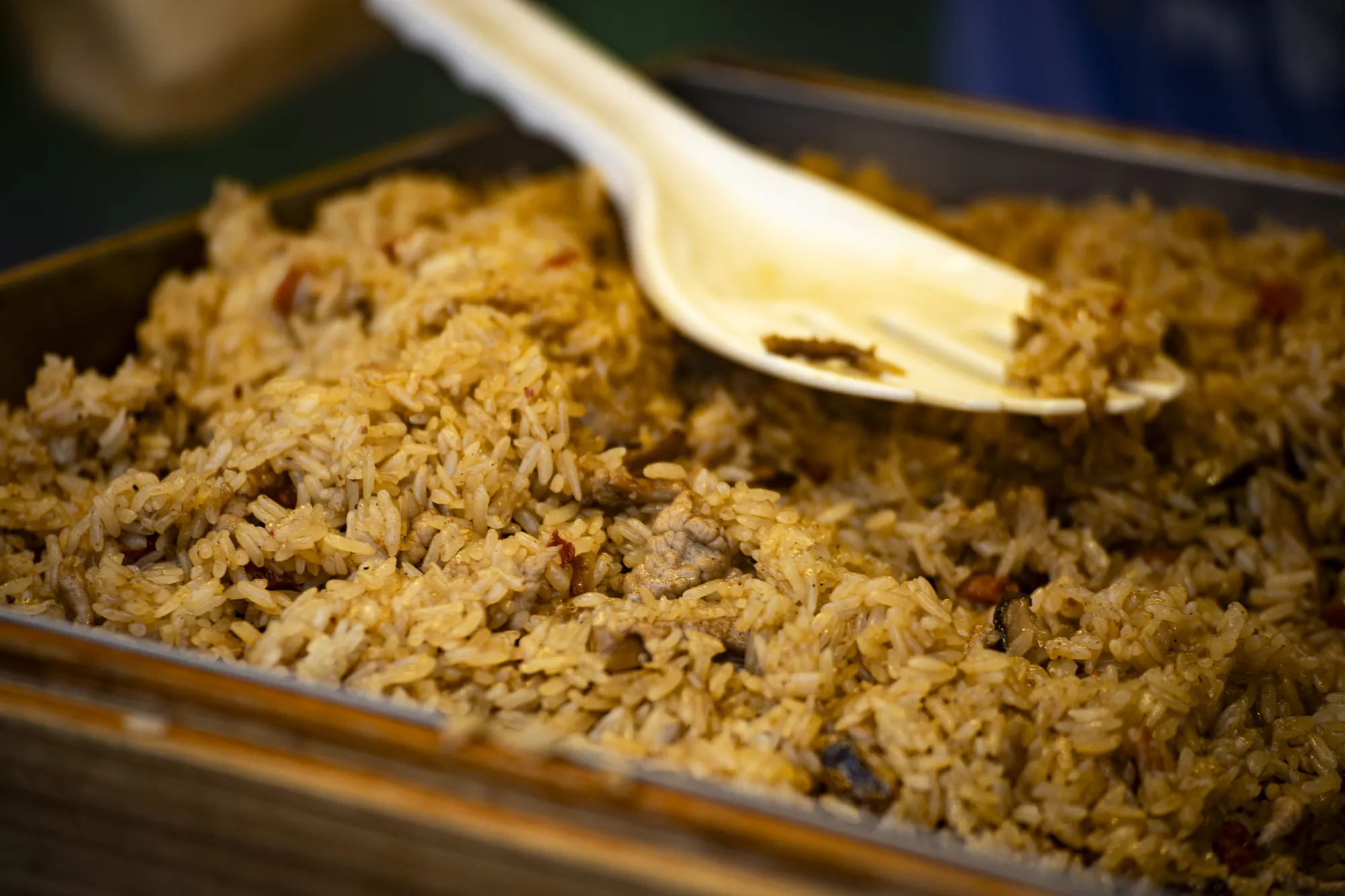
油飯最早可追溯至華南與閩南地區,並隨著漢人移民帶入台灣,在台灣發展出獨具儀式性與風味的「彌月油飯」「喜宴油飯」等模式。早期以豬油拌飯,後來混合糯米炊煮,再加入麻油、香菇、蝦米、豬肉、乾魷魚、油蔥等提味添香,逐漸發展出今日鹹香濃郁的風味。
台灣民間有句俗諺:「註生娘媽,毋敢食無囝仔油飯。」說的是註生娘娘掌管生育,若未庇佑人家添丁,便不好接受還願的油飯,藉此比喻「無功不受祿」。也因此,油飯在台灣從來不只是飽腹之食,更是人生喜訊的象徵。孩子滿月時分送油飯,是向親友報喜,也感謝神明庇佑,熱門的彌月油飯品牌則有「太子油飯」、「呷七碗」等。此外,在祭祀、廟會、嫁娶與人生重要節點裡,油飯也常作為吉慶供品與宴席佳餚。
台灣各地也逐漸發展出具代表性的油飯店家,例如台北大稻埕的林合發油飯,以手工彌月油飯聞名;北部亦有禮盒化的彌月油飯品牌,展現油飯在現代生活中的轉化。台南則有幸義油飯、美鳳油飯等在地老店,呈現南部較甜潤的油飯風味。從北到南,油飯隨著口味與生活節奏微幅變化,也映照出台灣飲食文化的多樣化。
油飯與米糕怎麼區分?
許多人常將油飯與米糕混淆,兩者雖同為糯米料理,但作法與風味各異。油飯是在炊煮完成後拌入配料與麻油;米糕則多為蒸熟後以大量油與滷汁拌勻。「炊煮」與「蒸熟」看似接近,實則不同。油飯的糯米通常先浸泡,再與配料一同以高湯或調味汁直接炊煮,讓米粒在吸收湯汁的過程中熟成,因此滋味能深入米心;米糕則多半先將糯米蒸熟,再於表層鋪上滷肉、香菇或肉燥等配料,滋味集中在外層,口感也較紮實。