
'%20fill='%23a9976d'/%3e%3cpath%20id='Path_251'%20data-name='Path%20251'%20d='M8,35a1,1,0,0,1,1-1H23a1,1,0,0,1,0,2H9A1,1,0,0,1,8,35Z'%20transform='translate(-8%20-22)'%20fill='%23a9976d'/%3e%3cpath%20id='Path_252'%20data-name='Path%20252'%20d='M9,22a1,1,0,0,0,0,2h8a1,1,0,0,0,0-2Z'%20transform='translate(-8%20-16)'%20fill='%23a9976d'/%3e%3c/svg%3e)
'%20fill='%23a9976d'/%3e%3c/g%3e%3c/svg%3e)
'%3e%3cg%20id='Ellipse_27'%20data-name='Ellipse%2027'%20transform='translate(813%20250)'%20fill='none'%20stroke='%23ccac89'%20stroke-width='1'%3e%3ccircle%20cx='16'%20cy='16'%20r='16'%20stroke='none'/%3e%3ccircle%20cx='16'%20cy='16'%20r='15.5'%20fill='none'/%3e%3c/g%3e%3cg%20id='facebook'%20transform='translate(824.105%20258.296)'%3e%3cpath%20id='Path_243'%20data-name='Path%20243'%20d='M8.894.111V2.556H7.441a1.361,1.361,0,0,0-1.074.333,1.534,1.534,0,0,0-.278,1v1.75H8.8L8.441,8.38H6.089v7.028H3.255V8.38H.894V5.639H3.255V3.62A3.582,3.582,0,0,1,4.218.949,3.5,3.5,0,0,1,6.783,0,15.317,15.317,0,0,1,8.894.111Z'%20transform='translate(0%200)'%20fill='%23ccac89'/%3e%3c/g%3e%3c/g%3e%3c/svg%3e)

'%3e%3cg%20id='Ellipse_29'%20data-name='Ellipse%2029'%20transform='translate(901%20250)'%20fill='none'%20stroke='%23ccac89'%20stroke-width='1'%3e%3ccircle%20cx='16'%20cy='16'%20r='16'%20stroke='none'/%3e%3ccircle%20cx='16'%20cy='16'%20r='15.5'%20fill='none'/%3e%3c/g%3e%3cg%20id='link-45deg'%20transform='translate(902.607%20253.105)'%3e%3cg%20id='Group_479'%20data-name='Group%20479'%20transform='translate(7.393%205.896)'%3e%3cpath%20id='Path_241'%20data-name='Path%20241'%20d='M10.246,17.821,8.507,19.56a3.8,3.8,0,0,0,5.378,5.378L16.2,22.62a3.8,3.8,0,0,0-1.05-6.12l-.743.743a1.27,1.27,0,0,0-.2.252,2.535,2.535,0,0,1,1.091,4.23L12.99,24.042A2.536,2.536,0,0,1,9.4,20.455l1.005-1a5.093,5.093,0,0,1-.162-1.631Z'%20transform='translate(-7.393%20-12.02)'%20fill='%23ccac89'/%3e%3cpath%20id='Path_242'%20data-name='Path%20242'%20d='M18.236,9.327a3.8,3.8,0,0,0,1.05,6.12l.982-.984a2.535,2.535,0,0,1-1.136-4.241L21.448,7.9a2.536,2.536,0,1,1,3.587,3.587l-1.005,1a5.1,5.1,0,0,1,.162,1.631l1.739-1.739A3.8,3.8,0,1,0,20.553,7.01Z'%20transform='translate(-13.011%20-5.896)'%20fill='%23ccac89'/%3e%3c/g%3e%3c/g%3e%3c/g%3e%3c/svg%3e)
◤文.圖 / 看見台灣基金會編輯群
「茯~苓~糕~」拉長的叫賣聲,曾在台南新化街區此起彼落。對在地人而言,這不只是聲音,更是一段關於甜味與日常的記憶。位於舊時山海物產往來要道的新化老街,因「八保七廟」(編按:指新化區八個里內的七座廟宇,包括朝天宮、太子宮、清水寺、觀音亭、護安宮、武安宮和上帝廟,分別主祀媽祖、太子爺、清水祖師、觀音媽、王公爺、武安尊王和上帝爺)的信仰文化而興盛,節慶祭祀頻繁,也帶動糕餅業發展,形成獨特的街區飲食風景。
從「水餅」轉身水果餅的風味演變
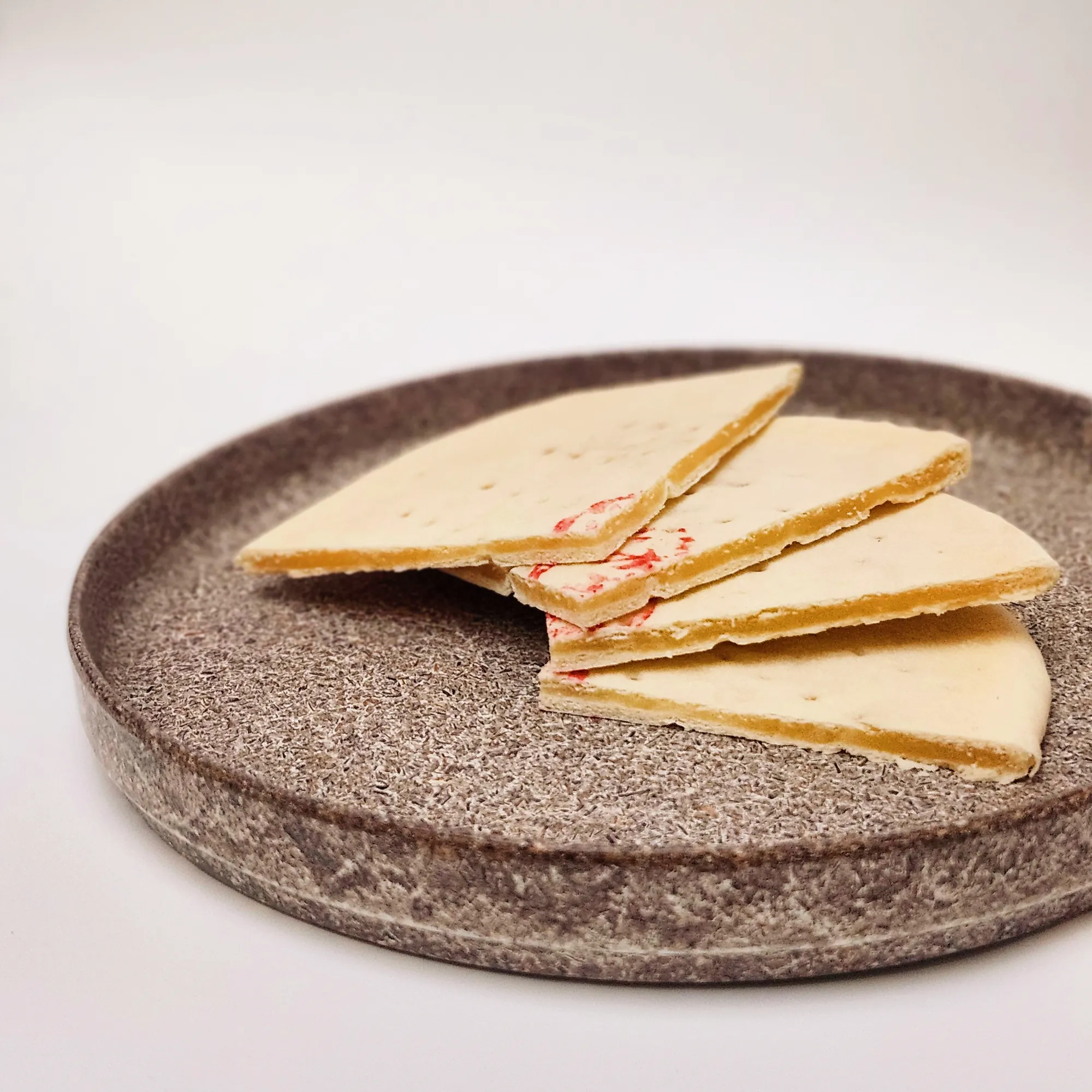
在眾多糕餅之中,以地瓜為內餡的「水果餅」最具代表性。作為新化五寶(鳳梨、竹筍、地瓜、胡麻、橄欖)之一的地瓜,質地綿密、甜味溫潤,經蒸煮壓泥後包入餅皮,再以烘烤定型,外層酥香、內餡柔軟,帶有淡淡的甘甜。地方耆老王榮森回憶,這類糕餅過去多用於向神明謝恩,或在家中添丁時分送親友,象徵祝福與分享。如今性別觀念轉變,不論生男生女,水果餅依然承載著「水」(媠,台語漂亮之意)的美好寓意,延續著地方的人情往來。
新化老街現存的老餅舖「泰香」,見證了這段味覺歷史的演變。老闆娘說道,水果餅原名「水餅」(tsuí-piánn),因為她父親加入柑橘果汁增加風味,改叫水果餅。走進店內,木製櫥櫃與陳列的糕餅仍維持著老街節奏,使人彷彿置身過往的生活場景。
近年來,新化老街陸續有產官學等團隊進駐,其中的核心人物是世居新化的王榮森,另有專長社區營造的許明揚,以及返鄉的蘇莞婷等人。王榮森細述老街祭祀與生活故事,促使山海屯社會企業推動「生活博物館」計畫。蘇莞婷與許明揚透過與屋主合作,以老店為場域重現昔日故事,整條街化身為展示在地人日常的博物館展區。遊客行走其間,從糕餅鋪、竹器店到日常店舖,得以從飲食與物產理解地方生活的紋理。