
'%20fill='%23a9976d'/%3e%3cpath%20id='Path_251'%20data-name='Path%20251'%20d='M8,35a1,1,0,0,1,1-1H23a1,1,0,0,1,0,2H9A1,1,0,0,1,8,35Z'%20transform='translate(-8%20-22)'%20fill='%23a9976d'/%3e%3cpath%20id='Path_252'%20data-name='Path%20252'%20d='M9,22a1,1,0,0,0,0,2h8a1,1,0,0,0,0-2Z'%20transform='translate(-8%20-16)'%20fill='%23a9976d'/%3e%3c/svg%3e)
'%20fill='%23a9976d'/%3e%3c/g%3e%3c/svg%3e)
'%3e%3cg%20id='Ellipse_27'%20data-name='Ellipse%2027'%20transform='translate(813%20250)'%20fill='none'%20stroke='%23ccac89'%20stroke-width='1'%3e%3ccircle%20cx='16'%20cy='16'%20r='16'%20stroke='none'/%3e%3ccircle%20cx='16'%20cy='16'%20r='15.5'%20fill='none'/%3e%3c/g%3e%3cg%20id='facebook'%20transform='translate(824.105%20258.296)'%3e%3cpath%20id='Path_243'%20data-name='Path%20243'%20d='M8.894.111V2.556H7.441a1.361,1.361,0,0,0-1.074.333,1.534,1.534,0,0,0-.278,1v1.75H8.8L8.441,8.38H6.089v7.028H3.255V8.38H.894V5.639H3.255V3.62A3.582,3.582,0,0,1,4.218.949,3.5,3.5,0,0,1,6.783,0,15.317,15.317,0,0,1,8.894.111Z'%20transform='translate(0%200)'%20fill='%23ccac89'/%3e%3c/g%3e%3c/g%3e%3c/svg%3e)

'%3e%3cg%20id='Ellipse_29'%20data-name='Ellipse%2029'%20transform='translate(901%20250)'%20fill='none'%20stroke='%23ccac89'%20stroke-width='1'%3e%3ccircle%20cx='16'%20cy='16'%20r='16'%20stroke='none'/%3e%3ccircle%20cx='16'%20cy='16'%20r='15.5'%20fill='none'/%3e%3c/g%3e%3cg%20id='link-45deg'%20transform='translate(902.607%20253.105)'%3e%3cg%20id='Group_479'%20data-name='Group%20479'%20transform='translate(7.393%205.896)'%3e%3cpath%20id='Path_241'%20data-name='Path%20241'%20d='M10.246,17.821,8.507,19.56a3.8,3.8,0,0,0,5.378,5.378L16.2,22.62a3.8,3.8,0,0,0-1.05-6.12l-.743.743a1.27,1.27,0,0,0-.2.252,2.535,2.535,0,0,1,1.091,4.23L12.99,24.042A2.536,2.536,0,0,1,9.4,20.455l1.005-1a5.093,5.093,0,0,1-.162-1.631Z'%20transform='translate(-7.393%20-12.02)'%20fill='%23ccac89'/%3e%3cpath%20id='Path_242'%20data-name='Path%20242'%20d='M18.236,9.327a3.8,3.8,0,0,0,1.05,6.12l.982-.984a2.535,2.535,0,0,1-1.136-4.241L21.448,7.9a2.536,2.536,0,1,1,3.587,3.587l-1.005,1a5.1,5.1,0,0,1,.162,1.631l1.739-1.739A3.8,3.8,0,1,0,20.553,7.01Z'%20transform='translate(-13.011%20-5.896)'%20fill='%23ccac89'/%3e%3c/g%3e%3c/g%3e%3c/g%3e%3c/svg%3e)
◤文.圖 / 看見台灣基金會編輯群
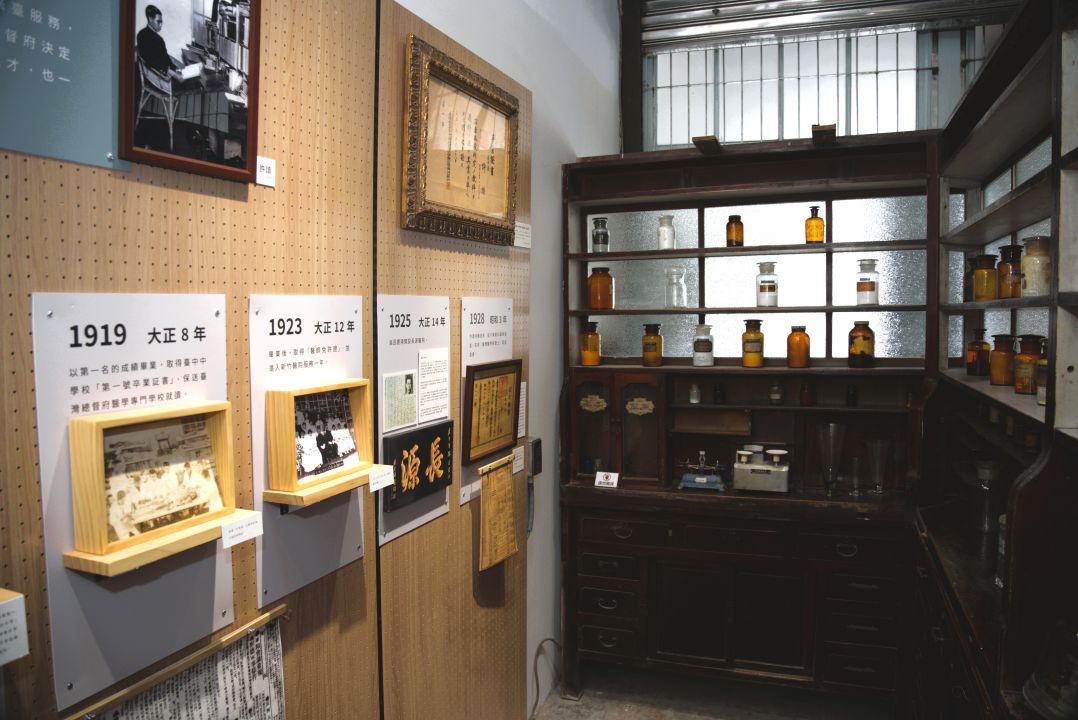
坐落於彰化鹿港老街中山路旁的「鹿港歷史影像館」,前身為1925年由許讀醫師創立的「長源醫院」,這棟建築融合了閩南建築的紅磚砌牆、雕花窗櫺,和日本時代帶來的和風建築元素如木質結構,以及西方洋風影響的鋼筋混凝土結構。它承載了一個家族與一座城鎮的百年記憶。身為許家在鹿港發跡第四代的許正園醫師,為延續家族記憶,著手重整老醫院,將其轉化為以影像為核心的文化場域。
老宅內仍完整保留當年的診間與診療器具,黃十一醫師娘的和室生活空間及其嫁妝家具,亦依原樣陳設。然而,最為珍貴的典藏,莫過於許正園之父──攝影師許蒼澤所留下的25萬張底片。這些影像細膩記錄了鹿港的街景、廟會、婚宴與常民生活。
影像、味覺與家園記憶
在鹿港,許家不僅熱愛醫學、攝影與音樂,更與這片土地有著深厚的情感連結。許正園年少時曾與音樂人羅大佑共組樂團,如今則以影像守護家鄉;其高齡95歲的母親施秀香女士,至今仍堅持每日至老宅上香,此舉正是家族深厚土地情感的具體展現。
許正園回憶道,兒時最開心的時刻,便是從母親手中接過零用錢,與夥伴們直奔市場,品嘗麵線糊、芋丸、什錦麵與魷魚羹等傳統小吃。這不僅是他的個人記憶,更是許多鹿港人共同的童年滋味。 如今,鹿港老街仍保存著豐富多樣的傳統美食,例如「素珠芋丸」選用新鮮大甲芋頭,香氣濃郁、肉餡紮實;有近百年歷史的「王罔麵線糊」,以小蝦米熬煮湯底,佐以赤肉條與蛋花,風味醇厚;「鹿港肉焿泉」的魷魚肉羹,則以滑順甘甜的羹湯著稱。
如今的影像館不僅展示歷史,也成為新世代創意的舞台。修繕團隊於一樓設置了甜品攤,不僅販售手搓愛玉,更以許蒼澤愛用的 Nikon S2 相機為藍本,創作出可食用的「愛玉相機」甜點。在影像的凝視與風味的交融之間,鹿港人的生活記憶被重新喚起,使這座老屋成為一座連結過去與未來的「時光放映機」。