
'%20fill='%23a9976d'/%3e%3cpath%20id='Path_251'%20data-name='Path%20251'%20d='M8,35a1,1,0,0,1,1-1H23a1,1,0,0,1,0,2H9A1,1,0,0,1,8,35Z'%20transform='translate(-8%20-22)'%20fill='%23a9976d'/%3e%3cpath%20id='Path_252'%20data-name='Path%20252'%20d='M9,22a1,1,0,0,0,0,2h8a1,1,0,0,0,0-2Z'%20transform='translate(-8%20-16)'%20fill='%23a9976d'/%3e%3c/svg%3e)
'%20fill='%23a9976d'/%3e%3c/g%3e%3c/svg%3e)
紅棗─苗栗為主產地,鮮食、曬乾皆可
地方探索
時令探索
主題探索
中部
夏
冬
文化美食
分享
'%3e%3cg%20id='Ellipse_27'%20data-name='Ellipse%2027'%20transform='translate(813%20250)'%20fill='none'%20stroke='%23ccac89'%20stroke-width='1'%3e%3ccircle%20cx='16'%20cy='16'%20r='16'%20stroke='none'/%3e%3ccircle%20cx='16'%20cy='16'%20r='15.5'%20fill='none'/%3e%3c/g%3e%3cg%20id='facebook'%20transform='translate(824.105%20258.296)'%3e%3cpath%20id='Path_243'%20data-name='Path%20243'%20d='M8.894.111V2.556H7.441a1.361,1.361,0,0,0-1.074.333,1.534,1.534,0,0,0-.278,1v1.75H8.8L8.441,8.38H6.089v7.028H3.255V8.38H.894V5.639H3.255V3.62A3.582,3.582,0,0,1,4.218.949,3.5,3.5,0,0,1,6.783,0,15.317,15.317,0,0,1,8.894.111Z'%20transform='translate(0%200)'%20fill='%23ccac89'/%3e%3c/g%3e%3c/g%3e%3c/svg%3e)

'%3e%3cg%20id='Ellipse_29'%20data-name='Ellipse%2029'%20transform='translate(901%20250)'%20fill='none'%20stroke='%23ccac89'%20stroke-width='1'%3e%3ccircle%20cx='16'%20cy='16'%20r='16'%20stroke='none'/%3e%3ccircle%20cx='16'%20cy='16'%20r='15.5'%20fill='none'/%3e%3c/g%3e%3cg%20id='link-45deg'%20transform='translate(902.607%20253.105)'%3e%3cg%20id='Group_479'%20data-name='Group%20479'%20transform='translate(7.393%205.896)'%3e%3cpath%20id='Path_241'%20data-name='Path%20241'%20d='M10.246,17.821,8.507,19.56a3.8,3.8,0,0,0,5.378,5.378L16.2,22.62a3.8,3.8,0,0,0-1.05-6.12l-.743.743a1.27,1.27,0,0,0-.2.252,2.535,2.535,0,0,1,1.091,4.23L12.99,24.042A2.536,2.536,0,0,1,9.4,20.455l1.005-1a5.093,5.093,0,0,1-.162-1.631Z'%20transform='translate(-7.393%20-12.02)'%20fill='%23ccac89'/%3e%3cpath%20id='Path_242'%20data-name='Path%20242'%20d='M18.236,9.327a3.8,3.8,0,0,0,1.05,6.12l.982-.984a2.535,2.535,0,0,1-1.136-4.241L21.448,7.9a2.536,2.536,0,1,1,3.587,3.587l-1.005,1a5.1,5.1,0,0,1,.162,1.631l1.739-1.739A3.8,3.8,0,1,0,20.553,7.01Z'%20transform='translate(-13.011%20-5.896)'%20fill='%23ccac89'/%3e%3c/g%3e%3c/g%3e%3c/g%3e%3c/svg%3e)
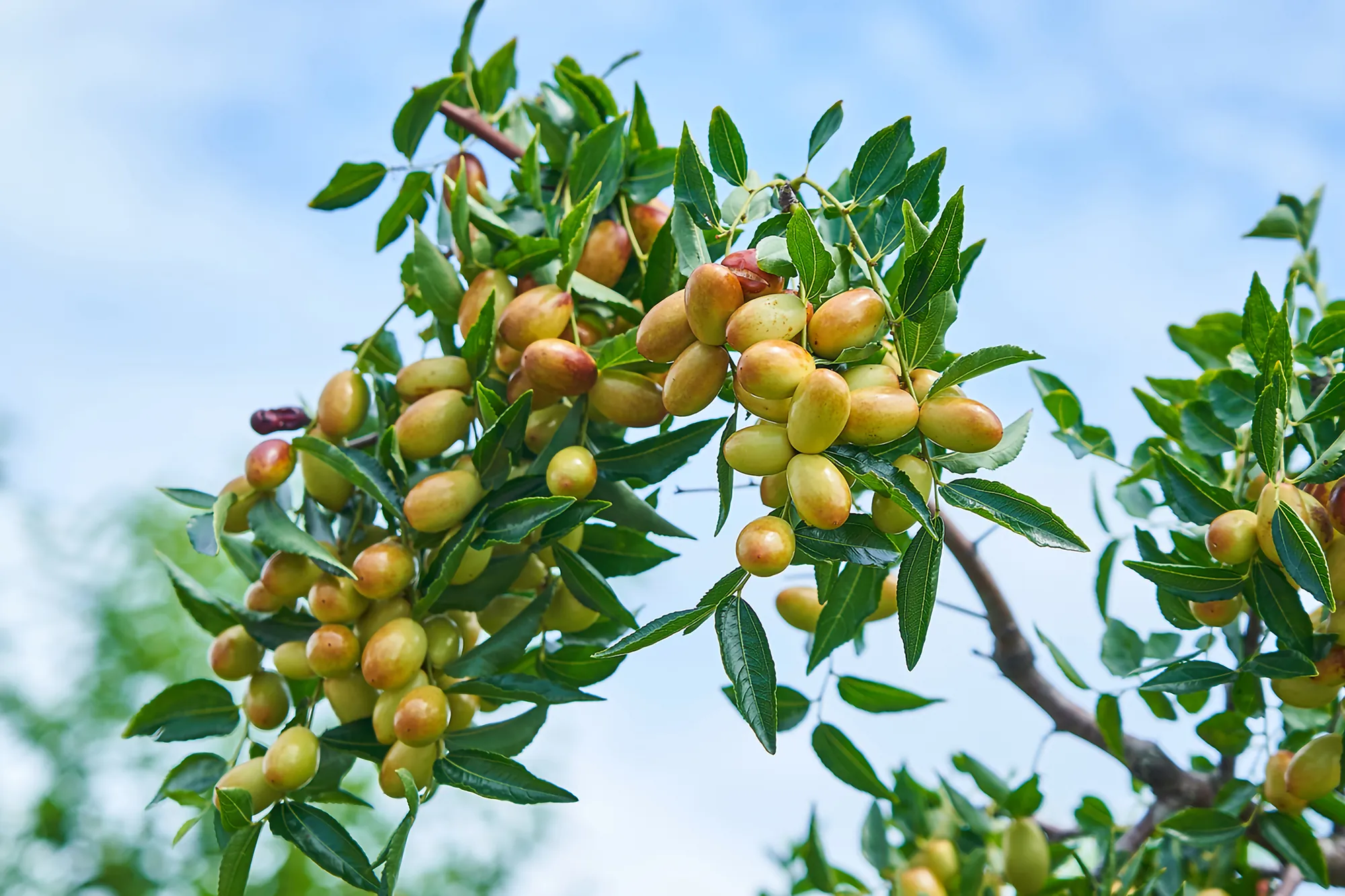
紅棗別名大棗、華棗,品種與產區多樣,環境適應力強且耐貧瘠土地。台灣業者行銷海外時,以「台灣紅寶石」稱呼做賣點,大陸民眾則以「活的維生素丸」形容紅棗的功效。
◤文.圖/看見台灣基金會編輯群
台
灣所栽種品種為清末從中國廣東引進,從此在台灣落地生根。除了可以食用的果實外,因為紅棗樹莖幹上有刺,一開始苗栗農民種植在住家外圍防禦外敵宵小,百餘年後意外成了苗栗代表性特產。
台灣的紅棗雖然栽種面積小、產量不高,但皆依循「台灣良好農業規範(TGAP)」種植,且通過嚴格檢驗。目前苗栗地區為台灣唯一的紅棗產區,公館鄉產量即占9成。
紅棗為鼠李科棗屬作物,鮮果產季集中於每年7、8月;一個多月的產季並不長,產季期間會在市場上看到青黃帶赭的新鮮紅棗。農業部資料顯示,紅棗鮮果100%為台灣自行生產;果肉香甜,口感似蘋果鬆脆,清綠色的果皮中點綴著一抹紅,一口咬下,口感清甜、爽脆。
▋棗農創新變變變 好吃、健康還可養顏美容
鮮果供食用之外,棗農會將紅棗日曬或用機器烘乾。
隨著日曬時間增加,紅棗皮由綠色轉為全紅色;連續多日日曬或烘乾後,表皮因失水而皺縮,紅通通的紅棗乾便可上架出售,即為大眾所熟知,食材兼中藥材的「紅棗乾」。
冬天手腳容易冰冷時,可以飲用紅棗桂圓茶暖身;若想補脾胃,則可食用紅棗淮山杞子豬骨湯。棗農還將紅棗乾研發了多項加工品,如:養生精力湯,和烘焙業合作紅棗糕餅、和生技業者合作製作紅棗面膜、紅棗精華液……,將紅棗產品發揮得淋漓盡致。
2018年,台灣紅棗以「農藥零檢出」的優異成果外銷國際,成為又一種達外銷海外品質的台灣農產品。
探索更多
香蕉─MIT香蕉,進駐東京奧運選手村
2021年7月的東京奧運,選手村食材中出現了「台灣香蕉」,這是第一次「MIT香蕉」成功進軍奧運殿堂。當時,農委會還召開了「跟世界蕉個朋友,為奧運選手加油」視訊記者會,是全台蕉農的一劑強心針。
葡萄─巨峰葡萄創造紫金傳奇
葡萄在6000多年前的非洲東北部和亞洲西南部已有栽種紀錄,台灣的葡萄栽培紀錄最早可追溯到1684年自中國引進的純歐洲品種。1895年,台灣人半田敏男從日本引進多種西洋、日本葡萄品種,奠定台灣種植釀酒用葡萄的基礎,但仍因台灣氣候條件限制,難以栽種。
鳳梨─台灣鳳梨品種,世界第一
無論是鮮果、加工食品,或是鳳梨酥,台灣鳳梨正以它的獨特風味,征服全球市場。