


◤Text and Images / iSee Taiwan Foundation Editorial Team
Monopterus albus-commonly known in Taiwan as the swamp eel or rice paddy eel-is a freshwater species quite different from the eels most people are familiar with. The swamp eel is long and snake-like, with smooth, scaleless skin coated in mucus. Whereas many familiar freshwater eels migrate between rivers and the sea during their life cycle, the swamp eel lives primarily in freshwater habitats such as rice paddies, ponds, drainage ditches, and muddy waterways. This made it a relatively accessible food in rural communities in earlier generations.
Exactly when people in Taiwan began cooking swamp eel is difficult to determine. Stir-fried eel became a distinctive food of the Chianan Plain and Tainan, and its development is often associated with the region's extensive paddy-field environment. Rice fields, irrigation channels, and muddy-bottomed waterways provided suitable habitat for swamp eels. After the Chianan Canal irrigation system was completed in 1930, irrigation conditions across the plain improved considerably, further shaping the agricultural landscape and its relationship with local food resources. Farmers cooked eels caught in the fields as part of everyday meals, and southern food stalls later developed high-heat stir-fried versions into a local specialty.
Tainan's food culture is also closely intertwined with its literary landscape. In his short story "Chocolate and Roses," Tainan writer Yeh Shih-tao described the historic food-stall area near Xinmei Street in the city's West Central District, known as 石精臼 (also written 石鐘臼), where vendors sold Tainan-style savory glutinous rice, fish ball soup, stir-fried eel, and other snacks. In Yeh's writing, stir-fried eel appears not merely as street food but as part of Tainan's urban memory.
Especially Good with Tainan-Style Yi Mian
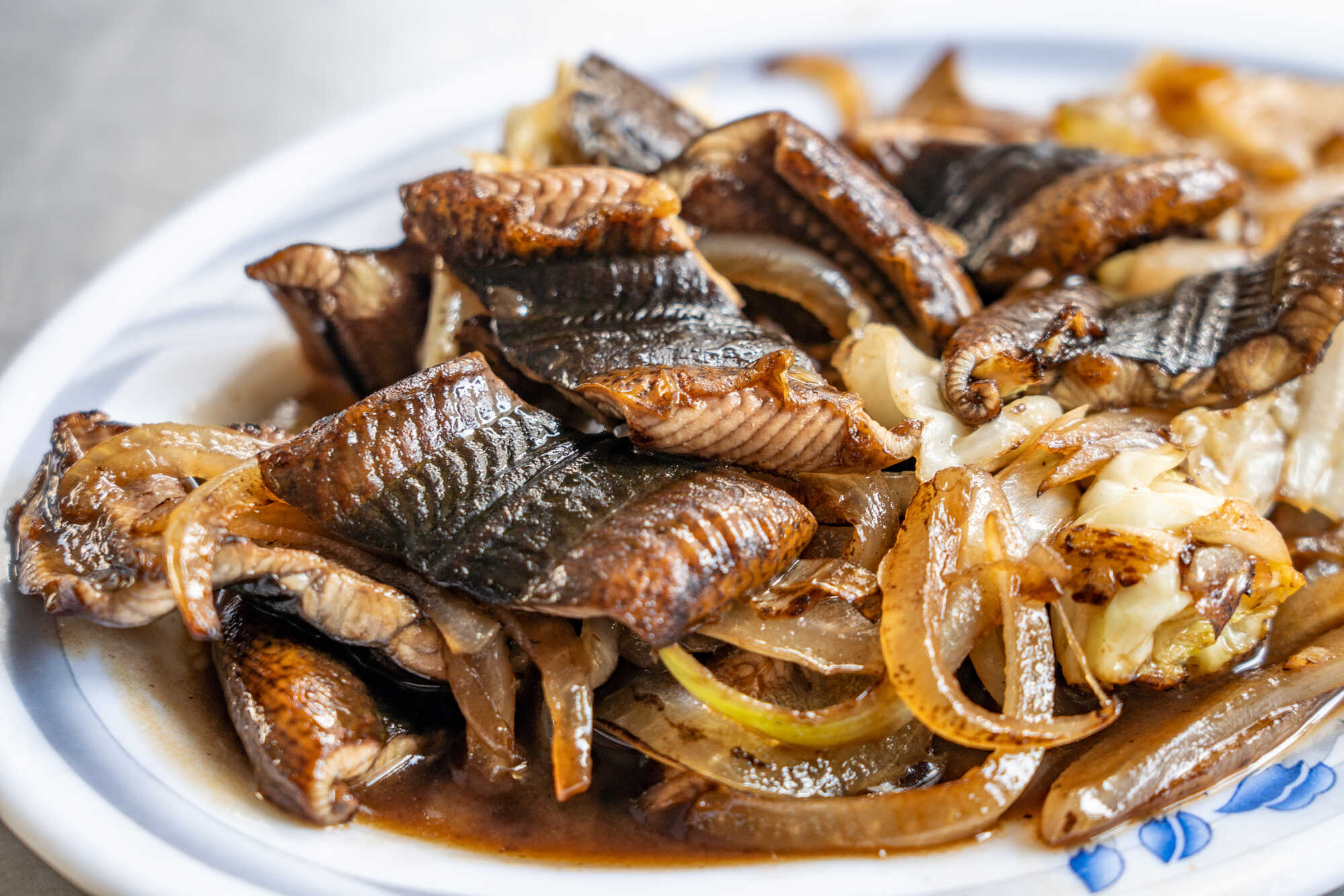
Heat is crucial when cooking eel. Fresh eel is sliced and stir-fried over intense heat for only a short time, helping it retain its springy, crisp texture. Soy sauce, sugar, white vinegar, Wuyin vinegar-a traditional grain-based black vinegar-rice wine, white pepper, onion, and scallion build layers of sour, sweet, salty, and savory flavors, along with the distinctive aroma of high-heat wok cooking.
A Taiwanese saying goes, "灶空炰鱔魚——燒鰻(相瞞)." Its punch line hinges on a Taiwanese homophone: sio-muâ can evoke both "cooking eel" and "mutual deception." The expression is used figuratively to describe people deceiving one another.
The dish may be paired with oil noodles, rice vermicelli, or yi mian, Mandarin for Tainan-style egg-enriched wheat noodles that are traditionally fried before cooking. Fried yi mian is a particularly common choice in Tainan. The noodles absorb the sweet-sour sauce while retaining a texture that shifts between crisp and soft. Dry-stirred versions emphasize sauce reduction and a lightly charred wok aroma, while versions with a starch-thickened sauce are smoother and silkier.
Wild swamp eels have become harder to source than they once were. As irrigation channels were increasingly lined with concrete, pesticide use expanded, and habitats changed, the availability of wild eels declined; meanwhile, changes in market demand and supply have led the market to rely increasingly on imported eel.
Even so, from stir-fried eel served on its own to Stir-Fried Eel with Yi Mian, Tainan continues to preserve the dish's defining combination of intense heat, crisp eel, sweet-sour seasoning, and distinctive wok aroma-a culinary memory rooted in the paddy landscapes of the Chianan Plain.