

◤Text and Images / iSee Taiwan Foundation Editorial Team
As evening descends on Yuanlin City, Changhua County, the streets drift with the subtle aroma of Chinese herbal medicine. A steaming bowl of Si Shen Herbal Soup arrives at the table, its warmth filling the air. Since the Qing period, Yuanlin has served as a crucial hub for herbal medicine trade in central Taiwan. Its strategic location along north-south routes made it an ideal center for herb commerce—supplies were plentiful and affordable. Today, the town's streets remain prime territory for this beloved soup, with venerable establishments like Guilin, Majia, and Nanmen commanding devoted followings.
From “Si Chen” to “Si Shen”: The Gentle Wisdom of Food Therapy
Si Shen Herbal Soup derives its name from classical Chinese medicine. Originally called “Si Chen Tang,” the name references a concept from the Huangdi Neijing (Inner Canon of the Yellow Emperor): “those who assist the ruler are called ministers.” The four ingredients—euryale seed, lotus seed, Chinese yam, and poria—are considered “minister herbs,” supportive rather than primary herbs, warming the body without excess heat. In Hokkien, “chen” (minister) sounds nearly identical to “shen” (spirit), so the soup gradually became known as Si Shen Herbal Soup. Though these four ingredients cannot cure illness, they are traditionally regarded as nourishing the spleen and stomach, making the soup a common year-round food tonic.
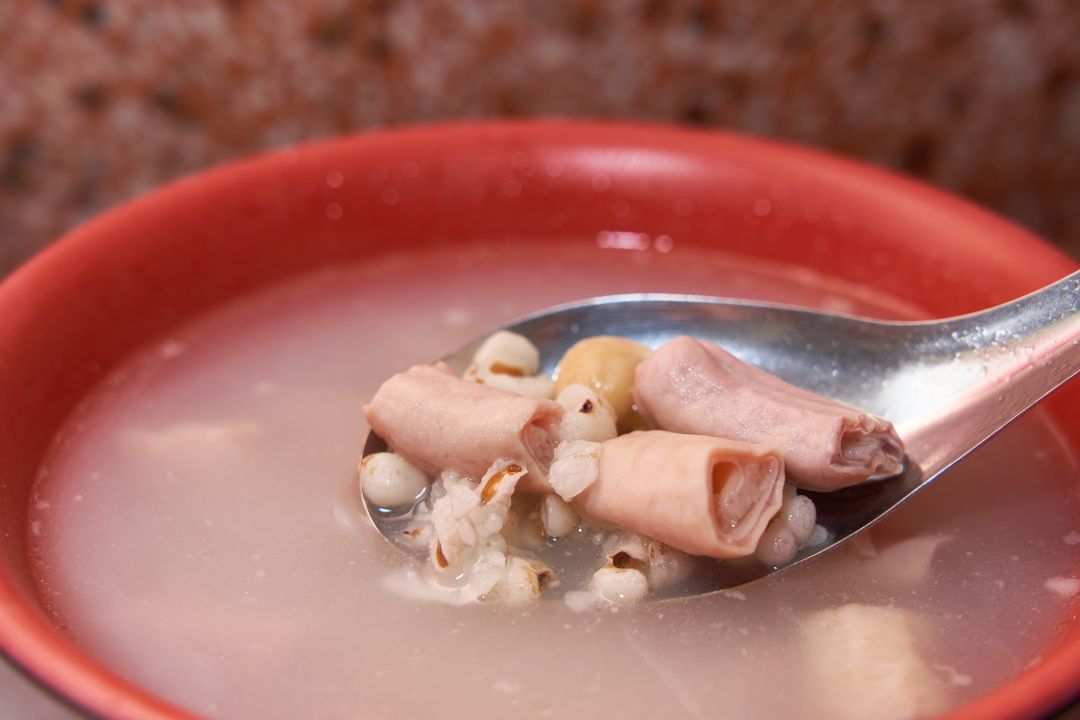
The soup traditionally simmers with diced pork tripe, embodying the Chinese medicine principle of “like treats like”—stomach nourishes stomach. The pale gray of the tripe also blends visually with the soup's color. Pork intestine or ribs substitute equally well, and many cooks add all three for richer depth. Some shops stir in Job's tears for added satiety, transforming Si Shen Herbal Soup from a broth into a complete, satisfying meal.
Taiwan's humid summers often dampen appetite. In traditional food-therapy thinking, excess “dampness” is associated with sensations such as fatigue and digestive discomfort. A bowl of Si Shen Herbal Soup—warm yet refreshing—is valued as a gentle herbal preparation. Euryale seed is traditionally associated with supporting the spleen and digestive function; lotus seed with calming and nourishment; Chinese yam with replenishing vital energy and nourishing yin; and poria with promoting water metabolism and addressing dampness. Each of the four ingredients serves a distinct role while remaining mild in character.
Si Shen Herbal Soup merges Chinese medical wisdom with everyday food culture. From Yuanlin's celebrated shops to night market stalls across Taiwan, this soup transcends mere cooking—it embodies the philosophy of nourishing life through food. In its quiet warmth lies a timeless expression of how Taiwanese people care for their own.