
'%20fill='%23a9976d'/%3e%3cpath%20id='Path_251'%20data-name='Path%20251'%20d='M8,35a1,1,0,0,1,1-1H23a1,1,0,0,1,0,2H9A1,1,0,0,1,8,35Z'%20transform='translate(-8%20-22)'%20fill='%23a9976d'/%3e%3cpath%20id='Path_252'%20data-name='Path%20252'%20d='M9,22a1,1,0,0,0,0,2h8a1,1,0,0,0,0-2Z'%20transform='translate(-8%20-16)'%20fill='%23a9976d'/%3e%3c/svg%3e)
'%20fill='%23a9976d'/%3e%3c/g%3e%3c/svg%3e)
葡萄─巨峰葡萄創造紫金傳奇
地方探索
主題探索
中部
文化美食
分享
'%3e%3cg%20id='Ellipse_27'%20data-name='Ellipse%2027'%20transform='translate(813%20250)'%20fill='none'%20stroke='%23ccac89'%20stroke-width='1'%3e%3ccircle%20cx='16'%20cy='16'%20r='16'%20stroke='none'/%3e%3ccircle%20cx='16'%20cy='16'%20r='15.5'%20fill='none'/%3e%3c/g%3e%3cg%20id='facebook'%20transform='translate(824.105%20258.296)'%3e%3cpath%20id='Path_243'%20data-name='Path%20243'%20d='M8.894.111V2.556H7.441a1.361,1.361,0,0,0-1.074.333,1.534,1.534,0,0,0-.278,1v1.75H8.8L8.441,8.38H6.089v7.028H3.255V8.38H.894V5.639H3.255V3.62A3.582,3.582,0,0,1,4.218.949,3.5,3.5,0,0,1,6.783,0,15.317,15.317,0,0,1,8.894.111Z'%20transform='translate(0%200)'%20fill='%23ccac89'/%3e%3c/g%3e%3c/g%3e%3c/svg%3e)

'%3e%3cg%20id='Ellipse_29'%20data-name='Ellipse%2029'%20transform='translate(901%20250)'%20fill='none'%20stroke='%23ccac89'%20stroke-width='1'%3e%3ccircle%20cx='16'%20cy='16'%20r='16'%20stroke='none'/%3e%3ccircle%20cx='16'%20cy='16'%20r='15.5'%20fill='none'/%3e%3c/g%3e%3cg%20id='link-45deg'%20transform='translate(902.607%20253.105)'%3e%3cg%20id='Group_479'%20data-name='Group%20479'%20transform='translate(7.393%205.896)'%3e%3cpath%20id='Path_241'%20data-name='Path%20241'%20d='M10.246,17.821,8.507,19.56a3.8,3.8,0,0,0,5.378,5.378L16.2,22.62a3.8,3.8,0,0,0-1.05-6.12l-.743.743a1.27,1.27,0,0,0-.2.252,2.535,2.535,0,0,1,1.091,4.23L12.99,24.042A2.536,2.536,0,0,1,9.4,20.455l1.005-1a5.093,5.093,0,0,1-.162-1.631Z'%20transform='translate(-7.393%20-12.02)'%20fill='%23ccac89'/%3e%3cpath%20id='Path_242'%20data-name='Path%20242'%20d='M18.236,9.327a3.8,3.8,0,0,0,1.05,6.12l.982-.984a2.535,2.535,0,0,1-1.136-4.241L21.448,7.9a2.536,2.536,0,1,1,3.587,3.587l-1.005,1a5.1,5.1,0,0,1,.162,1.631l1.739-1.739A3.8,3.8,0,1,0,20.553,7.01Z'%20transform='translate(-13.011%20-5.896)'%20fill='%23ccac89'/%3e%3c/g%3e%3c/g%3e%3c/g%3e%3c/svg%3e)
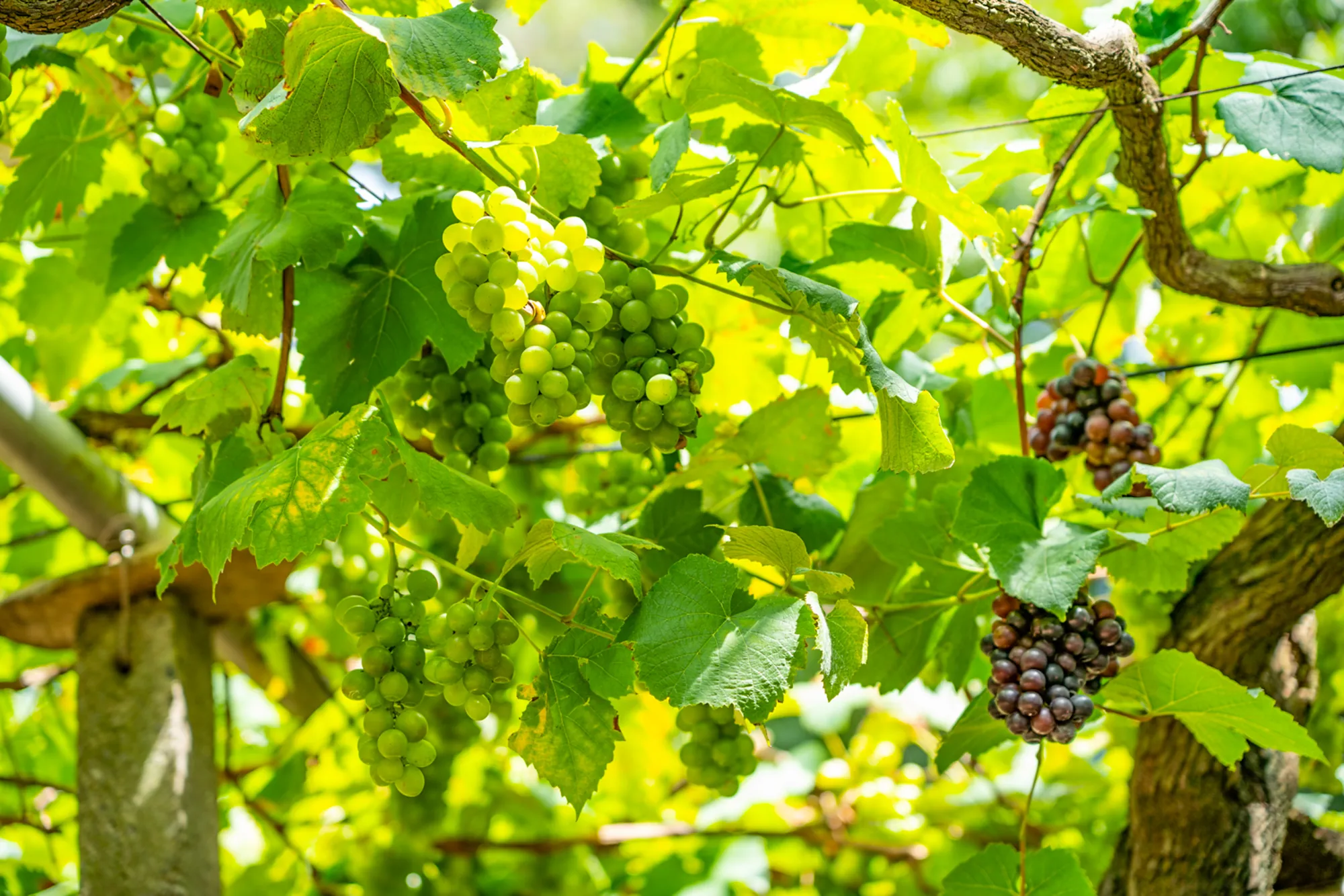
葡萄在6000多年前的非洲東北部和亞洲西南部已有栽種紀錄,台灣的葡萄栽培紀錄最早可追溯到1684年自中國引進的純歐洲品種。1895年,台灣人半田敏男從日本引進多種西洋、日本葡萄品種,奠定台灣種植釀酒用葡萄的基礎,但仍因台灣氣候條件限制,難以栽種。
◤文.圖/看見台灣基金會編輯群
在
1717年(清康熙56年)的《諸羅縣志》提到台灣葡萄:「臺止有黑者,亦甚稀。」栽種葡萄之不普遍,可見一斑。1955年開始試作推廣葡萄酒,始擴大葡萄生產面積。
也是在同一個時期(1950年左右),特別適合在台灣潮濕的天氣及中部大甲溪所沖積出來的砂礫土高地種植的鮮食葡萄品種「巨峰」從日本引進台灣,試種一舉成功。果實成熟後果皮呈現紫黑色,果粒大、糖度高、酸度低、果肉Q彈多汁且有特殊香氣的巨峰葡萄,至今都是台灣的主要也是最重要的鮮食葡萄品種,目前佔台灣鮮食葡萄9成以上市場。
巨峰葡萄主要產地在彰化、苗栗、台中、南投等中部縣市, 台灣終年溫暖的亞熱帶氣候,再透過設施栽培、夜間燈照產期調節技術,一年可二至三收,巨峰葡萄創造出「紫金傳奇」。
探索更多
愛玉─台灣獨有,米其林指南也讚嘆
全球美食聖經《米其林指南》這樣形容愛玉:「這是台灣獨步全球的食材,全世界只有台灣能生產這個澎潤 Q 彈的美味。」台灣不少精緻料理廚師,採用愛玉來彰顯它「世界唯一」的台灣價值。
酪梨─綽號「幸福果」,台灣版本更適合做酪梨牛奶
酪梨因為形狀像梨、果肉吃起來像乳酪,在台灣稱之為「酪梨」。早期延續日治時代以「鱷梨」稱之,或是取其「窮人奶油」的美稱,稱之為「油梨」。
龍眼─柴燒龍眼乾,助吳寶春在世界烘焙賽發光
台灣物資不豐的年代,盛夏之際到龍眼樹下奮力一跳,摘下一束龍眼,撥開褐色的外皮,瞬間出現晶瑩剔透的白色果肉,隱約還可以看到中間黑色的果核,看起來像極了眼珠子,滋味甜滋滋,這就是早年台灣孩子最重要的童年回憶。