
'%20fill='%23a9976d'/%3e%3cpath%20id='Path_251'%20data-name='Path%20251'%20d='M8,35a1,1,0,0,1,1-1H23a1,1,0,0,1,0,2H9A1,1,0,0,1,8,35Z'%20transform='translate(-8%20-22)'%20fill='%23a9976d'/%3e%3cpath%20id='Path_252'%20data-name='Path%20252'%20d='M9,22a1,1,0,0,0,0,2h8a1,1,0,0,0,0-2Z'%20transform='translate(-8%20-16)'%20fill='%23a9976d'/%3e%3c/svg%3e)
'%20fill='%23a9976d'/%3e%3c/g%3e%3c/svg%3e)
'%3e%3cg%20id='Ellipse_27'%20data-name='Ellipse%2027'%20transform='translate(813%20250)'%20fill='none'%20stroke='%23ccac89'%20stroke-width='1'%3e%3ccircle%20cx='16'%20cy='16'%20r='16'%20stroke='none'/%3e%3ccircle%20cx='16'%20cy='16'%20r='15.5'%20fill='none'/%3e%3c/g%3e%3cg%20id='facebook'%20transform='translate(824.105%20258.296)'%3e%3cpath%20id='Path_243'%20data-name='Path%20243'%20d='M8.894.111V2.556H7.441a1.361,1.361,0,0,0-1.074.333,1.534,1.534,0,0,0-.278,1v1.75H8.8L8.441,8.38H6.089v7.028H3.255V8.38H.894V5.639H3.255V3.62A3.582,3.582,0,0,1,4.218.949,3.5,3.5,0,0,1,6.783,0,15.317,15.317,0,0,1,8.894.111Z'%20transform='translate(0%200)'%20fill='%23ccac89'/%3e%3c/g%3e%3c/g%3e%3c/svg%3e)

'%3e%3cg%20id='Ellipse_29'%20data-name='Ellipse%2029'%20transform='translate(901%20250)'%20fill='none'%20stroke='%23ccac89'%20stroke-width='1'%3e%3ccircle%20cx='16'%20cy='16'%20r='16'%20stroke='none'/%3e%3ccircle%20cx='16'%20cy='16'%20r='15.5'%20fill='none'/%3e%3c/g%3e%3cg%20id='link-45deg'%20transform='translate(902.607%20253.105)'%3e%3cg%20id='Group_479'%20data-name='Group%20479'%20transform='translate(7.393%205.896)'%3e%3cpath%20id='Path_241'%20data-name='Path%20241'%20d='M10.246,17.821,8.507,19.56a3.8,3.8,0,0,0,5.378,5.378L16.2,22.62a3.8,3.8,0,0,0-1.05-6.12l-.743.743a1.27,1.27,0,0,0-.2.252,2.535,2.535,0,0,1,1.091,4.23L12.99,24.042A2.536,2.536,0,0,1,9.4,20.455l1.005-1a5.093,5.093,0,0,1-.162-1.631Z'%20transform='translate(-7.393%20-12.02)'%20fill='%23ccac89'/%3e%3cpath%20id='Path_242'%20data-name='Path%20242'%20d='M18.236,9.327a3.8,3.8,0,0,0,1.05,6.12l.982-.984a2.535,2.535,0,0,1-1.136-4.241L21.448,7.9a2.536,2.536,0,1,1,3.587,3.587l-1.005,1a5.1,5.1,0,0,1,.162,1.631l1.739-1.739A3.8,3.8,0,1,0,20.553,7.01Z'%20transform='translate(-13.011%20-5.896)'%20fill='%23ccac89'/%3e%3c/g%3e%3c/g%3e%3c/g%3e%3c/svg%3e)
◤文.圖 / 看見台灣基金會編輯群
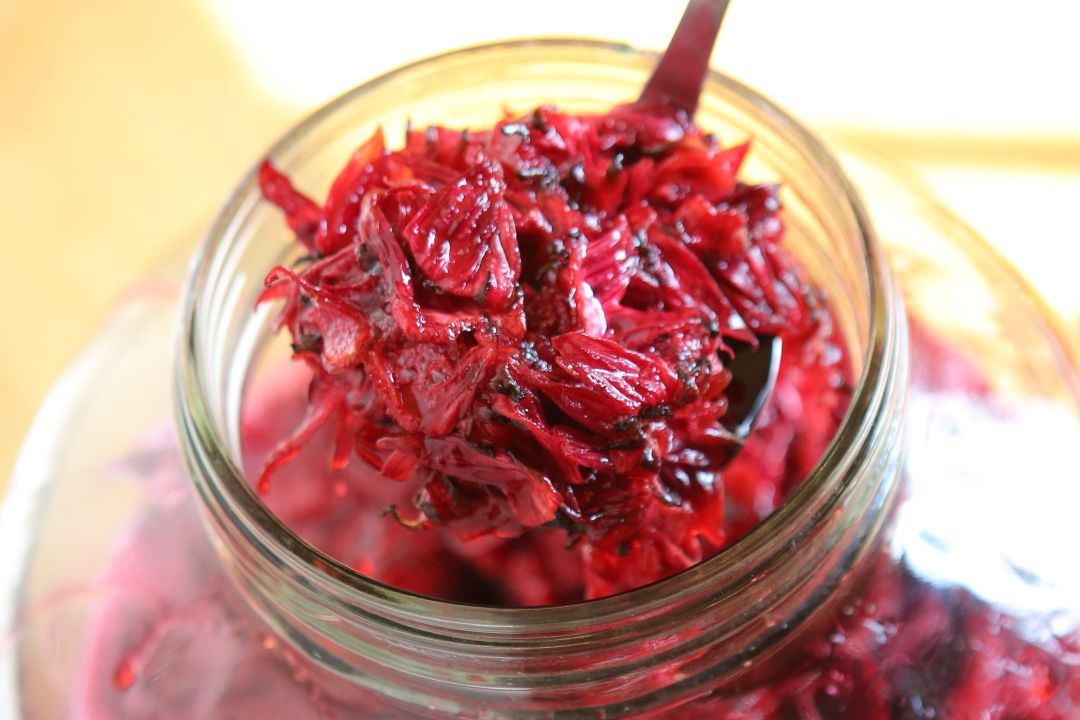
姿態如火焰般鮮紅亮眼的洛神花,是許多人想到台東時最鮮明的印象之一。洛神花(學名 Hibiscus sabdariffa Linn.,又稱洛神葵、玫瑰茄)外型鮮紅飽滿,可醃製成蜜餞,也能日曬或烘成果乾泡出亮麗艷紅的花茶。洛神花茶因花青素、維生素 C 與多酚含量高,被視為兼具美味與保健的天然飲品。其酸味來自有機酸,可促進新陳代謝、幫助消化;花青素則具抗氧化作用,有助維持心血管健康與調節生理機能。
有趣的是,「洛神」二字並非取自曹植的《洛神賦》,而是英文Roselle的音譯;洛神花也並非漢人傳統中藥,而是在台灣的栽種、加工與創意運用下,成功轉化為具有高經濟價值的「紅寶石」。此外,洛神花的「花」並非指花瓣,而是厚實多汁的花萼,屬錦葵科植物,因此又稱洛神葵。
既時髦又抗氧的美味選擇
洛神花於日本時代 由藤根吉春自新加坡引入台灣,並在台東率先試種,之後又陸續引進不同品系。台東因日照強、溫差大、空氣乾淨,被視為台灣最適合栽植洛神的區域,如今金峰、太麻里、卑南、長濱等鄉鎮已成為主要產地,全台每年約有300餘公頃、2,000多噸的新鮮花萼產量,其中台東即占六至七成,名副其實是「洛神王國」。
台東農業改良場自2000年起,陸續育成台東1至6號新品種,不僅提升花青素含量,也改善繁瑣的人工去籽流程,使栽培與加工朝向更穩定、高效的方向發展,讓洛神花從傳統作物跨入更高值化的食品產業。隨著產業鏈發展成熟,洛神花逐漸衍生出果乾、蜜餞、茶包、原汁、脆片、果醬、糕點等多種加工品,甚至成為餐酒館調酒與甜點創作中的亮點。