
'%20fill='%23a9976d'/%3e%3cpath%20id='Path_251'%20data-name='Path%20251'%20d='M8,35a1,1,0,0,1,1-1H23a1,1,0,0,1,0,2H9A1,1,0,0,1,8,35Z'%20transform='translate(-8%20-22)'%20fill='%23a9976d'/%3e%3cpath%20id='Path_252'%20data-name='Path%20252'%20d='M9,22a1,1,0,0,0,0,2h8a1,1,0,0,0,0-2Z'%20transform='translate(-8%20-16)'%20fill='%23a9976d'/%3e%3c/svg%3e)
'%20fill='%23a9976d'/%3e%3c/g%3e%3c/svg%3e)
鏽斑蟳—萬里蟹滋味鮮美的秘密
地方探索
北部
分享
'%3e%3cg%20id='Ellipse_27'%20data-name='Ellipse%2027'%20transform='translate(813%20250)'%20fill='none'%20stroke='%23ccac89'%20stroke-width='1'%3e%3ccircle%20cx='16'%20cy='16'%20r='16'%20stroke='none'/%3e%3ccircle%20cx='16'%20cy='16'%20r='15.5'%20fill='none'/%3e%3c/g%3e%3cg%20id='facebook'%20transform='translate(824.105%20258.296)'%3e%3cpath%20id='Path_243'%20data-name='Path%20243'%20d='M8.894.111V2.556H7.441a1.361,1.361,0,0,0-1.074.333,1.534,1.534,0,0,0-.278,1v1.75H8.8L8.441,8.38H6.089v7.028H3.255V8.38H.894V5.639H3.255V3.62A3.582,3.582,0,0,1,4.218.949,3.5,3.5,0,0,1,6.783,0,15.317,15.317,0,0,1,8.894.111Z'%20transform='translate(0%200)'%20fill='%23ccac89'/%3e%3c/g%3e%3c/g%3e%3c/svg%3e)

'%3e%3cg%20id='Ellipse_29'%20data-name='Ellipse%2029'%20transform='translate(901%20250)'%20fill='none'%20stroke='%23ccac89'%20stroke-width='1'%3e%3ccircle%20cx='16'%20cy='16'%20r='16'%20stroke='none'/%3e%3ccircle%20cx='16'%20cy='16'%20r='15.5'%20fill='none'/%3e%3c/g%3e%3cg%20id='link-45deg'%20transform='translate(902.607%20253.105)'%3e%3cg%20id='Group_479'%20data-name='Group%20479'%20transform='translate(7.393%205.896)'%3e%3cpath%20id='Path_241'%20data-name='Path%20241'%20d='M10.246,17.821,8.507,19.56a3.8,3.8,0,0,0,5.378,5.378L16.2,22.62a3.8,3.8,0,0,0-1.05-6.12l-.743.743a1.27,1.27,0,0,0-.2.252,2.535,2.535,0,0,1,1.091,4.23L12.99,24.042A2.536,2.536,0,0,1,9.4,20.455l1.005-1a5.093,5.093,0,0,1-.162-1.631Z'%20transform='translate(-7.393%20-12.02)'%20fill='%23ccac89'/%3e%3cpath%20id='Path_242'%20data-name='Path%20242'%20d='M18.236,9.327a3.8,3.8,0,0,0,1.05,6.12l.982-.984a2.535,2.535,0,0,1-1.136-4.241L21.448,7.9a2.536,2.536,0,1,1,3.587,3.587l-1.005,1a5.1,5.1,0,0,1,.162,1.631l1.739-1.739A3.8,3.8,0,1,0,20.553,7.01Z'%20transform='translate(-13.011%20-5.896)'%20fill='%23ccac89'/%3e%3c/g%3e%3c/g%3e%3c/g%3e%3c/svg%3e)
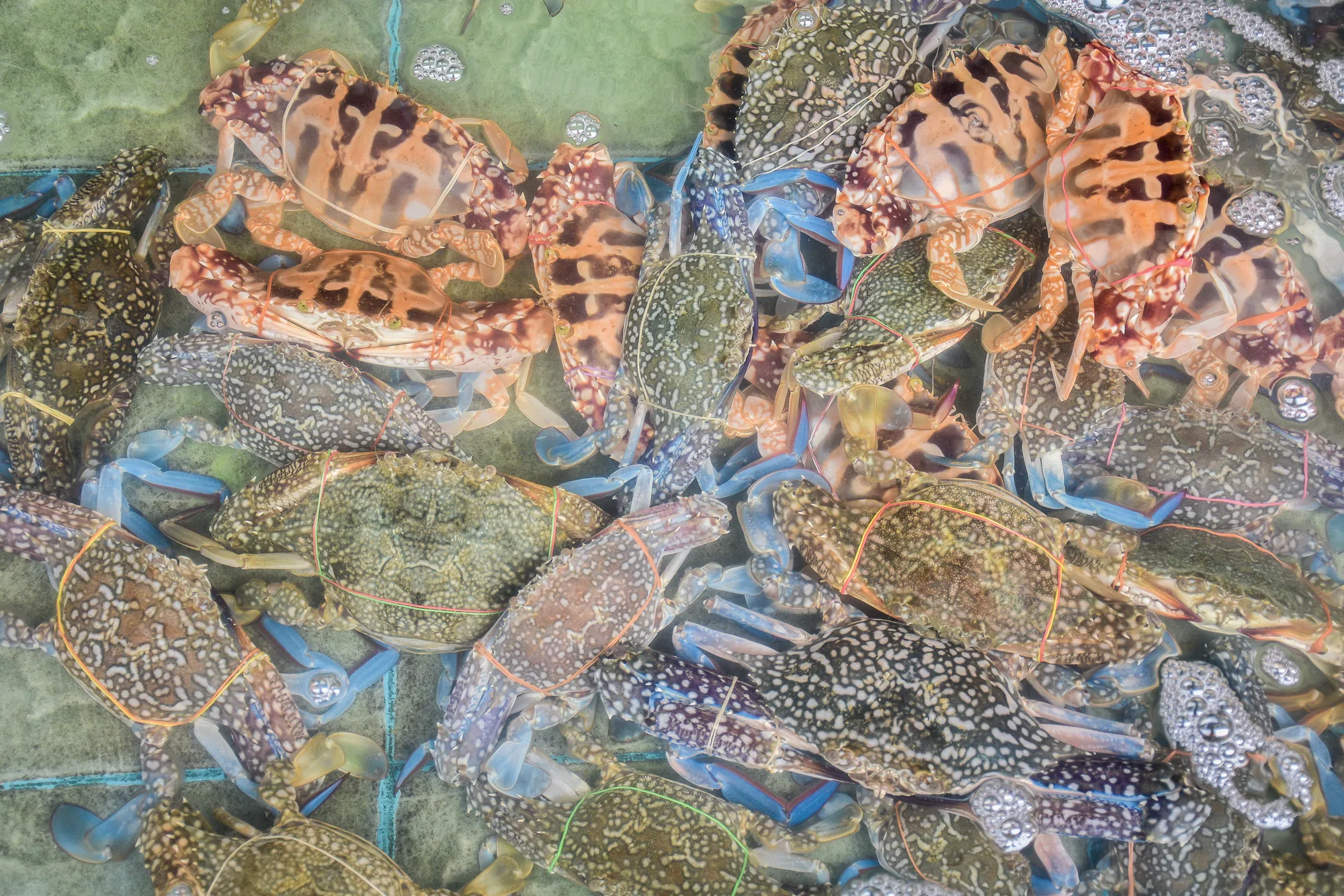
台灣北海岸盛產的鏽斑蟳,俗稱花蟹,不僅是餐桌上鮮美的佳餚,更承載著當地的漁業文化與生態智慧。
◤文.圖/看見台灣基金會編輯群
鏽
斑蟳(Charybdis feriatus)在台灣俗稱花蟹、火燒公、花蠘仔(hue-tshi̍h-á)等,主要產地為北海岸地區,以新北市萬里為全台灣最大集散地。每年9月至12月為主要產季,此時的鏽斑蟳肉質飽滿,滋味鮮甜,吸引許多饕客。花蟹和三點蟹、石蟳(善泳蟳)亦合稱萬里三大蟹、萬里蟹。
鏽斑蟳為梭子蟹科蟳屬動物,全身雜布紅褐色、暗色斑紋,身體(頭胸部)則有縱長、條狀的淡色花紋,相當醒目特殊,故有花蟹、花蠘仔之名,以沿近海漁船捕撈為主,主要棲息於台灣北海岸一帶。萬里,作為全台灣最大的鏽斑蟳集散地,其漁業發展與鏽斑蟳的捕撈息息相關。
▋萬里蟹帶動當地的觀光產業
因鏽斑蟳殼薄、容易入味,故鮮蟹多以清蒸或快炒料理,以嘗其鮮。簡單的烹調方式,最能展現鏽斑蟳的原始美味。萬里蟹的品牌建立,不僅提升了鏽斑蟳的知名度,也帶動了當地的觀光產業發展,成為北海岸重要的經濟支柱。
為達資源永續,漁業署限制捕撈上岸的鏽斑蟳肩寬需達9公分以上,並禁止於8月至12月捕撈抱卵之母蟹。新北市農業局和國立海洋大學亦於2015年起推動「雙花計畫」,研究人工繁殖花枝(烏賊)和花蟹(鏽斑蟳),除了人工培育出鏽斑蟳幼苗,也開發出能讓蟹苗順利食用成長的「石垣偽鏢水蚤」餌料,完成從卵到成熟個體的養殖過程,並持續研究提高育成率。
這些研究成果使得海洋中之鏽斑蟳得以人工繁殖放流的方式補充,未來能否進一步商業化養殖則令人期待。
探索更多
清水米糕──滷肉與海味蒸進筒仔,端出海線滋味
圓糯米、滷五花肉與乾海味在筒中一同蒸熟,倒扣後淋上醬汁,成為台中清水最具辨識度的小吃。從早期陶罐到今日常見的金屬筒,各家米糕在肉片、米粒與醬汁之間調出不同滋味,也盛著海線小鎮數十年來的日常記憶。
蘭嶼飛魚乾──達悟族守護海洋的「食魚哲學」
經歷了黑潮的洗禮、烈日的曝曬與爐火的燻烤,一塊塊黝黑緊實的飛魚乾,是蘭嶼與台東海岸深刻的文化符碼。它不只是達悟族人在禁捕期調節糧食的生存智慧,更封存了「節制與永續」的食魚哲學。
台式香腸─有人潮的地方就有它
香腸為肉品保存方式之一,因肉類為珍貴蛋白質來源,冷藏設備出現之前,人們即以各種方式,試圖延長肉品保存期限。而香腸便是其中一種常見的製作方式,世界諸文明皆可見到製作香腸的文化,台灣也不例外。