
'%20fill='%23a9976d'/%3e%3cpath%20id='Path_251'%20data-name='Path%20251'%20d='M8,35a1,1,0,0,1,1-1H23a1,1,0,0,1,0,2H9A1,1,0,0,1,8,35Z'%20transform='translate(-8%20-22)'%20fill='%23a9976d'/%3e%3cpath%20id='Path_252'%20data-name='Path%20252'%20d='M9,22a1,1,0,0,0,0,2h8a1,1,0,0,0,0-2Z'%20transform='translate(-8%20-16)'%20fill='%23a9976d'/%3e%3c/svg%3e)
'%20fill='%23a9976d'/%3e%3c/g%3e%3c/svg%3e)
'%3e%3cg%20id='Ellipse_27'%20data-name='Ellipse%2027'%20transform='translate(813%20250)'%20fill='none'%20stroke='%23ccac89'%20stroke-width='1'%3e%3ccircle%20cx='16'%20cy='16'%20r='16'%20stroke='none'/%3e%3ccircle%20cx='16'%20cy='16'%20r='15.5'%20fill='none'/%3e%3c/g%3e%3cg%20id='facebook'%20transform='translate(824.105%20258.296)'%3e%3cpath%20id='Path_243'%20data-name='Path%20243'%20d='M8.894.111V2.556H7.441a1.361,1.361,0,0,0-1.074.333,1.534,1.534,0,0,0-.278,1v1.75H8.8L8.441,8.38H6.089v7.028H3.255V8.38H.894V5.639H3.255V3.62A3.582,3.582,0,0,1,4.218.949,3.5,3.5,0,0,1,6.783,0,15.317,15.317,0,0,1,8.894.111Z'%20transform='translate(0%200)'%20fill='%23ccac89'/%3e%3c/g%3e%3c/g%3e%3c/svg%3e)

'%3e%3cg%20id='Ellipse_29'%20data-name='Ellipse%2029'%20transform='translate(901%20250)'%20fill='none'%20stroke='%23ccac89'%20stroke-width='1'%3e%3ccircle%20cx='16'%20cy='16'%20r='16'%20stroke='none'/%3e%3ccircle%20cx='16'%20cy='16'%20r='15.5'%20fill='none'/%3e%3c/g%3e%3cg%20id='link-45deg'%20transform='translate(902.607%20253.105)'%3e%3cg%20id='Group_479'%20data-name='Group%20479'%20transform='translate(7.393%205.896)'%3e%3cpath%20id='Path_241'%20data-name='Path%20241'%20d='M10.246,17.821,8.507,19.56a3.8,3.8,0,0,0,5.378,5.378L16.2,22.62a3.8,3.8,0,0,0-1.05-6.12l-.743.743a1.27,1.27,0,0,0-.2.252,2.535,2.535,0,0,1,1.091,4.23L12.99,24.042A2.536,2.536,0,0,1,9.4,20.455l1.005-1a5.093,5.093,0,0,1-.162-1.631Z'%20transform='translate(-7.393%20-12.02)'%20fill='%23ccac89'/%3e%3cpath%20id='Path_242'%20data-name='Path%20242'%20d='M18.236,9.327a3.8,3.8,0,0,0,1.05,6.12l.982-.984a2.535,2.535,0,0,1-1.136-4.241L21.448,7.9a2.536,2.536,0,1,1,3.587,3.587l-1.005,1a5.1,5.1,0,0,1,.162,1.631l1.739-1.739A3.8,3.8,0,1,0,20.553,7.01Z'%20transform='translate(-13.011%20-5.896)'%20fill='%23ccac89'/%3e%3c/g%3e%3c/g%3e%3c/g%3e%3c/svg%3e)
◤文.圖/看見台灣基金會編輯群
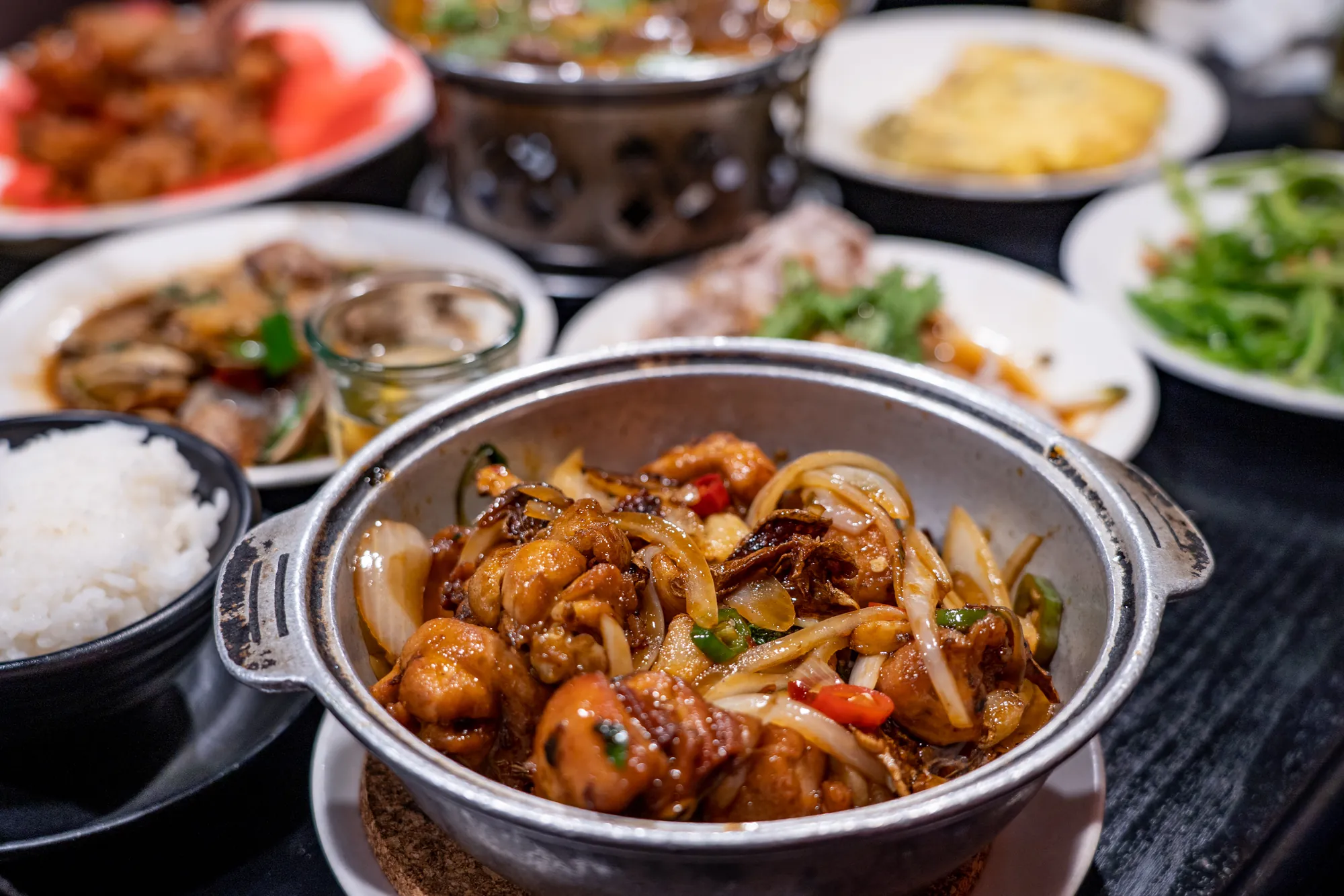
2019年,看見台灣基金會委託前國立高雄餐旅大學教授楊昭景進行「台灣菜味型研究」,其中「三杯味」的代表菜即是三杯雞。台灣三杯雞的「三杯」之名源於其三種核心調料:一杯醬油、一杯米酒、一杯黑芝麻油,佐以薑、蒜、辣椒,最後加入九層塔注入靈魂香氣。
台灣之所以能發展出三杯雞的獨特版本,是因為加入了在地食材。現今台式三杯雞必備的兩項關鍵元素為黑芝麻油與九層塔,其中九層塔雖非台灣原生種,但自外引進、適應本地氣候後,逐漸演化成具獨特香味的品種。此外,台式三杯雞源自台灣南部農村,而作為核心調味的黑芝麻油,也大多來自中南部芝麻產區,其中以台南為大宗,產量約占全台七成。
從農村智慧到熱門菜色
高雄餐旅大學助理教授郭忠豪在其著作《品饌東亞》中訪談多位台菜廚師指出,台式三杯雞的發展與南部農村息息相關。早期農家生活節儉且缺乏冷藏設備,宰殺雞隻後,利用黑芝麻油、醬油與米酒進行乾燒,透過高溫油脂封存與重口味調理,可延長雞肉在常溫下的保存期限,體現了農村社會的惜物智慧。
1970年代,全台各地陸續出現「土雞城」,由於土雞城主打放山雞肉質強韌,而台式三杯雞特有的乾燒技法能讓強韌的肉質入味,並保持Q彈口感,使其成為每家土雞城的熱門菜色,也成為台式三杯雞普及化的助力。如今,台式三杯雞料理不僅是熱炒店的明星菜色,更延伸出三杯中卷、三杯杏鮑菇等變化,成為國內外台式餐飲店中的人氣菜色之一。