
'%20fill='%23a9976d'/%3e%3cpath%20id='Path_251'%20data-name='Path%20251'%20d='M8,35a1,1,0,0,1,1-1H23a1,1,0,0,1,0,2H9A1,1,0,0,1,8,35Z'%20transform='translate(-8%20-22)'%20fill='%23a9976d'/%3e%3cpath%20id='Path_252'%20data-name='Path%20252'%20d='M9,22a1,1,0,0,0,0,2h8a1,1,0,0,0,0-2Z'%20transform='translate(-8%20-16)'%20fill='%23a9976d'/%3e%3c/svg%3e)
'%20fill='%23a9976d'/%3e%3c/g%3e%3c/svg%3e)
'%3e%3cg%20id='Ellipse_27'%20data-name='Ellipse%2027'%20transform='translate(813%20250)'%20fill='none'%20stroke='%23ccac89'%20stroke-width='1'%3e%3ccircle%20cx='16'%20cy='16'%20r='16'%20stroke='none'/%3e%3ccircle%20cx='16'%20cy='16'%20r='15.5'%20fill='none'/%3e%3c/g%3e%3cg%20id='facebook'%20transform='translate(824.105%20258.296)'%3e%3cpath%20id='Path_243'%20data-name='Path%20243'%20d='M8.894.111V2.556H7.441a1.361,1.361,0,0,0-1.074.333,1.534,1.534,0,0,0-.278,1v1.75H8.8L8.441,8.38H6.089v7.028H3.255V8.38H.894V5.639H3.255V3.62A3.582,3.582,0,0,1,4.218.949,3.5,3.5,0,0,1,6.783,0,15.317,15.317,0,0,1,8.894.111Z'%20transform='translate(0%200)'%20fill='%23ccac89'/%3e%3c/g%3e%3c/g%3e%3c/svg%3e)

'%3e%3cg%20id='Ellipse_29'%20data-name='Ellipse%2029'%20transform='translate(901%20250)'%20fill='none'%20stroke='%23ccac89'%20stroke-width='1'%3e%3ccircle%20cx='16'%20cy='16'%20r='16'%20stroke='none'/%3e%3ccircle%20cx='16'%20cy='16'%20r='15.5'%20fill='none'/%3e%3c/g%3e%3cg%20id='link-45deg'%20transform='translate(902.607%20253.105)'%3e%3cg%20id='Group_479'%20data-name='Group%20479'%20transform='translate(7.393%205.896)'%3e%3cpath%20id='Path_241'%20data-name='Path%20241'%20d='M10.246,17.821,8.507,19.56a3.8,3.8,0,0,0,5.378,5.378L16.2,22.62a3.8,3.8,0,0,0-1.05-6.12l-.743.743a1.27,1.27,0,0,0-.2.252,2.535,2.535,0,0,1,1.091,4.23L12.99,24.042A2.536,2.536,0,0,1,9.4,20.455l1.005-1a5.093,5.093,0,0,1-.162-1.631Z'%20transform='translate(-7.393%20-12.02)'%20fill='%23ccac89'/%3e%3cpath%20id='Path_242'%20data-name='Path%20242'%20d='M18.236,9.327a3.8,3.8,0,0,0,1.05,6.12l.982-.984a2.535,2.535,0,0,1-1.136-4.241L21.448,7.9a2.536,2.536,0,1,1,3.587,3.587l-1.005,1a5.1,5.1,0,0,1,.162,1.631l1.739-1.739A3.8,3.8,0,1,0,20.553,7.01Z'%20transform='translate(-13.011%20-5.896)'%20fill='%23ccac89'/%3e%3c/g%3e%3c/g%3e%3c/g%3e%3c/svg%3e)
◤文.圖/看見台灣基金會編輯群
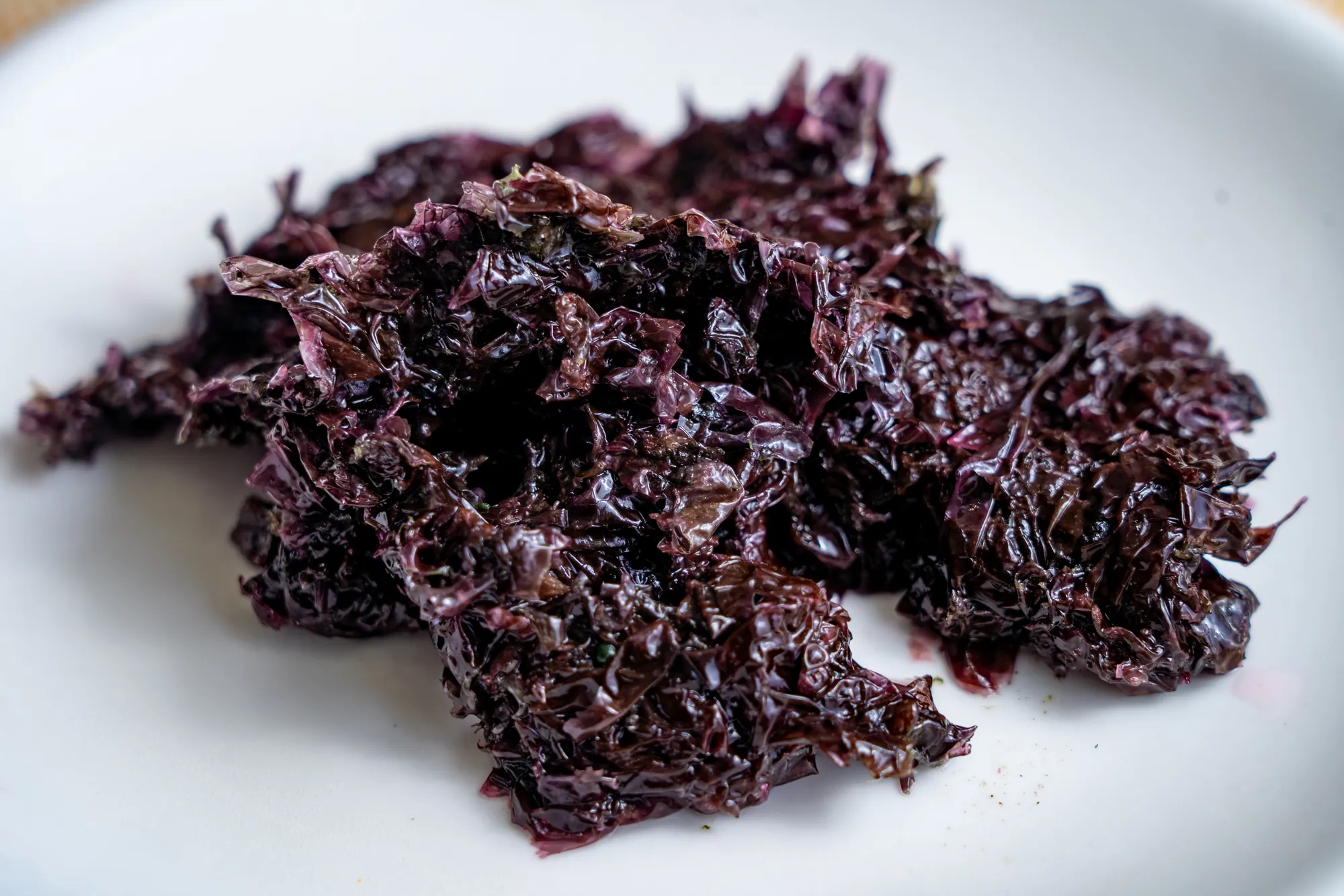
冬日海風拂過澎湖沿岸,潮水退去後,潮間帶礁岩上浮現一片暗紫色的柔軟海衣,那是澎湖人眼中的珍寶──紫菜。潔淨的水質與冬季低溫的海水,是紫菜生長不可或缺的條件。每年冬至過後,主要潮間帶會開放讓居民採摘。此時正值歲末年終,紫菜因而被戲稱為「澎湖人的年終獎金」,象徵著一年辛勞後,大海所賜予的豐厚回報。
到了開放的採集日,海邊便聚滿了採菜人。人人腳踩特製草鞋,在濕滑的礁岩上穩住步伐,雙手套著外覆網布的手套,熟練地撈取那滑溜的紫菜。首輪採摘嚴禁使用工具,全憑一雙巧手與海浪搶時間、爭速度;待第二輪開始,才允許使用湯匙等小器具,細心掏取礁岩縫隙間殘留的紫菜。這是一場與大海節奏共舞的競速,更是世代澎湖人口手相傳的生存智慧。
科學的介入,不為賺錢,只為永續
採收歸來後,居民會將紫菜仔細洗淨、鋪曬成乾,再變化成餐桌上的各式美味。最家常的莫過於一碗紫菜湯,湯底以小魚乾或虱目魚骨細火熬成,再加入蒜酥、蛋花與幾滴麻油提香,鮮鹹交織的風味中,滿是海洋的氣息。澎湖人也習慣將紫菜夾入飯糰、包裹米飯或與雞蛋同炒,使其成為早餐與宵夜中不可或缺的角色。
隨著環境意識抬頭,澎湖縣水產種苗繁殖場自 1968 年起投入紫菜繁殖研究,研究人員以廢棄的牡蠣殼作為培養基,讓紫菜的果孢子附著生長,再將它們懸掛於潮間帶的養殖架上,逐步建立起穩定的人工繁殖技術。這項努力初衷並非商業開發,而是為了讓那片漂浮於海面的紫色風景,以及留存於舌尖的鮮美記憶,都能夠世代綿延,長久不息。