
'%20fill='%23a9976d'/%3e%3cpath%20id='Path_251'%20data-name='Path%20251'%20d='M8,35a1,1,0,0,1,1-1H23a1,1,0,0,1,0,2H9A1,1,0,0,1,8,35Z'%20transform='translate(-8%20-22)'%20fill='%23a9976d'/%3e%3cpath%20id='Path_252'%20data-name='Path%20252'%20d='M9,22a1,1,0,0,0,0,2h8a1,1,0,0,0,0-2Z'%20transform='translate(-8%20-16)'%20fill='%23a9976d'/%3e%3c/svg%3e)
'%20fill='%23a9976d'/%3e%3c/g%3e%3c/svg%3e)
'%3e%3cg%20id='Ellipse_27'%20data-name='Ellipse%2027'%20transform='translate(813%20250)'%20fill='none'%20stroke='%23ccac89'%20stroke-width='1'%3e%3ccircle%20cx='16'%20cy='16'%20r='16'%20stroke='none'/%3e%3ccircle%20cx='16'%20cy='16'%20r='15.5'%20fill='none'/%3e%3c/g%3e%3cg%20id='facebook'%20transform='translate(824.105%20258.296)'%3e%3cpath%20id='Path_243'%20data-name='Path%20243'%20d='M8.894.111V2.556H7.441a1.361,1.361,0,0,0-1.074.333,1.534,1.534,0,0,0-.278,1v1.75H8.8L8.441,8.38H6.089v7.028H3.255V8.38H.894V5.639H3.255V3.62A3.582,3.582,0,0,1,4.218.949,3.5,3.5,0,0,1,6.783,0,15.317,15.317,0,0,1,8.894.111Z'%20transform='translate(0%200)'%20fill='%23ccac89'/%3e%3c/g%3e%3c/g%3e%3c/svg%3e)

'%3e%3cg%20id='Ellipse_29'%20data-name='Ellipse%2029'%20transform='translate(901%20250)'%20fill='none'%20stroke='%23ccac89'%20stroke-width='1'%3e%3ccircle%20cx='16'%20cy='16'%20r='16'%20stroke='none'/%3e%3ccircle%20cx='16'%20cy='16'%20r='15.5'%20fill='none'/%3e%3c/g%3e%3cg%20id='link-45deg'%20transform='translate(902.607%20253.105)'%3e%3cg%20id='Group_479'%20data-name='Group%20479'%20transform='translate(7.393%205.896)'%3e%3cpath%20id='Path_241'%20data-name='Path%20241'%20d='M10.246,17.821,8.507,19.56a3.8,3.8,0,0,0,5.378,5.378L16.2,22.62a3.8,3.8,0,0,0-1.05-6.12l-.743.743a1.27,1.27,0,0,0-.2.252,2.535,2.535,0,0,1,1.091,4.23L12.99,24.042A2.536,2.536,0,0,1,9.4,20.455l1.005-1a5.093,5.093,0,0,1-.162-1.631Z'%20transform='translate(-7.393%20-12.02)'%20fill='%23ccac89'/%3e%3cpath%20id='Path_242'%20data-name='Path%20242'%20d='M18.236,9.327a3.8,3.8,0,0,0,1.05,6.12l.982-.984a2.535,2.535,0,0,1-1.136-4.241L21.448,7.9a2.536,2.536,0,1,1,3.587,3.587l-1.005,1a5.1,5.1,0,0,1,.162,1.631l1.739-1.739A3.8,3.8,0,1,0,20.553,7.01Z'%20transform='translate(-13.011%20-5.896)'%20fill='%23ccac89'/%3e%3c/g%3e%3c/g%3e%3c/g%3e%3c/svg%3e)
◤文.圖/看見台灣基金會編輯群
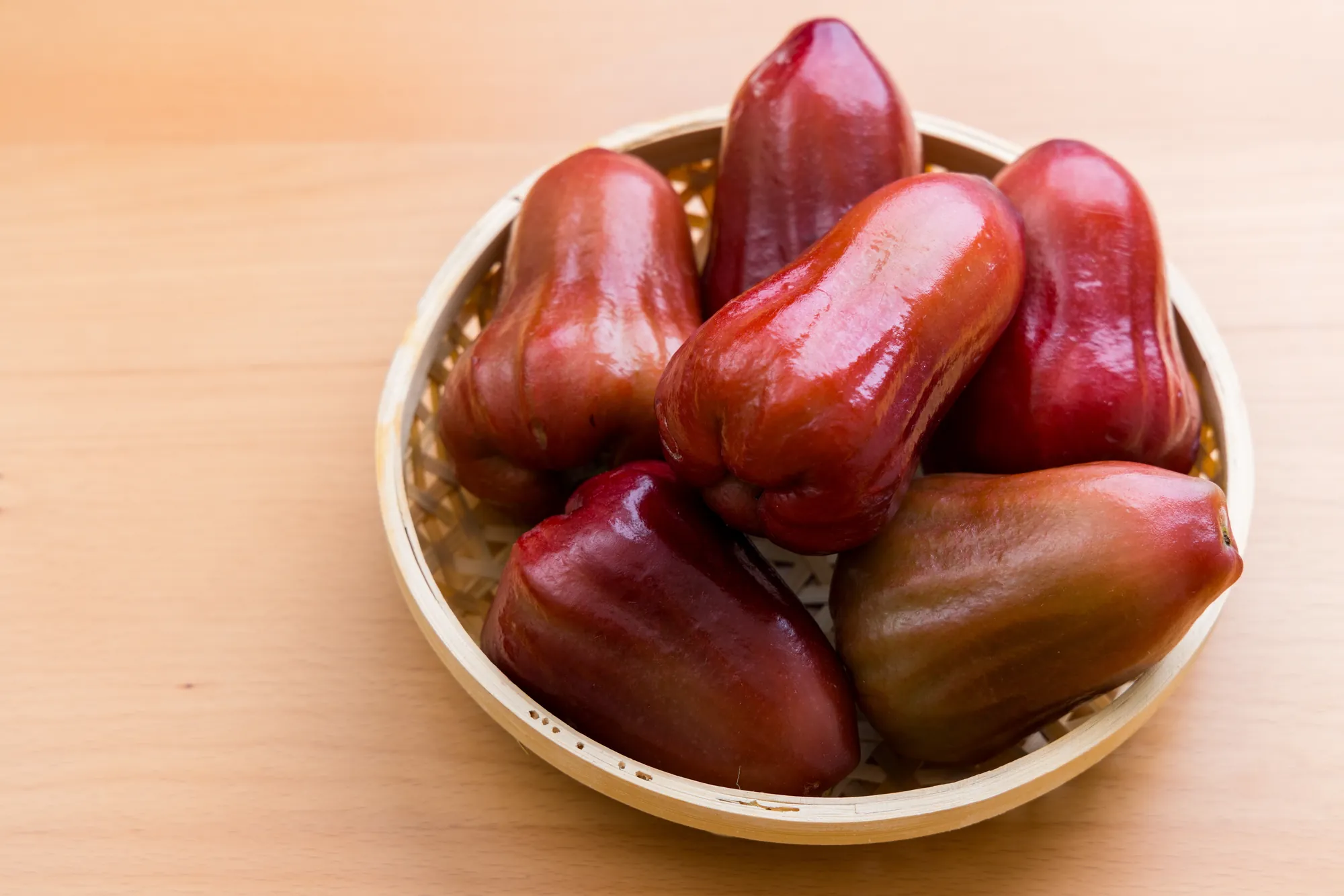
「黑透紅、肚臍開、皮幼幼、粒頭飽」,這句流傳於農間的台語口訣,道出人們辨識優質蓮霧的經驗準則,也蘊含著世代累積的栽培智慧。蓮霧約於17世紀由荷蘭人引入台灣,經長期馴化與品種改良,已成為台灣重要水果之一,其中以高雄六龜出產的深色品系最具代表性。
在台灣蓮霧產業版圖中,南部為主要產區,以屏東與高雄為核心,而六龜地區所產的深色蓮霧,因果形飽滿、色澤深紅、口感清脆多汁,在市場上被譽為「黑鑽石」,逐漸建立高品質產地形象,也成為冬季水果的重要選項。這句農間口訣所描述的「黑透紅」與「粒頭飽」,正是六龜蓮霧成熟時最迷人的樣貌。
從餐桌鮮果到節慶象徵
六龜蓮霧多種植於荖濃溪沿岸坡地,土壤排水良好且富含礦物質,水源穩定,加上日夜溫差明顯,有助於糖分累積與果色形成。蓮霧品質亦隨季節變化:冬季果實生長期較長,果形碩大、甜度較高,是主要產季;夏季則因生長快速,風味相對清爽。在栽培管理上,果農需進行疏果與套袋,以控制結果數量並防止病蟲害,使養分集中於少數果實,維持外觀與品質穩定。這些細緻的農事操作,不僅展現精緻農業的技術累積,也反映農民長年與土地互動的經驗。
在食用上,蓮霧多以鮮食為主,冷藏後更能凸顯其爽脆口感與高含水量。食用前常將果實對半切開,去除底部略帶苦味的部位,再切片入口,清甜而不膩。由於水分充足,蓮霧既是夏季消暑水果,也常在冬季餐後作為解膩之選。
在台灣日常生活中,蓮霧不僅是家庭水果盤上的常客,也經常出現在年節供桌與禮盒之中,象徵圓滿與豐收,反映出台灣社會對水果品質與吉祥寓意的重視。近年部分產地亦嘗試延伸加工,如製成果汁、蜜漬或入菜搭配鹹食,拓展其風味表現。從六龜山谷的果園,到家家戶戶的餐桌,蓮霧所承載的,不只是風土條件的累積,更是一種融入日常的飲食文化記憶。