
'%20fill='%23a9976d'/%3e%3cpath%20id='Path_251'%20data-name='Path%20251'%20d='M8,35a1,1,0,0,1,1-1H23a1,1,0,0,1,0,2H9A1,1,0,0,1,8,35Z'%20transform='translate(-8%20-22)'%20fill='%23a9976d'/%3e%3cpath%20id='Path_252'%20data-name='Path%20252'%20d='M9,22a1,1,0,0,0,0,2h8a1,1,0,0,0,0-2Z'%20transform='translate(-8%20-16)'%20fill='%23a9976d'/%3e%3c/svg%3e)
'%20fill='%23a9976d'/%3e%3c/g%3e%3c/svg%3e)
'%3e%3cg%20id='Ellipse_27'%20data-name='Ellipse%2027'%20transform='translate(813%20250)'%20fill='none'%20stroke='%23ccac89'%20stroke-width='1'%3e%3ccircle%20cx='16'%20cy='16'%20r='16'%20stroke='none'/%3e%3ccircle%20cx='16'%20cy='16'%20r='15.5'%20fill='none'/%3e%3c/g%3e%3cg%20id='facebook'%20transform='translate(824.105%20258.296)'%3e%3cpath%20id='Path_243'%20data-name='Path%20243'%20d='M8.894.111V2.556H7.441a1.361,1.361,0,0,0-1.074.333,1.534,1.534,0,0,0-.278,1v1.75H8.8L8.441,8.38H6.089v7.028H3.255V8.38H.894V5.639H3.255V3.62A3.582,3.582,0,0,1,4.218.949,3.5,3.5,0,0,1,6.783,0,15.317,15.317,0,0,1,8.894.111Z'%20transform='translate(0%200)'%20fill='%23ccac89'/%3e%3c/g%3e%3c/g%3e%3c/svg%3e)

'%3e%3cg%20id='Ellipse_29'%20data-name='Ellipse%2029'%20transform='translate(901%20250)'%20fill='none'%20stroke='%23ccac89'%20stroke-width='1'%3e%3ccircle%20cx='16'%20cy='16'%20r='16'%20stroke='none'/%3e%3ccircle%20cx='16'%20cy='16'%20r='15.5'%20fill='none'/%3e%3c/g%3e%3cg%20id='link-45deg'%20transform='translate(902.607%20253.105)'%3e%3cg%20id='Group_479'%20data-name='Group%20479'%20transform='translate(7.393%205.896)'%3e%3cpath%20id='Path_241'%20data-name='Path%20241'%20d='M10.246,17.821,8.507,19.56a3.8,3.8,0,0,0,5.378,5.378L16.2,22.62a3.8,3.8,0,0,0-1.05-6.12l-.743.743a1.27,1.27,0,0,0-.2.252,2.535,2.535,0,0,1,1.091,4.23L12.99,24.042A2.536,2.536,0,0,1,9.4,20.455l1.005-1a5.093,5.093,0,0,1-.162-1.631Z'%20transform='translate(-7.393%20-12.02)'%20fill='%23ccac89'/%3e%3cpath%20id='Path_242'%20data-name='Path%20242'%20d='M18.236,9.327a3.8,3.8,0,0,0,1.05,6.12l.982-.984a2.535,2.535,0,0,1-1.136-4.241L21.448,7.9a2.536,2.536,0,1,1,3.587,3.587l-1.005,1a5.1,5.1,0,0,1,.162,1.631l1.739-1.739A3.8,3.8,0,1,0,20.553,7.01Z'%20transform='translate(-13.011%20-5.896)'%20fill='%23ccac89'/%3e%3c/g%3e%3c/g%3e%3c/g%3e%3c/svg%3e)
◤文.圖 / 看見台灣基金會編輯群
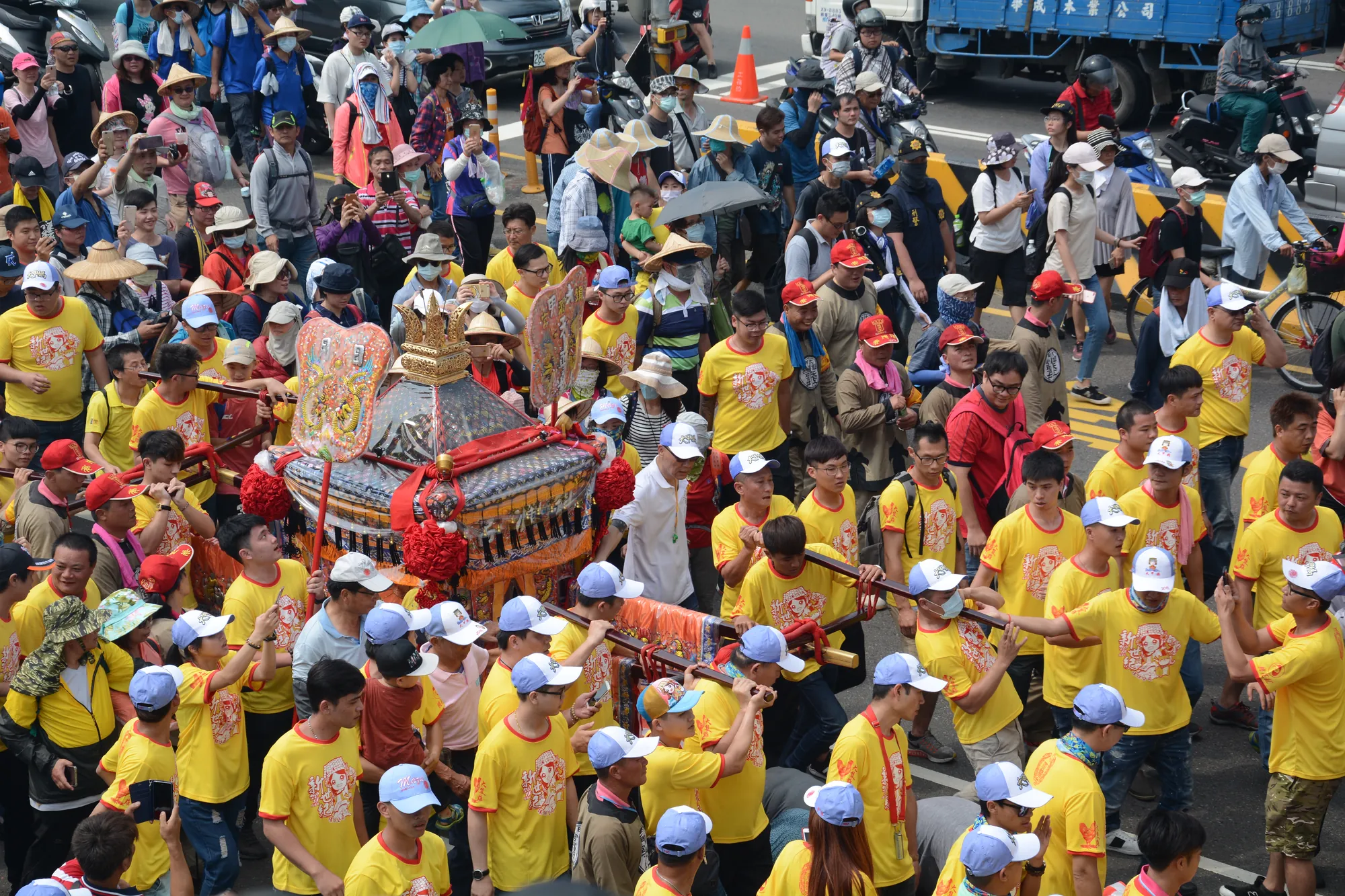
台中大甲鎮瀾宮媽祖遶境進香是每年台灣中部重要的宗教慶典之一,起駕後徒步行經台中、彰化、雲林、嘉義四個縣市,歷經九天八夜。來自全台各地數十萬名信徒廣為參與,是台灣盛大的民間信仰活動,甚至在2010年被指定登錄為國家無形文化資產。
大甲鎮瀾宮的媽祖信仰源自中國福建湄洲媽祖崇祀,相傳清朝雍正8年(西元1730年),由移民自湄洲恭請媽祖神像來台,逐漸成為地方的公共信仰中心。其遶境進香活動,最初為前往湄洲進香,後來因台中大甲與雲林北港牛墟之間的經濟活動,1988年開始前往雲林北港朝天宮進香。
每年大甲媽祖遶境進香的日子並不固定,需於農曆正月十五擲筊決定出發時辰,整體儀軌依序包含筊筶、豎旗、祈安、上轎、起駕、駐駕、祈福、祝壽、回駕、安座等程序。隨著長時間徒步行進,飲食補給成為重要需求,也發展出沿途供餐的文化形式。追隨鑾駕的信眾,於起駕前三天乃至去程期間多茹素,以表達對媽祖的敬意,而沿途的早、中、晚餐與消夜,則多由宮廟、地方居民與店家主動提供。
流動的民間生活博物館
供食內容多以易於分送與大量製作為主,如紫米素粽、豆花、潤餅、素肉圓、鹹粥及各式在地農產,既能迅速補充體力,也反映地方物產特色。祝壽大典後開葷,回鑾路線上則可見海鮮粥、鴨肉米糕、五穀飯糰及各類點心,形成不同階段的飲食轉換。這些食物的提供,不僅回應行腳所需,也與民間信仰中的「結緣」與「行善」觀念相關,透過供餐累積功德,並與香客建立互動關係。
從沿途店家到臨時設置的供食點,飲食隨著隊伍移動而展開,形成一條動態的飲食路徑。對參與者而言,進食不只是補充體力,更是參與儀式的一部分。隨著活動規模擴大與參與人數增加,供食內容與形式亦逐漸多元,傳統與當代並存,使遶境進香不僅是宗教行動,也呈現出台灣社會中飲食、信仰與人際連結交織的文化樣貌。