
'%20fill='%23a9976d'/%3e%3cpath%20id='Path_251'%20data-name='Path%20251'%20d='M8,35a1,1,0,0,1,1-1H23a1,1,0,0,1,0,2H9A1,1,0,0,1,8,35Z'%20transform='translate(-8%20-22)'%20fill='%23a9976d'/%3e%3cpath%20id='Path_252'%20data-name='Path%20252'%20d='M9,22a1,1,0,0,0,0,2h8a1,1,0,0,0,0-2Z'%20transform='translate(-8%20-16)'%20fill='%23a9976d'/%3e%3c/svg%3e)
'%20fill='%23a9976d'/%3e%3c/g%3e%3c/svg%3e)
'%3e%3cg%20id='Ellipse_27'%20data-name='Ellipse%2027'%20transform='translate(813%20250)'%20fill='none'%20stroke='%23ccac89'%20stroke-width='1'%3e%3ccircle%20cx='16'%20cy='16'%20r='16'%20stroke='none'/%3e%3ccircle%20cx='16'%20cy='16'%20r='15.5'%20fill='none'/%3e%3c/g%3e%3cg%20id='facebook'%20transform='translate(824.105%20258.296)'%3e%3cpath%20id='Path_243'%20data-name='Path%20243'%20d='M8.894.111V2.556H7.441a1.361,1.361,0,0,0-1.074.333,1.534,1.534,0,0,0-.278,1v1.75H8.8L8.441,8.38H6.089v7.028H3.255V8.38H.894V5.639H3.255V3.62A3.582,3.582,0,0,1,4.218.949,3.5,3.5,0,0,1,6.783,0,15.317,15.317,0,0,1,8.894.111Z'%20transform='translate(0%200)'%20fill='%23ccac89'/%3e%3c/g%3e%3c/g%3e%3c/svg%3e)

'%3e%3cg%20id='Ellipse_29'%20data-name='Ellipse%2029'%20transform='translate(901%20250)'%20fill='none'%20stroke='%23ccac89'%20stroke-width='1'%3e%3ccircle%20cx='16'%20cy='16'%20r='16'%20stroke='none'/%3e%3ccircle%20cx='16'%20cy='16'%20r='15.5'%20fill='none'/%3e%3c/g%3e%3cg%20id='link-45deg'%20transform='translate(902.607%20253.105)'%3e%3cg%20id='Group_479'%20data-name='Group%20479'%20transform='translate(7.393%205.896)'%3e%3cpath%20id='Path_241'%20data-name='Path%20241'%20d='M10.246,17.821,8.507,19.56a3.8,3.8,0,0,0,5.378,5.378L16.2,22.62a3.8,3.8,0,0,0-1.05-6.12l-.743.743a1.27,1.27,0,0,0-.2.252,2.535,2.535,0,0,1,1.091,4.23L12.99,24.042A2.536,2.536,0,0,1,9.4,20.455l1.005-1a5.093,5.093,0,0,1-.162-1.631Z'%20transform='translate(-7.393%20-12.02)'%20fill='%23ccac89'/%3e%3cpath%20id='Path_242'%20data-name='Path%20242'%20d='M18.236,9.327a3.8,3.8,0,0,0,1.05,6.12l.982-.984a2.535,2.535,0,0,1-1.136-4.241L21.448,7.9a2.536,2.536,0,1,1,3.587,3.587l-1.005,1a5.1,5.1,0,0,1,.162,1.631l1.739-1.739A3.8,3.8,0,1,0,20.553,7.01Z'%20transform='translate(-13.011%20-5.896)'%20fill='%23ccac89'/%3e%3c/g%3e%3c/g%3e%3c/g%3e%3c/svg%3e)
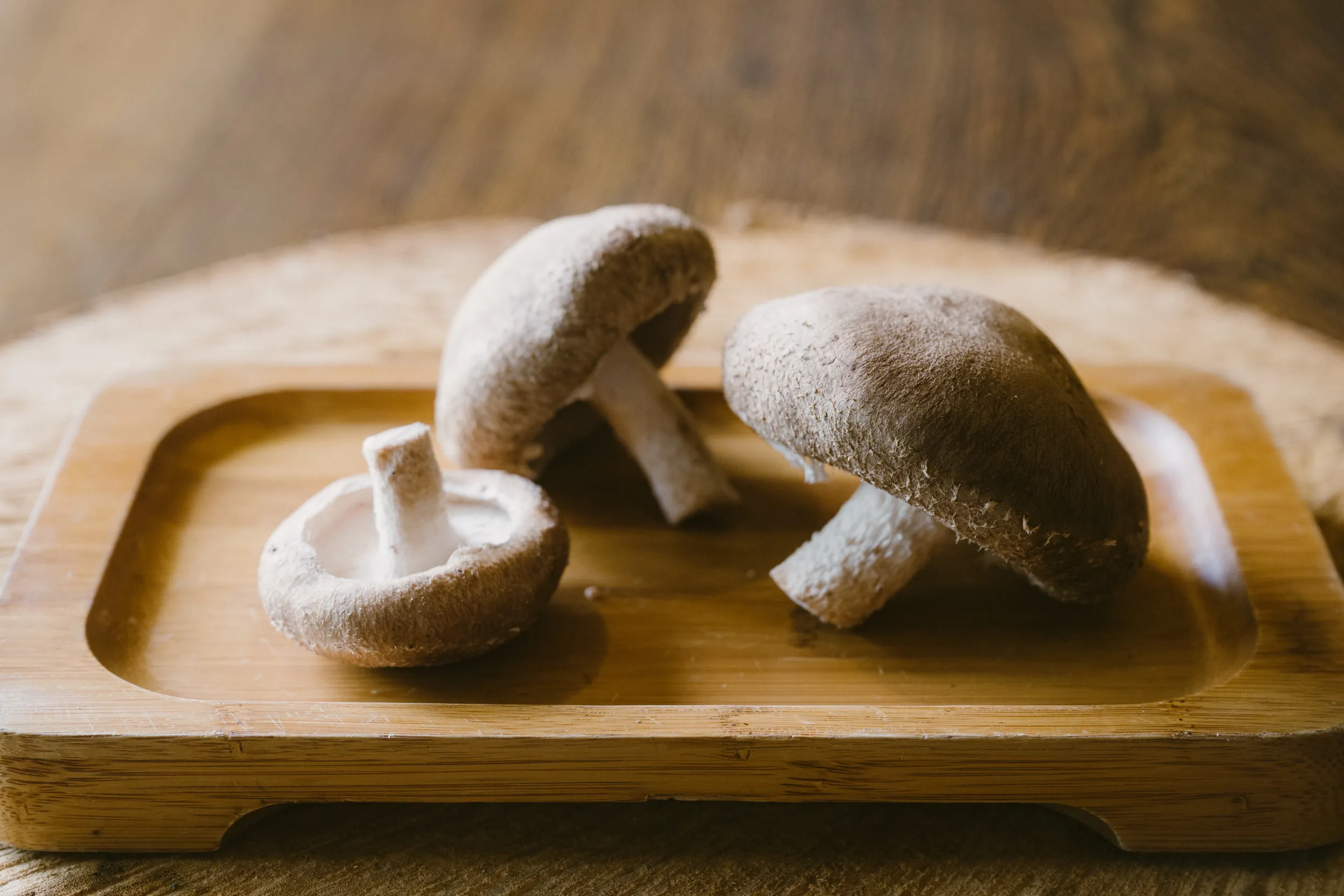
◤文.圖 / 看見台灣基金會編輯群
清晨的南投埔里,山嵐尚未散去,香菇寮內已悄然飄出淡淡的木質菌香。這座山城的高海拔(約500公尺)環境、涼爽濕潤的山區氣候(年均溫攝氏18至22度),以及周邊中央山脈提供的林木資源與排水良好的土壤,完美適合香菇菌絲生長,使埔里成為台灣香菇主要產區,素有「香菇之都」之稱。
早在日本時代,埔里便有成功栽種香菇的紀錄。1960至1980年代,是埔里香菇的黃金年代,當時農民主要採用「段木栽培法」,將台灣櫸木、杜英、台灣赤楊等樹幹裁切成段,鑽孔後植入菌種,再以封蠟培養,需耐心等待近十個月方能收成。此法雖耗時費工,但所產出的香菇菇體厚實、香氣飽滿,深受市場青睞。
以科技提升效率、實踐循環經濟
1980年代後,環保意識興起,政府實施林木禁伐政策,傳統的段木栽培法逐漸被「太空包栽培法」所取代。這種以木屑、米糠等混合製成的人工培養基,不僅生長週期大幅縮短、產量穩定,更使香菇產業從山林走向菇寮。然而,氣候暖化帶來了新的挑戰。香菇菌絲在攝氏25度以上便發育遲緩,使得埔里的夏季(均溫攝氏26至28度)成為菇農必須與高溫賽跑的艱困時期。
近年來,埔里香菇產業正迎來一場科技革命。農業試驗所與業界合作,引進「水簾控溫溫室」與「立體層架栽培系統」,透過智慧環控技術穩定生長環境與產量,同時研發自動化採收與剪柄設備,大幅減輕人力負荷。而廢棄的太空包則被回收,轉化為生質燃料與有機堆肥,實踐了農業循環經濟的理念。
埔里香菇不僅是農業明星,更融入在地飲食文化。從香菇煨湯、火鍋到湯圓內餡,新鮮菇體帶來獨特鮮甜;更有農場提供採菇DIY與菇菇披薩,鍋物店則以厚實菇片成鍋底,吸引遊客品嘗。此轉型讓香菇從田間走向餐桌,深化地方經濟循環。