
'%20fill='%23a9976d'/%3e%3cpath%20id='Path_251'%20data-name='Path%20251'%20d='M8,35a1,1,0,0,1,1-1H23a1,1,0,0,1,0,2H9A1,1,0,0,1,8,35Z'%20transform='translate(-8%20-22)'%20fill='%23a9976d'/%3e%3cpath%20id='Path_252'%20data-name='Path%20252'%20d='M9,22a1,1,0,0,0,0,2h8a1,1,0,0,0,0-2Z'%20transform='translate(-8%20-16)'%20fill='%23a9976d'/%3e%3c/svg%3e)
'%20fill='%23a9976d'/%3e%3c/g%3e%3c/svg%3e)
米粉─古早時,喜慶宴客才吃得到
地方探索
主題探索
北部
中部
文化美食
分享
'%3e%3cg%20id='Ellipse_27'%20data-name='Ellipse%2027'%20transform='translate(813%20250)'%20fill='none'%20stroke='%23ccac89'%20stroke-width='1'%3e%3ccircle%20cx='16'%20cy='16'%20r='16'%20stroke='none'/%3e%3ccircle%20cx='16'%20cy='16'%20r='15.5'%20fill='none'/%3e%3c/g%3e%3cg%20id='facebook'%20transform='translate(824.105%20258.296)'%3e%3cpath%20id='Path_243'%20data-name='Path%20243'%20d='M8.894.111V2.556H7.441a1.361,1.361,0,0,0-1.074.333,1.534,1.534,0,0,0-.278,1v1.75H8.8L8.441,8.38H6.089v7.028H3.255V8.38H.894V5.639H3.255V3.62A3.582,3.582,0,0,1,4.218.949,3.5,3.5,0,0,1,6.783,0,15.317,15.317,0,0,1,8.894.111Z'%20transform='translate(0%200)'%20fill='%23ccac89'/%3e%3c/g%3e%3c/g%3e%3c/svg%3e)

'%3e%3cg%20id='Ellipse_29'%20data-name='Ellipse%2029'%20transform='translate(901%20250)'%20fill='none'%20stroke='%23ccac89'%20stroke-width='1'%3e%3ccircle%20cx='16'%20cy='16'%20r='16'%20stroke='none'/%3e%3ccircle%20cx='16'%20cy='16'%20r='15.5'%20fill='none'/%3e%3c/g%3e%3cg%20id='link-45deg'%20transform='translate(902.607%20253.105)'%3e%3cg%20id='Group_479'%20data-name='Group%20479'%20transform='translate(7.393%205.896)'%3e%3cpath%20id='Path_241'%20data-name='Path%20241'%20d='M10.246,17.821,8.507,19.56a3.8,3.8,0,0,0,5.378,5.378L16.2,22.62a3.8,3.8,0,0,0-1.05-6.12l-.743.743a1.27,1.27,0,0,0-.2.252,2.535,2.535,0,0,1,1.091,4.23L12.99,24.042A2.536,2.536,0,0,1,9.4,20.455l1.005-1a5.093,5.093,0,0,1-.162-1.631Z'%20transform='translate(-7.393%20-12.02)'%20fill='%23ccac89'/%3e%3cpath%20id='Path_242'%20data-name='Path%20242'%20d='M18.236,9.327a3.8,3.8,0,0,0,1.05,6.12l.982-.984a2.535,2.535,0,0,1-1.136-4.241L21.448,7.9a2.536,2.536,0,1,1,3.587,3.587l-1.005,1a5.1,5.1,0,0,1,.162,1.631l1.739-1.739A3.8,3.8,0,1,0,20.553,7.01Z'%20transform='translate(-13.011%20-5.896)'%20fill='%23ccac89'/%3e%3c/g%3e%3c/g%3e%3c/g%3e%3c/svg%3e)
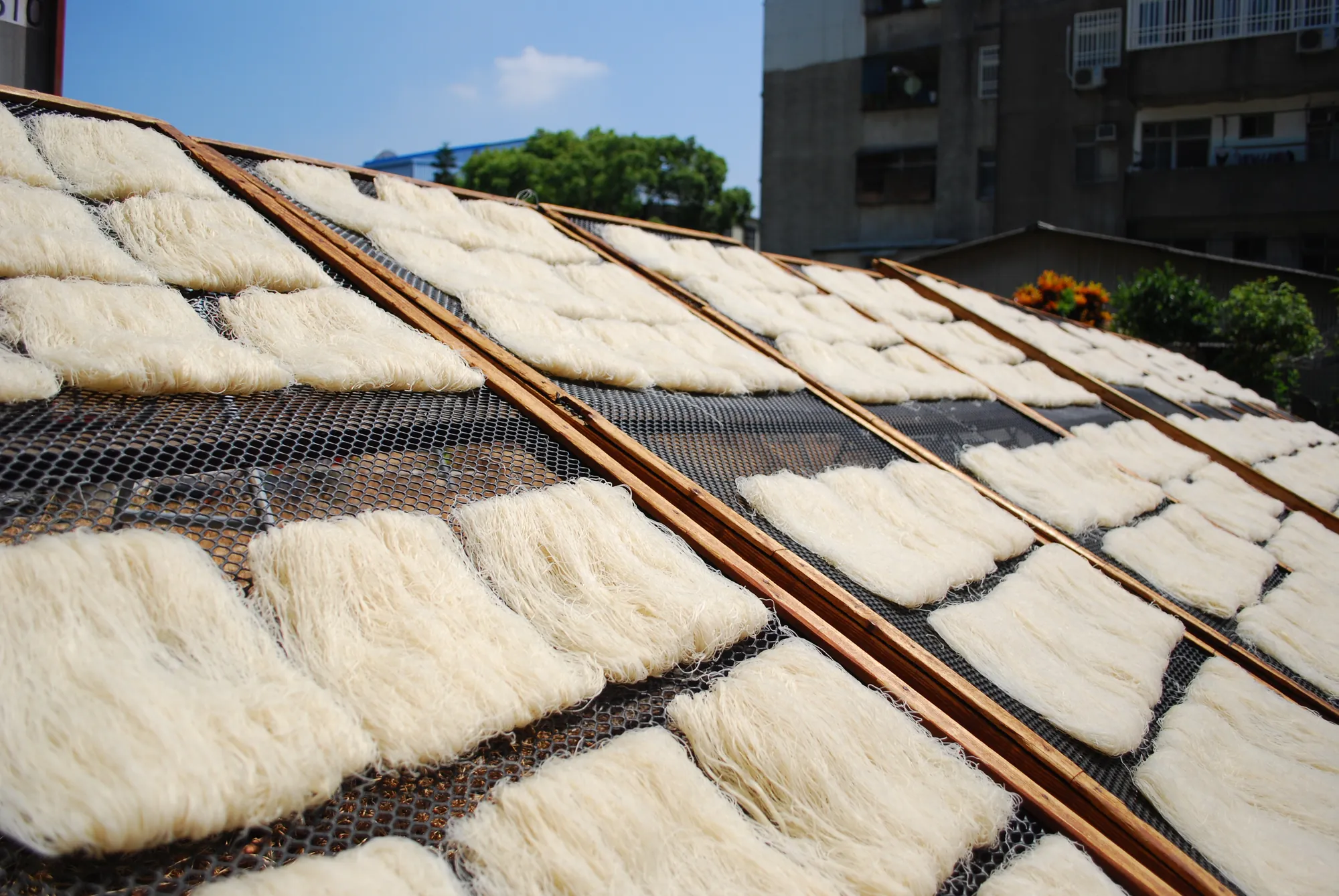
台灣的米粉源於中國福建惠安,應為渡台先民傳入,後於台灣中部發跡,其後逐漸區分為兩種形式:向東發展為南投埔里米粉,向北發展為新竹米粉,為台灣兩大著名產區。
◤文.圖/看見台灣基金會編輯群
根
據《新竹市志》所記載,「五胡亂華,華人南遷閩浙時,仍以稻米榨條而食,即當今之米粉也」、「米粉之製法由福建惠安傳入台灣」即言其起源。今日,台灣的米粉可區分為粗、細兩種,其差異主要與製作工序相關,米糰壓成條狀後,經水煮燙熟、沖涼浸泡後日曬,稱為粗米粉,體積較粗、較為滑順,例如埔里米粉。壓成細絲狀後蒸熟日曬,則稱細米粉,以新竹米粉為主,蒸炊後日曬,體積較細、較為Q彈。
▋含米量不到五成的叫「炊粉」
米粉為台灣常見小吃,為米食加工品。傳統米粉以在來米磨製加工而成,過往米粉價格相對昂貴,因主要用於喜慶宴客或節日之用;但歷經百年發展,如今已成為常民小吃。常見的料理形式為米粉湯、炒米粉等,廣受台灣人喜愛。
雖然米粉主要為在來米所製,後來業者為了改善品質與口感,也會添加玉米澱粉或其他食用澱粉為原料,外觀較帶有光澤感、也較耐煮,購買米粉時,可以看品名和標示含米量,米含量在5成以下的產品,2014年起依政府規定必須正名為「炊粉」。
真正的米粉以100%的秈米(在來米)為原料,外觀無光澤、不透明,免浸泡、免汆燙,烹煮前只需輕輕沖水,料炒好,起鍋前再下鍋燜煮,即能享受好滋味。
探索更多
肉圓─南蒸北炸,互別苗頭
台灣諸多小吃源起不可考,但肉圓由彰化人范萬居所創的說法廣被接受,所以彰化肉圓有一定的地位。有名的彰化肉圓排隊店比比皆是,網評破萬的不在少數。
茭白筍─俗稱美人腿,其實是生了病
茭白筍為多年生水生禾本科菰屬植物,由於肥大化的嫩莖形如小腿,且色澤白皙,在台灣又稱為「美人腿」,以南投埔里為主要產區,占了9成。
金針花─觀為花、食為菜、用為藥
盛夏之際,到台灣東部的金針花產地欣賞澄黃的壯闊花海,之後再享用產地限定的新鮮金針花湯、清炒金針花,是很夯的旅遊行程,尤其是台東的太麻里、花蓮富里的六十石山、玉里的赤科山,場面壯觀。