
'%20fill='%23a9976d'/%3e%3cpath%20id='Path_251'%20data-name='Path%20251'%20d='M8,35a1,1,0,0,1,1-1H23a1,1,0,0,1,0,2H9A1,1,0,0,1,8,35Z'%20transform='translate(-8%20-22)'%20fill='%23a9976d'/%3e%3cpath%20id='Path_252'%20data-name='Path%20252'%20d='M9,22a1,1,0,0,0,0,2h8a1,1,0,0,0,0-2Z'%20transform='translate(-8%20-16)'%20fill='%23a9976d'/%3e%3c/svg%3e)
'%20fill='%23a9976d'/%3e%3c/g%3e%3c/svg%3e)
'%3e%3cg%20id='Ellipse_27'%20data-name='Ellipse%2027'%20transform='translate(813%20250)'%20fill='none'%20stroke='%23ccac89'%20stroke-width='1'%3e%3ccircle%20cx='16'%20cy='16'%20r='16'%20stroke='none'/%3e%3ccircle%20cx='16'%20cy='16'%20r='15.5'%20fill='none'/%3e%3c/g%3e%3cg%20id='facebook'%20transform='translate(824.105%20258.296)'%3e%3cpath%20id='Path_243'%20data-name='Path%20243'%20d='M8.894.111V2.556H7.441a1.361,1.361,0,0,0-1.074.333,1.534,1.534,0,0,0-.278,1v1.75H8.8L8.441,8.38H6.089v7.028H3.255V8.38H.894V5.639H3.255V3.62A3.582,3.582,0,0,1,4.218.949,3.5,3.5,0,0,1,6.783,0,15.317,15.317,0,0,1,8.894.111Z'%20transform='translate(0%200)'%20fill='%23ccac89'/%3e%3c/g%3e%3c/g%3e%3c/svg%3e)

'%3e%3cg%20id='Ellipse_29'%20data-name='Ellipse%2029'%20transform='translate(901%20250)'%20fill='none'%20stroke='%23ccac89'%20stroke-width='1'%3e%3ccircle%20cx='16'%20cy='16'%20r='16'%20stroke='none'/%3e%3ccircle%20cx='16'%20cy='16'%20r='15.5'%20fill='none'/%3e%3c/g%3e%3cg%20id='link-45deg'%20transform='translate(902.607%20253.105)'%3e%3cg%20id='Group_479'%20data-name='Group%20479'%20transform='translate(7.393%205.896)'%3e%3cpath%20id='Path_241'%20data-name='Path%20241'%20d='M10.246,17.821,8.507,19.56a3.8,3.8,0,0,0,5.378,5.378L16.2,22.62a3.8,3.8,0,0,0-1.05-6.12l-.743.743a1.27,1.27,0,0,0-.2.252,2.535,2.535,0,0,1,1.091,4.23L12.99,24.042A2.536,2.536,0,0,1,9.4,20.455l1.005-1a5.093,5.093,0,0,1-.162-1.631Z'%20transform='translate(-7.393%20-12.02)'%20fill='%23ccac89'/%3e%3cpath%20id='Path_242'%20data-name='Path%20242'%20d='M18.236,9.327a3.8,3.8,0,0,0,1.05,6.12l.982-.984a2.535,2.535,0,0,1-1.136-4.241L21.448,7.9a2.536,2.536,0,1,1,3.587,3.587l-1.005,1a5.1,5.1,0,0,1,.162,1.631l1.739-1.739A3.8,3.8,0,1,0,20.553,7.01Z'%20transform='translate(-13.011%20-5.896)'%20fill='%23ccac89'/%3e%3c/g%3e%3c/g%3e%3c/g%3e%3c/svg%3e)
◤文.圖/看見台灣基金會編輯群
位於新北中和南勢角的華新街,隱身於城市邊緣,卻是北台灣少見的異國飲食聚落。這條街的形成,與歷史中的遷徙密不可分──來自雲泰邊境的異域孤軍後裔、後續移入的緬甸移民,以及在都市邊緣落腳的學生與上班族,共同構築出多元族群交織的生活場域。隨著捷運通車,人潮逐漸湧入,原本內聚的移民社群,也在香料與食物的引領下,轉化為一條對外開放的「緬甸街」,成為台灣少數以東南亞飲食為核心的街區。
除香料、美食,潑水節也完整保留
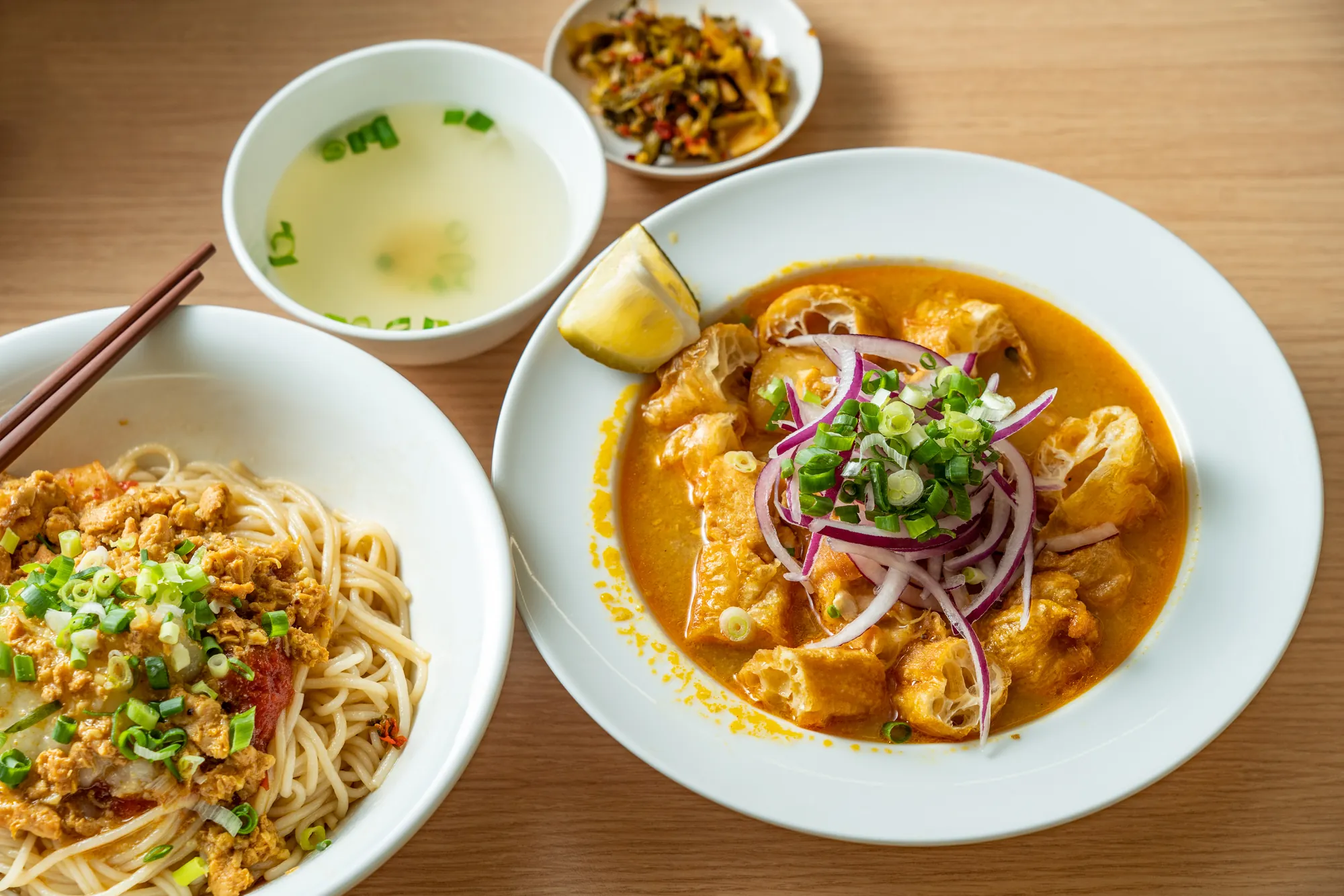
走入華新街,最先感受到的並非視覺,而是氣味。街道兩側店家飄散的香氣,來自與台灣傳統油蔥、蒜香截然不同的風味體系,以咖哩葉、羅望子、嘎拋葉等東南亞常見香料,構築出層次鮮明的飲食語彙。在炎熱午後,一杯以羅望子調製的飲品,酸香清爽,成為在地日常的消暑選擇。飲食內容也呈現高度混融的特性:從泰式料理、越南河粉,到印度烤餅與緬甸奶茶,展現出東南亞至南亞跨地域的飲食網絡。其中,以魚類熬煮湯底、加入椰奶與香料的緬甸魚湯麵尤具代表性,風味濃郁且帶有異國辛香;此外,粑粑絲、炸豆餅等少見點心,也在此地成為日常可得的滋味。街區內同時販售各式進口香料與食材,使華新街不僅是用餐場域,更是異國飲食文化的供應節點。
除了日常飲食,節慶亦為這條街的重要文化展現。每年四月中旬的潑水節(浴佛節),為東南亞重要節慶之一,華新街也同步舉行慶祝活動。人們透過潑水互動,象徵洗去過往、迎接新生,信仰與節慶在異地延續,轉化為台灣城市中的文化景觀。透過飲食與節慶,華新街不僅呈現移民生活的適應與轉化,也讓台灣社會得以在日常之中,接觸並理解來自不同文化的味覺記憶。