
'%20fill='%23a9976d'/%3e%3cpath%20id='Path_251'%20data-name='Path%20251'%20d='M8,35a1,1,0,0,1,1-1H23a1,1,0,0,1,0,2H9A1,1,0,0,1,8,35Z'%20transform='translate(-8%20-22)'%20fill='%23a9976d'/%3e%3cpath%20id='Path_252'%20data-name='Path%20252'%20d='M9,22a1,1,0,0,0,0,2h8a1,1,0,0,0,0-2Z'%20transform='translate(-8%20-16)'%20fill='%23a9976d'/%3e%3c/svg%3e)
'%20fill='%23a9976d'/%3e%3c/g%3e%3c/svg%3e)
肉乾─從前是束脩,現在是零食
地方探索
主題探索
離島
文化美食
分享
'%3e%3cg%20id='Ellipse_27'%20data-name='Ellipse%2027'%20transform='translate(813%20250)'%20fill='none'%20stroke='%23ccac89'%20stroke-width='1'%3e%3ccircle%20cx='16'%20cy='16'%20r='16'%20stroke='none'/%3e%3ccircle%20cx='16'%20cy='16'%20r='15.5'%20fill='none'/%3e%3c/g%3e%3cg%20id='facebook'%20transform='translate(824.105%20258.296)'%3e%3cpath%20id='Path_243'%20data-name='Path%20243'%20d='M8.894.111V2.556H7.441a1.361,1.361,0,0,0-1.074.333,1.534,1.534,0,0,0-.278,1v1.75H8.8L8.441,8.38H6.089v7.028H3.255V8.38H.894V5.639H3.255V3.62A3.582,3.582,0,0,1,4.218.949,3.5,3.5,0,0,1,6.783,0,15.317,15.317,0,0,1,8.894.111Z'%20transform='translate(0%200)'%20fill='%23ccac89'/%3e%3c/g%3e%3c/g%3e%3c/svg%3e)

'%3e%3cg%20id='Ellipse_29'%20data-name='Ellipse%2029'%20transform='translate(901%20250)'%20fill='none'%20stroke='%23ccac89'%20stroke-width='1'%3e%3ccircle%20cx='16'%20cy='16'%20r='16'%20stroke='none'/%3e%3ccircle%20cx='16'%20cy='16'%20r='15.5'%20fill='none'/%3e%3c/g%3e%3cg%20id='link-45deg'%20transform='translate(902.607%20253.105)'%3e%3cg%20id='Group_479'%20data-name='Group%20479'%20transform='translate(7.393%205.896)'%3e%3cpath%20id='Path_241'%20data-name='Path%20241'%20d='M10.246,17.821,8.507,19.56a3.8,3.8,0,0,0,5.378,5.378L16.2,22.62a3.8,3.8,0,0,0-1.05-6.12l-.743.743a1.27,1.27,0,0,0-.2.252,2.535,2.535,0,0,1,1.091,4.23L12.99,24.042A2.536,2.536,0,0,1,9.4,20.455l1.005-1a5.093,5.093,0,0,1-.162-1.631Z'%20transform='translate(-7.393%20-12.02)'%20fill='%23ccac89'/%3e%3cpath%20id='Path_242'%20data-name='Path%20242'%20d='M18.236,9.327a3.8,3.8,0,0,0,1.05,6.12l.982-.984a2.535,2.535,0,0,1-1.136-4.241L21.448,7.9a2.536,2.536,0,1,1,3.587,3.587l-1.005,1a5.1,5.1,0,0,1,.162,1.631l1.739-1.739A3.8,3.8,0,1,0,20.553,7.01Z'%20transform='translate(-13.011%20-5.896)'%20fill='%23ccac89'/%3e%3c/g%3e%3c/g%3e%3c/g%3e%3c/svg%3e)
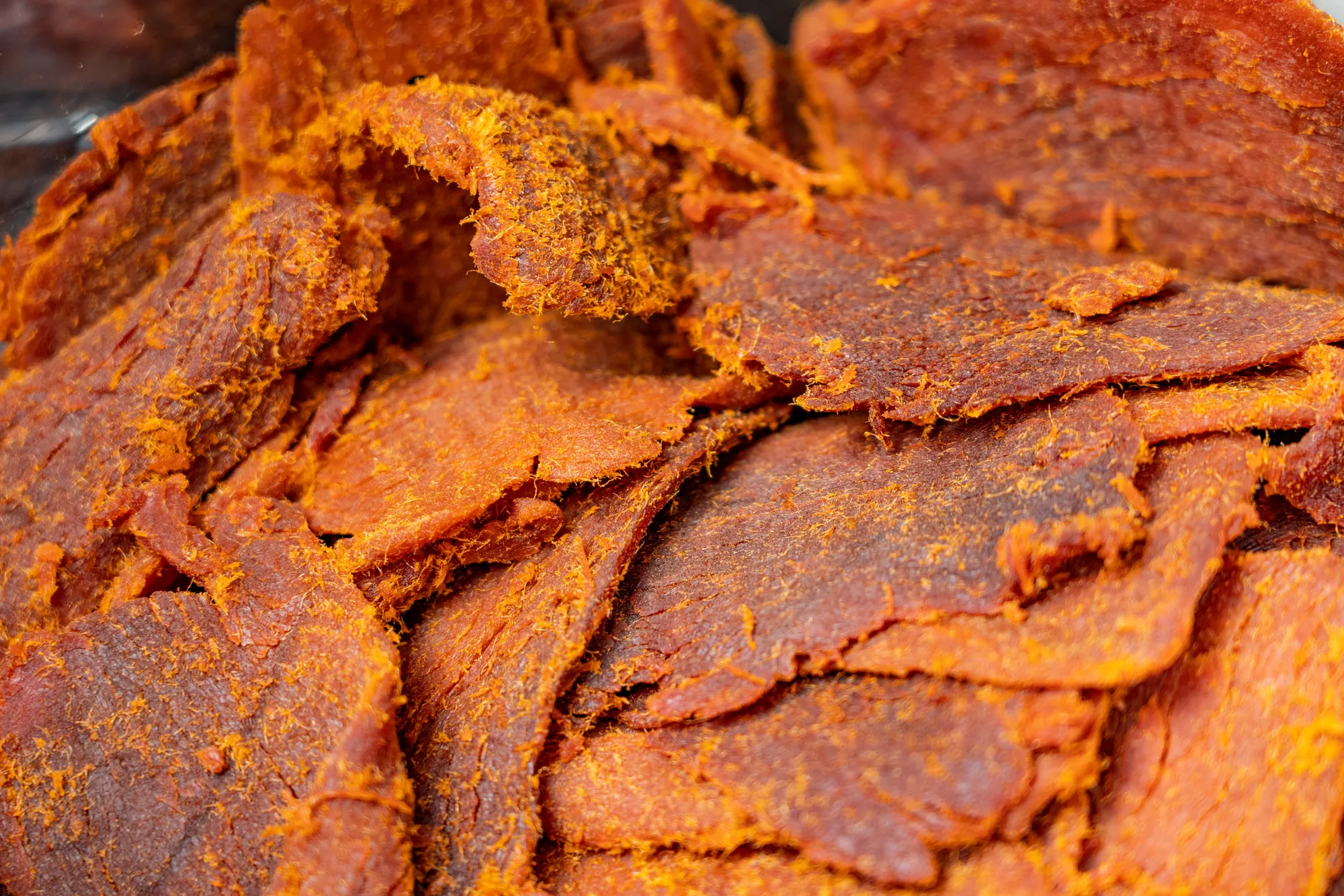
肉乾是指經醃製及乾燥處理後的肉類,常見有豬肉乾及牛肉乾。早期肉乾在人類飲食生活中的主要目的是作為久存吃食,孔子學生拜見尊師的見面禮「束脩」也常用肉乾;但歸功於食品加工技術進步,及生活水準提升,現代民眾已當成零食或補充蛋白質之用。
◤文.圖/看見台灣基金會編輯群
台
灣逢年過節熱門的伴手禮──肉乾,除了單純的乾燥肉塊,還出現肉條、肉紙等加工形式,滋味與型態都很多變。其中,台灣因為豬肉產量大,價格又較牛肉乾便宜,受到消費者偏愛,豬肉乾的年產量很大,也外銷到不少國家。
▋金門高粱酒牛肉、豬肉乾獨樹一幟
肉乾的製程,以牛肉乾為例,將肉塊滾水燙煮後切片,再以文火滷汁焙炒後烘烤至乾燥;而豬肉乾則是肉塊修整切片後醃漬調味,入味後將肉均勻鋪於篩籃上,先以低溫烘烤至乾燥,再用高溫烘烤至熟透,即為成品。牛肉乾與豬肉乾製程上最大不同,在於豬肉乾原料無須水煮,可直接醃漬入味。
台灣處處可見肉乾,豬肉乾的種類尤其多,例如厚燒條子肉乾、原味杏仁香脆肉紙、麻辣、蒜味等;知名的品牌非常多,夜市、觀光景點也處處可見現烤豬肉乾攤位,撲鼻的香氣常讓經過的人忍不住。
以地區特產而言,金門因為有高粱酒優勢,出品的高粱酒豬肉乾、牛肉乾就有獨家特色。
探索更多
年糕─甜甜神明嘴,只說好話
年糕,台語稱年糕為甜粿,客語稱為甜粄,不同族群所製作之年糕或有不同,然多半為赤黃色、琥珀色之糯米製甜食。台灣有「吃年糕,年年高」之俗諺,且由於過往糖不易取得,故帶有甜味的食物多半象徵富貴。
醬瓜─清苦農村生活中溫暖的鹹香
醬瓜為台灣常見的傳統醃漬料理,簡單易做,廣見於家戶之間。醬瓜使用小黃瓜(又稱小胡瓜、小花瓜、花胡瓜、刺瓜仔)用黃豆醬油醃漬而成。
木瓜─米其林必嘗台灣美味:木瓜牛奶
從清朝的「番木瓜」到外銷日本的台農品種,台灣木瓜透過改良與精緻栽培,成功打造口感香甜的風味,也為機能食品開創更多可能。