
'%20fill='%23a9976d'/%3e%3cpath%20id='Path_251'%20data-name='Path%20251'%20d='M8,35a1,1,0,0,1,1-1H23a1,1,0,0,1,0,2H9A1,1,0,0,1,8,35Z'%20transform='translate(-8%20-22)'%20fill='%23a9976d'/%3e%3cpath%20id='Path_252'%20data-name='Path%20252'%20d='M9,22a1,1,0,0,0,0,2h8a1,1,0,0,0,0-2Z'%20transform='translate(-8%20-16)'%20fill='%23a9976d'/%3e%3c/svg%3e)
'%20fill='%23a9976d'/%3e%3c/g%3e%3c/svg%3e)
'%3e%3cg%20id='Ellipse_27'%20data-name='Ellipse%2027'%20transform='translate(813%20250)'%20fill='none'%20stroke='%23ccac89'%20stroke-width='1'%3e%3ccircle%20cx='16'%20cy='16'%20r='16'%20stroke='none'/%3e%3ccircle%20cx='16'%20cy='16'%20r='15.5'%20fill='none'/%3e%3c/g%3e%3cg%20id='facebook'%20transform='translate(824.105%20258.296)'%3e%3cpath%20id='Path_243'%20data-name='Path%20243'%20d='M8.894.111V2.556H7.441a1.361,1.361,0,0,0-1.074.333,1.534,1.534,0,0,0-.278,1v1.75H8.8L8.441,8.38H6.089v7.028H3.255V8.38H.894V5.639H3.255V3.62A3.582,3.582,0,0,1,4.218.949,3.5,3.5,0,0,1,6.783,0,15.317,15.317,0,0,1,8.894.111Z'%20transform='translate(0%200)'%20fill='%23ccac89'/%3e%3c/g%3e%3c/g%3e%3c/svg%3e)

'%3e%3cg%20id='Ellipse_29'%20data-name='Ellipse%2029'%20transform='translate(901%20250)'%20fill='none'%20stroke='%23ccac89'%20stroke-width='1'%3e%3ccircle%20cx='16'%20cy='16'%20r='16'%20stroke='none'/%3e%3ccircle%20cx='16'%20cy='16'%20r='15.5'%20fill='none'/%3e%3c/g%3e%3cg%20id='link-45deg'%20transform='translate(902.607%20253.105)'%3e%3cg%20id='Group_479'%20data-name='Group%20479'%20transform='translate(7.393%205.896)'%3e%3cpath%20id='Path_241'%20data-name='Path%20241'%20d='M10.246,17.821,8.507,19.56a3.8,3.8,0,0,0,5.378,5.378L16.2,22.62a3.8,3.8,0,0,0-1.05-6.12l-.743.743a1.27,1.27,0,0,0-.2.252,2.535,2.535,0,0,1,1.091,4.23L12.99,24.042A2.536,2.536,0,0,1,9.4,20.455l1.005-1a5.093,5.093,0,0,1-.162-1.631Z'%20transform='translate(-7.393%20-12.02)'%20fill='%23ccac89'/%3e%3cpath%20id='Path_242'%20data-name='Path%20242'%20d='M18.236,9.327a3.8,3.8,0,0,0,1.05,6.12l.982-.984a2.535,2.535,0,0,1-1.136-4.241L21.448,7.9a2.536,2.536,0,1,1,3.587,3.587l-1.005,1a5.1,5.1,0,0,1,.162,1.631l1.739-1.739A3.8,3.8,0,1,0,20.553,7.01Z'%20transform='translate(-13.011%20-5.896)'%20fill='%23ccac89'/%3e%3c/g%3e%3c/g%3e%3c/g%3e%3c/svg%3e)
◤文.圖/看見台灣基金會編輯群
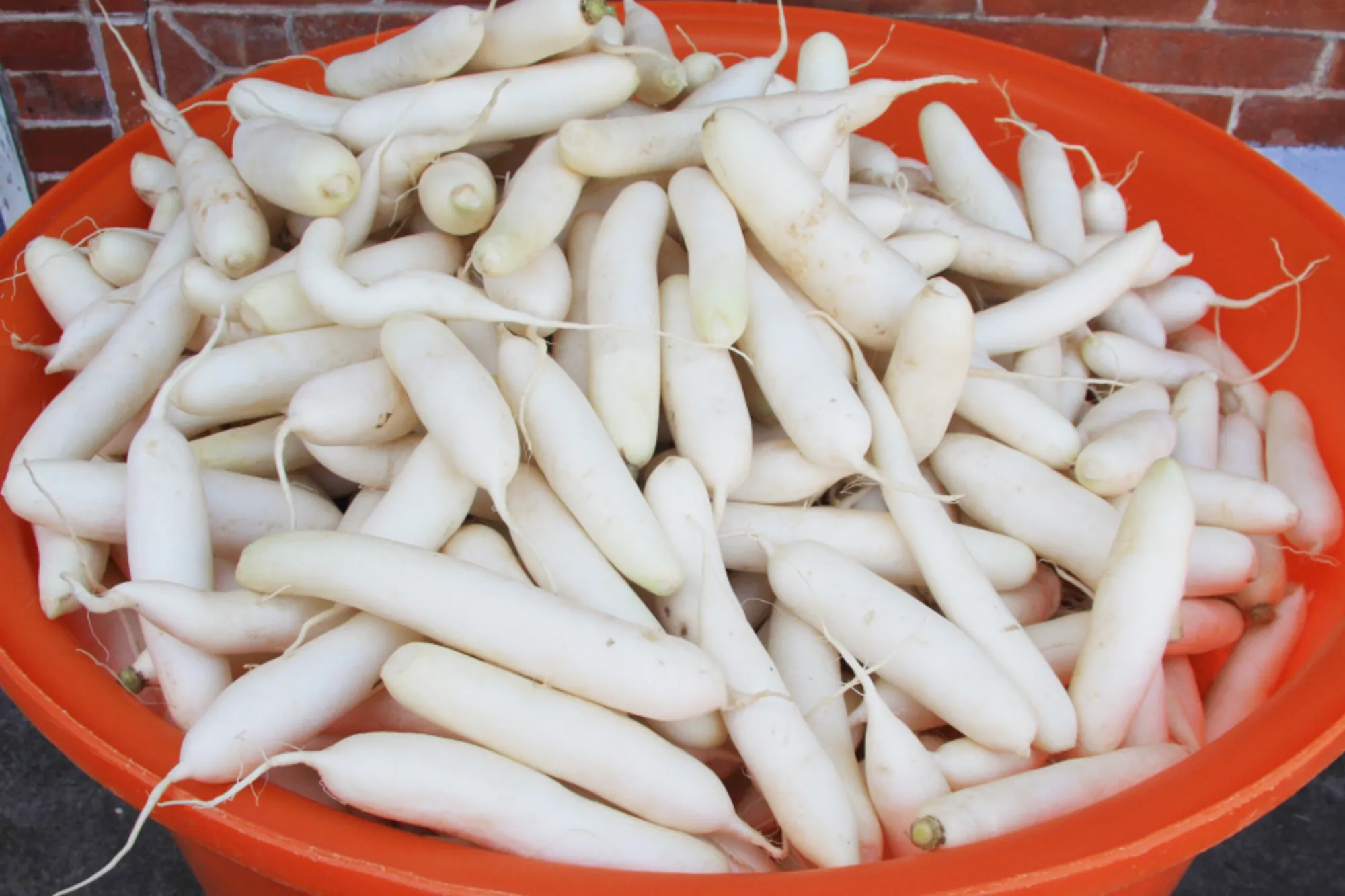
在高雄美濃,冬季田間有一種潔白如玉的作物,靜靜鋪展在沖積扇平原之上,象徵客家農人的勤勉與土地智慧──那便是「白玉蘿蔔」。美濃農民多採「裡作」制度,於二期稻作收成後接續種植白玉蘿蔔,使土地在冬季不會閒置,展現「地盡其利」的生活哲學。潔淨水源、充足日照與鬆軟肥沃的砂質壤土,共同孕育出質地細嫩的白玉蘿蔔,成為客庄冬季最具代表性的風味象徵。
美濃白玉蘿蔔品種主要為日本引進的「白玉大根」,於1980年代引進後,經在地農民長年馴化選育,逐漸發展出適應南台灣氣候的地方品系。其最大特色在於薄皮、爽脆、甘甜,燉煮後則化為綿軟細緻,幾乎入口即化。料理方式多元,無論清炒、煲湯、製成蘿蔔糕或醃漬醬菜,皆能展現其溫潤本味。其中,慢火滷煮的「蘿蔔封」,吸飽滷汁、甘甜回潤,是許多美濃人冬日溫暖的家常記憶。
「白玉蘿蔔季」結合拔蘿蔔體驗、食農教育
「白玉」之名,不僅指其外觀潔白溫潤,更是一種文化隱喻。詩人余光中在詠嘆故宮典藏「白玉苦瓜」時以詩寫道:「瓜而曰苦,正象徵生命的現實」,白玉的純淨,反而映照出人生與土地的真實滋味;美濃白玉蘿蔔亦然,以樸實之姿承載深厚的農業記憶,因此得名「白玉」,並非奢華,而是對土地與作物本質的珍視。
目前美濃白玉蘿蔔年產量約一萬公噸,除鮮食外,也發展出蘿蔔乾、蘿蔔絲餅、蘿蔔糕等加工產品。每年11月登場的「美濃白玉蘿蔔季」,結合拔蘿蔔體驗、食農教育與地方市集,讓旅人親身感受作物從土地拔起的重量與溫度。
展望未來,美濃白玉蘿蔔正朝向產地標章與文化品牌深化發展。透過農業與文化並進,讓一條潔白如玉的蘿蔔,不只是冬季作物,更成為連結土地永續、客家生活與當代飲食文化的重要媒介。