
'%20fill='%23a9976d'/%3e%3cpath%20id='Path_251'%20data-name='Path%20251'%20d='M8,35a1,1,0,0,1,1-1H23a1,1,0,0,1,0,2H9A1,1,0,0,1,8,35Z'%20transform='translate(-8%20-22)'%20fill='%23a9976d'/%3e%3cpath%20id='Path_252'%20data-name='Path%20252'%20d='M9,22a1,1,0,0,0,0,2h8a1,1,0,0,0,0-2Z'%20transform='translate(-8%20-16)'%20fill='%23a9976d'/%3e%3c/svg%3e)
'%20fill='%23a9976d'/%3e%3c/g%3e%3c/svg%3e)
金針花─觀為花、食為菜、用為藥
地方探索
時令探索
主題探索
東部
夏
文化美食
分享
'%3e%3cg%20id='Ellipse_27'%20data-name='Ellipse%2027'%20transform='translate(813%20250)'%20fill='none'%20stroke='%23ccac89'%20stroke-width='1'%3e%3ccircle%20cx='16'%20cy='16'%20r='16'%20stroke='none'/%3e%3ccircle%20cx='16'%20cy='16'%20r='15.5'%20fill='none'/%3e%3c/g%3e%3cg%20id='facebook'%20transform='translate(824.105%20258.296)'%3e%3cpath%20id='Path_243'%20data-name='Path%20243'%20d='M8.894.111V2.556H7.441a1.361,1.361,0,0,0-1.074.333,1.534,1.534,0,0,0-.278,1v1.75H8.8L8.441,8.38H6.089v7.028H3.255V8.38H.894V5.639H3.255V3.62A3.582,3.582,0,0,1,4.218.949,3.5,3.5,0,0,1,6.783,0,15.317,15.317,0,0,1,8.894.111Z'%20transform='translate(0%200)'%20fill='%23ccac89'/%3e%3c/g%3e%3c/g%3e%3c/svg%3e)

'%3e%3cg%20id='Ellipse_29'%20data-name='Ellipse%2029'%20transform='translate(901%20250)'%20fill='none'%20stroke='%23ccac89'%20stroke-width='1'%3e%3ccircle%20cx='16'%20cy='16'%20r='16'%20stroke='none'/%3e%3ccircle%20cx='16'%20cy='16'%20r='15.5'%20fill='none'/%3e%3c/g%3e%3cg%20id='link-45deg'%20transform='translate(902.607%20253.105)'%3e%3cg%20id='Group_479'%20data-name='Group%20479'%20transform='translate(7.393%205.896)'%3e%3cpath%20id='Path_241'%20data-name='Path%20241'%20d='M10.246,17.821,8.507,19.56a3.8,3.8,0,0,0,5.378,5.378L16.2,22.62a3.8,3.8,0,0,0-1.05-6.12l-.743.743a1.27,1.27,0,0,0-.2.252,2.535,2.535,0,0,1,1.091,4.23L12.99,24.042A2.536,2.536,0,0,1,9.4,20.455l1.005-1a5.093,5.093,0,0,1-.162-1.631Z'%20transform='translate(-7.393%20-12.02)'%20fill='%23ccac89'/%3e%3cpath%20id='Path_242'%20data-name='Path%20242'%20d='M18.236,9.327a3.8,3.8,0,0,0,1.05,6.12l.982-.984a2.535,2.535,0,0,1-1.136-4.241L21.448,7.9a2.536,2.536,0,1,1,3.587,3.587l-1.005,1a5.1,5.1,0,0,1,.162,1.631l1.739-1.739A3.8,3.8,0,1,0,20.553,7.01Z'%20transform='translate(-13.011%20-5.896)'%20fill='%23ccac89'/%3e%3c/g%3e%3c/g%3e%3c/g%3e%3c/svg%3e)
盛夏之際,到台灣東部的金針花產地欣賞澄黃的壯闊花海,之後再享用產地限定的新鮮金針花湯、清炒金針花,是很夯的旅遊行程,尤其是台東的太麻里、花蓮富里的六十石山、玉里的赤科山,場面壯觀。
◤文.圖/看見台灣基金會編輯群
金
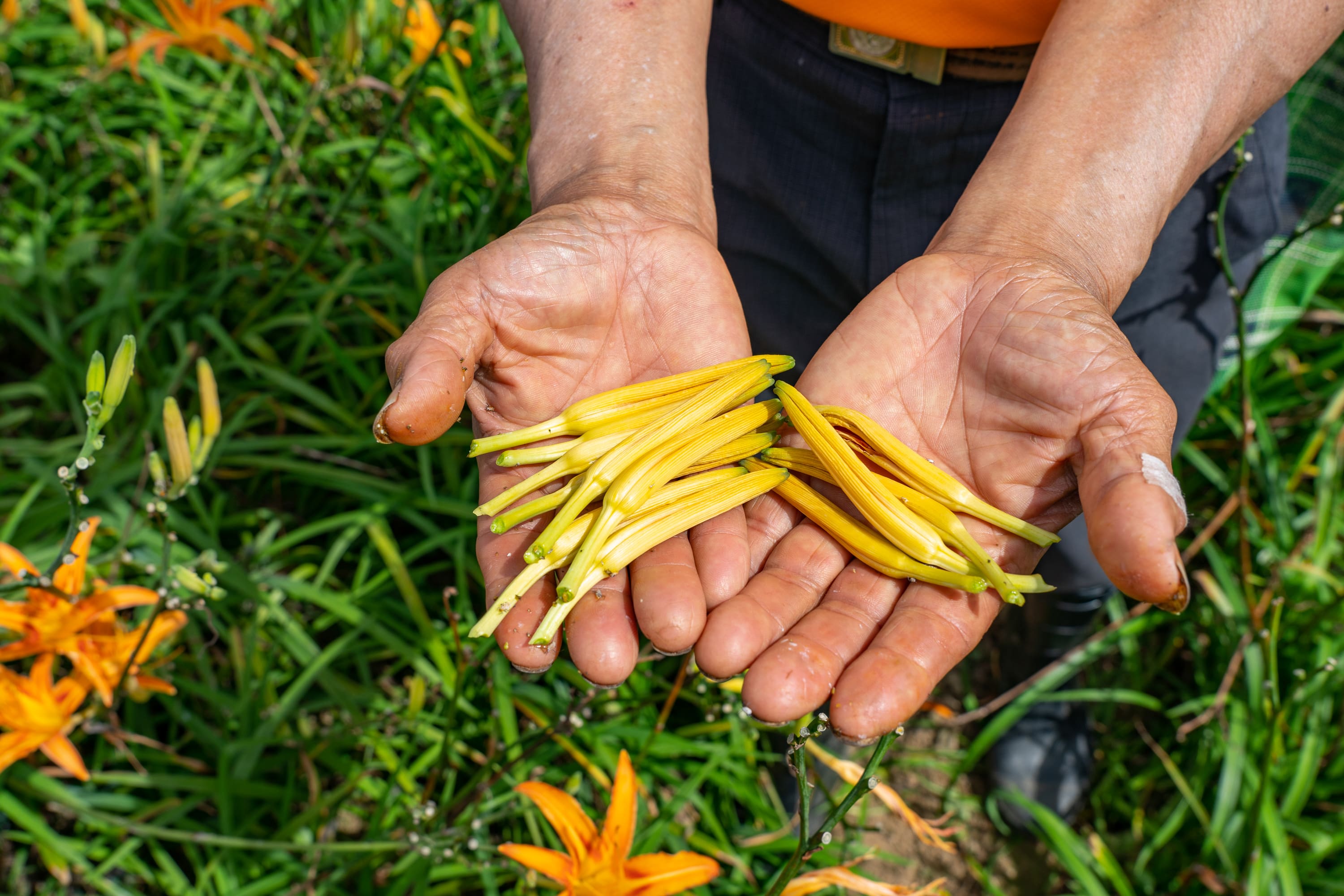
針花又稱為黃花菜,花苞可以吃,盛開時又有觀賞價值,還可以作為中藥材,真正做到「觀為花、食為菜、用為藥」;因為金針開花後只有一天生命,當天太陽下山後即枯萎,也有「一日美人」之稱,這也是金針花英文名「Daylily」(一日百合)的由來。
這位一日美人,原產於中國南方,在《本草綱目》中即有記載,同屬的植物統稱為萱草,有代表母親的意涵。
▋盛開後就沒有食用價值
金針花一旦盛開,就沒有食用價值,只能欣賞,一般民眾最常吃的「金針」指的是還沒開花的花苞。金針花農以一日花、兩日花、三日花區分金針花苞距離開花還有幾天,一日花表示隔天就要開花、價錢不好;最常送到餐廳的是顏色沒這麼黃、比較小株,但口感最好的二日花。
至於民眾在超市、傳統市場買到的金針花乾,則是金針農在開花前搶收的一日花或二日花,採收完畢後得迅速烘乾才能儲存。
早年金針花農為求烘乾後仍保持色澤鮮豔、延長保存期限,普遍使用攝取過量會中毒的亞硫酸鹽類浸泡加工花乾,加上進口金針花品質不一、削價競爭,使本土金針花價格不穩定,花蓮六十石山的農場2010年開始轉型為無毒農耕,保障了消費者,也使台灣的金針花種植朝向友善栽種、永續經營的方向前進。
探索更多
蔥─1米高的蔥,展現台灣農民實力
青蔥不僅是料理的最佳配角,更是台灣農業實力的象徵。嘉義農民成功培育超越日本的大蔥,宜蘭三星蔥則以細緻口感與獨特風味聞名。
小白菜─是大白菜的「祖先」
國民蔬菜之一的小白菜,源於中國,根據考古資料,5000年前已現蹤跡,而且是大白菜的「祖先」,歷史跟中國一樣悠久,笑看多少朝代的起落,風光存活至今,自成龐大的「白菜王朝」。
葡萄酒─兩個酒莊連奪世界首獎
葡萄酒,原本是法國的天下;然而,誰料得到,在亞洲,相較之下只是彈丸之地的台灣,以橫空出世的氣勢,在三年內連續冒出兩個世界冠軍等級的葡萄酒。(圖片來源:Unsplash)