
'%20fill='%23a9976d'/%3e%3cpath%20id='Path_251'%20data-name='Path%20251'%20d='M8,35a1,1,0,0,1,1-1H23a1,1,0,0,1,0,2H9A1,1,0,0,1,8,35Z'%20transform='translate(-8%20-22)'%20fill='%23a9976d'/%3e%3cpath%20id='Path_252'%20data-name='Path%20252'%20d='M9,22a1,1,0,0,0,0,2h8a1,1,0,0,0,0-2Z'%20transform='translate(-8%20-16)'%20fill='%23a9976d'/%3e%3c/svg%3e)
'%20fill='%23a9976d'/%3e%3c/g%3e%3c/svg%3e)
'%3e%3cg%20id='Ellipse_27'%20data-name='Ellipse%2027'%20transform='translate(813%20250)'%20fill='none'%20stroke='%23ccac89'%20stroke-width='1'%3e%3ccircle%20cx='16'%20cy='16'%20r='16'%20stroke='none'/%3e%3ccircle%20cx='16'%20cy='16'%20r='15.5'%20fill='none'/%3e%3c/g%3e%3cg%20id='facebook'%20transform='translate(824.105%20258.296)'%3e%3cpath%20id='Path_243'%20data-name='Path%20243'%20d='M8.894.111V2.556H7.441a1.361,1.361,0,0,0-1.074.333,1.534,1.534,0,0,0-.278,1v1.75H8.8L8.441,8.38H6.089v7.028H3.255V8.38H.894V5.639H3.255V3.62A3.582,3.582,0,0,1,4.218.949,3.5,3.5,0,0,1,6.783,0,15.317,15.317,0,0,1,8.894.111Z'%20transform='translate(0%200)'%20fill='%23ccac89'/%3e%3c/g%3e%3c/g%3e%3c/svg%3e)

'%3e%3cg%20id='Ellipse_29'%20data-name='Ellipse%2029'%20transform='translate(901%20250)'%20fill='none'%20stroke='%23ccac89'%20stroke-width='1'%3e%3ccircle%20cx='16'%20cy='16'%20r='16'%20stroke='none'/%3e%3ccircle%20cx='16'%20cy='16'%20r='15.5'%20fill='none'/%3e%3c/g%3e%3cg%20id='link-45deg'%20transform='translate(902.607%20253.105)'%3e%3cg%20id='Group_479'%20data-name='Group%20479'%20transform='translate(7.393%205.896)'%3e%3cpath%20id='Path_241'%20data-name='Path%20241'%20d='M10.246,17.821,8.507,19.56a3.8,3.8,0,0,0,5.378,5.378L16.2,22.62a3.8,3.8,0,0,0-1.05-6.12l-.743.743a1.27,1.27,0,0,0-.2.252,2.535,2.535,0,0,1,1.091,4.23L12.99,24.042A2.536,2.536,0,0,1,9.4,20.455l1.005-1a5.093,5.093,0,0,1-.162-1.631Z'%20transform='translate(-7.393%20-12.02)'%20fill='%23ccac89'/%3e%3cpath%20id='Path_242'%20data-name='Path%20242'%20d='M18.236,9.327a3.8,3.8,0,0,0,1.05,6.12l.982-.984a2.535,2.535,0,0,1-1.136-4.241L21.448,7.9a2.536,2.536,0,1,1,3.587,3.587l-1.005,1a5.1,5.1,0,0,1,.162,1.631l1.739-1.739A3.8,3.8,0,1,0,20.553,7.01Z'%20transform='translate(-13.011%20-5.896)'%20fill='%23ccac89'/%3e%3c/g%3e%3c/g%3e%3c/g%3e%3c/svg%3e)
◤文.圖 / 看見台灣基金會編輯群
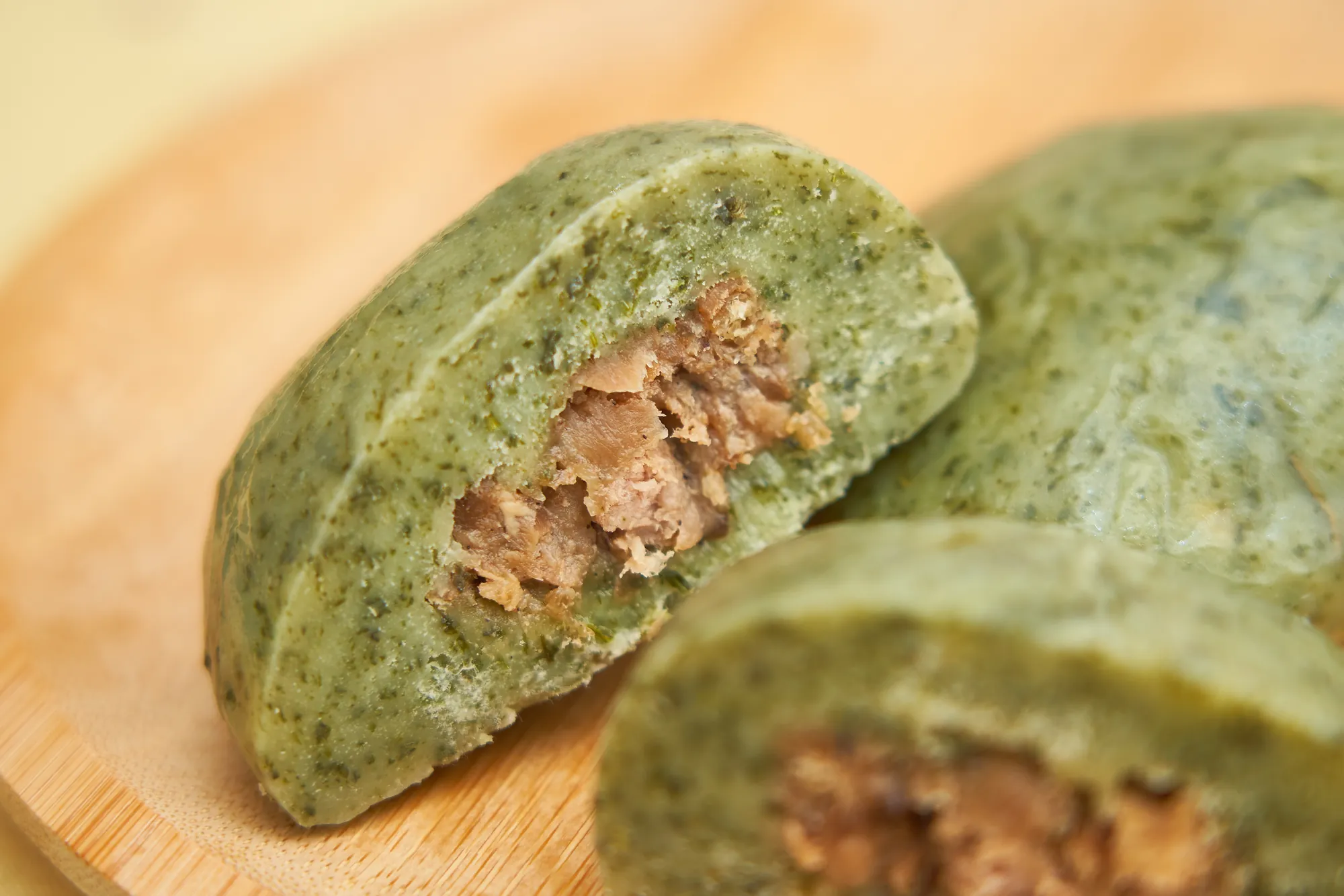
草仔粿是一種台灣傳統米食,古稱「青糰」,客家人稱其「艾粄」,閩南地區則稱「草仔粿」。一般用糯米製成,或者按習慣比例混合蓬萊米、在來米製作外皮,常以艾草、鼠麴草或其他春季採集的青草榨汁拌入米糰,使粿身呈現翠綠色並帶青草香,並包裹各式內餡。
傳統為甜鹹兩種口味,鹹餡常以蘿蔔絲為料,並加入豬絞肉、蝦米、乾香菇、紅蔥頭等食材一同炒製,或有菜脯米、素肉排等,增添鹹香;甜餡則以豆沙為主,一般以紅豆或綠豆煮至軟爛磨搗成泥,加入糖調味,近年還有巧克力奶油等創新口味,成為多樣化的甜點。
製法與餡料因地域呈現多樣化
清代《重修福建台灣府誌》記載:「三月三日,採鼠麴草合米粉為粿,以祀其先;謂之三月節。清明日,祀其祖先,祭掃墳墓……」可知當時即有草仔粿祭祀祖先的習俗。最早,春祭是在寒食節(冬至後第105日,在清明前一或二日),與清明時間相近,隨著時間演變逐漸由清明節所取代,掃墓祭祖、禁火、吃冷食等習俗,多半融合了寒食節的傳統。
在台灣,草仔粿會因地域與族群不同而呈現多樣變化,不僅體現在製法與餡料,也反映各地對季節食材的運用。時至今日,草仔粿仍是清明節祭祖常見的供品之一,許多家庭會自行製作,或於市場購買,作為掃墓祭祀與分食的食物。除節慶用途外,草仔粿也逐漸進入日常飲食,在街市與店家中全年可見,成為兼具季節象徵與日常食用的米食點心。隨著口味與製作方式的變化,從傳統鹹甜餡料到現代創新內餡,草仔粿在延續祭祀文化的同時,也持續回應當代飲食需求。