
'%20fill='%23a9976d'/%3e%3cpath%20id='Path_251'%20data-name='Path%20251'%20d='M8,35a1,1,0,0,1,1-1H23a1,1,0,0,1,0,2H9A1,1,0,0,1,8,35Z'%20transform='translate(-8%20-22)'%20fill='%23a9976d'/%3e%3cpath%20id='Path_252'%20data-name='Path%20252'%20d='M9,22a1,1,0,0,0,0,2h8a1,1,0,0,0,0-2Z'%20transform='translate(-8%20-16)'%20fill='%23a9976d'/%3e%3c/svg%3e)
'%20fill='%23a9976d'/%3e%3c/g%3e%3c/svg%3e)
端午─粽子百家爭鳴
時令探索
夏
分享
'%3e%3cg%20id='Ellipse_27'%20data-name='Ellipse%2027'%20transform='translate(813%20250)'%20fill='none'%20stroke='%23ccac89'%20stroke-width='1'%3e%3ccircle%20cx='16'%20cy='16'%20r='16'%20stroke='none'/%3e%3ccircle%20cx='16'%20cy='16'%20r='15.5'%20fill='none'/%3e%3c/g%3e%3cg%20id='facebook'%20transform='translate(824.105%20258.296)'%3e%3cpath%20id='Path_243'%20data-name='Path%20243'%20d='M8.894.111V2.556H7.441a1.361,1.361,0,0,0-1.074.333,1.534,1.534,0,0,0-.278,1v1.75H8.8L8.441,8.38H6.089v7.028H3.255V8.38H.894V5.639H3.255V3.62A3.582,3.582,0,0,1,4.218.949,3.5,3.5,0,0,1,6.783,0,15.317,15.317,0,0,1,8.894.111Z'%20transform='translate(0%200)'%20fill='%23ccac89'/%3e%3c/g%3e%3c/g%3e%3c/svg%3e)

'%3e%3cg%20id='Ellipse_29'%20data-name='Ellipse%2029'%20transform='translate(901%20250)'%20fill='none'%20stroke='%23ccac89'%20stroke-width='1'%3e%3ccircle%20cx='16'%20cy='16'%20r='16'%20stroke='none'/%3e%3ccircle%20cx='16'%20cy='16'%20r='15.5'%20fill='none'/%3e%3c/g%3e%3cg%20id='link-45deg'%20transform='translate(902.607%20253.105)'%3e%3cg%20id='Group_479'%20data-name='Group%20479'%20transform='translate(7.393%205.896)'%3e%3cpath%20id='Path_241'%20data-name='Path%20241'%20d='M10.246,17.821,8.507,19.56a3.8,3.8,0,0,0,5.378,5.378L16.2,22.62a3.8,3.8,0,0,0-1.05-6.12l-.743.743a1.27,1.27,0,0,0-.2.252,2.535,2.535,0,0,1,1.091,4.23L12.99,24.042A2.536,2.536,0,0,1,9.4,20.455l1.005-1a5.093,5.093,0,0,1-.162-1.631Z'%20transform='translate(-7.393%20-12.02)'%20fill='%23ccac89'/%3e%3cpath%20id='Path_242'%20data-name='Path%20242'%20d='M18.236,9.327a3.8,3.8,0,0,0,1.05,6.12l.982-.984a2.535,2.535,0,0,1-1.136-4.241L21.448,7.9a2.536,2.536,0,1,1,3.587,3.587l-1.005,1a5.1,5.1,0,0,1,.162,1.631l1.739-1.739A3.8,3.8,0,1,0,20.553,7.01Z'%20transform='translate(-13.011%20-5.896)'%20fill='%23ccac89'/%3e%3c/g%3e%3c/g%3e%3c/g%3e%3c/svg%3e)
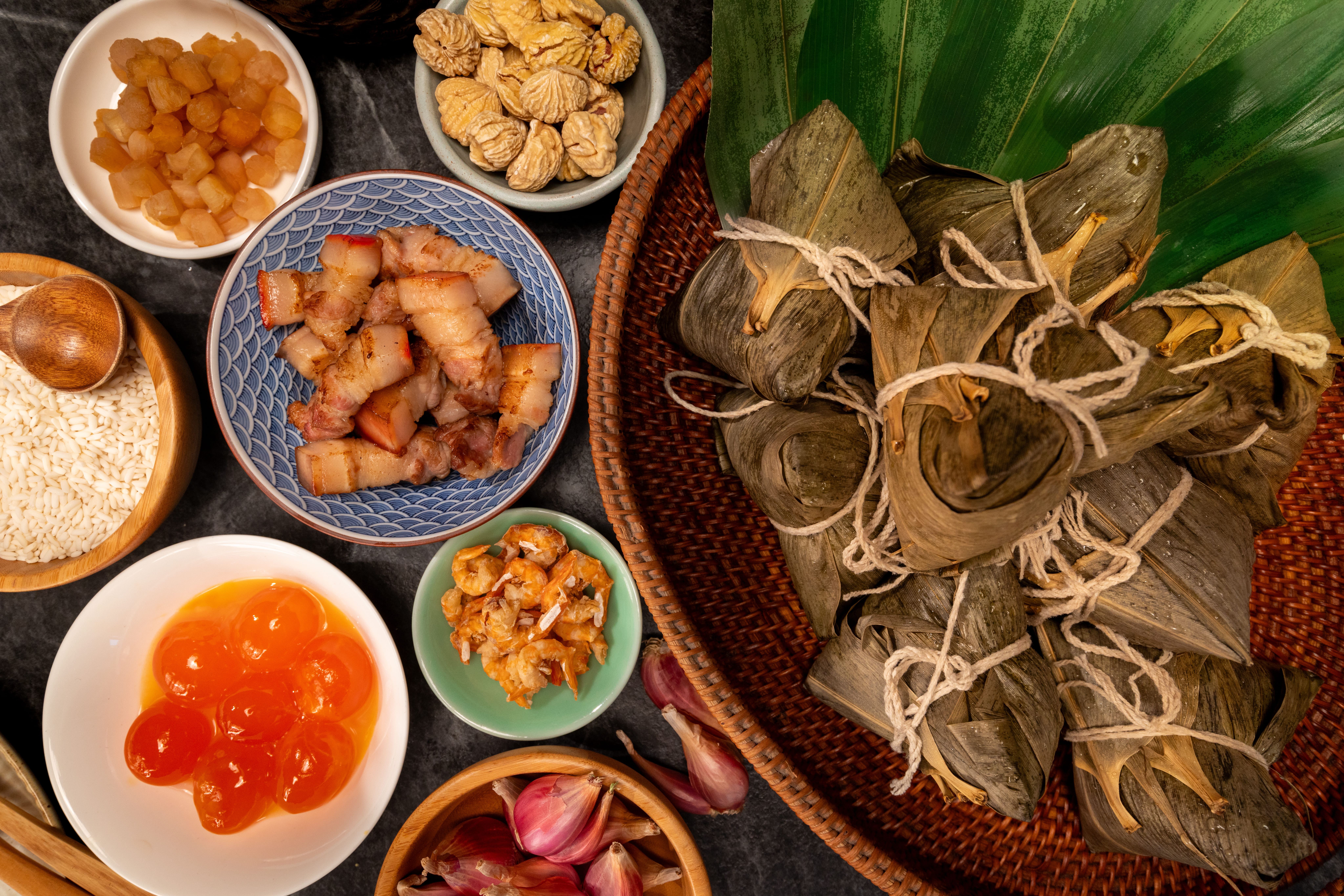
端午佳節,粽子飄香。台灣的粽子文化豐富多元,從南北粽的口味之爭,到各地特色粽的創意巧思,每顆粽子都包著文化底蘊與節慶氛圍。
◤文.圖/看見台灣基金會編輯群
每
年農曆五月初五的端午節,又稱五日節、午日節或五月節。此外,這天大多數人會食用粽子,民間故有「粽子節」的戲稱。
端午起源有一說為紀念戰國時期的忠臣屈原,然而將「端午」兩字回歸漢字起源與解釋,「端」為始也,五與午同,以節令觀之:五日為候,三候為氣,六氣為時,四時為歲,一歲有二十四節氣、七十二候。因此「端午」可視作五月的第一個節氣變化日。
而端午節所食的台灣本土粽子大宗,分別是北部粽與南部粽。
▋北部粽口味重,南部粽清淡
北部粽會將生糯米與料炒至半熟,加上滷過的滷肉、香菇與鹹蛋黃,用葉子包好再另外蒸熟,口味偏油鹹而米粒分明。南部粽餡料雖大致相似,但會將泡好的生糯米與料包好後,直接放入水中煮到熟軟,口感較黏稠軟糯、口味也較清淡。此外也有只包花生的菜粽,加入鹼水後淋蜂蜜或沾糖吃的甜粽(鹼粽)。
外省粽和客家粽是台灣另兩種具代表性的粽子。外省粽是隨著1949年後大量軍民遷台而傳入,以湖州粽較為常見,特點是形狀較長,內餡多為滷肉、蛋黃等。客家粽有以下幾種類型:米粽,以蒸熟的圓糯米包入蝦米、紅蔥頭、菜脯、香菇絲、豬肉等材料;粄粽,將泡水後的糯米研磨成米漿,瀝乾水分後搓揉成粄糰,加入菜脯等;野薑花粽,以野薑花葉包裹山地香菇、豬肉、糯米等。
探索更多
鍋燒意麵──小鍋現煮的台南日常
從油炸意麵到一人一鍋的現煮形式,鍋燒意麵把台南常見的麵食與湯料組合,煮成早午餐、點心乃至宵夜都能上桌的庶民滋味。
風茹草──滋補又消暑聖品的「澎湖人參」
澎湖有一種名為「風茹草」的草本植物,以其製成的風茹茶,常被形容帶有草本香氣與微苦滋味,入口後轉為清甜回甘。它不僅是世代相傳的消暑飲品,更展現澎湖人順應自然、善用在地植物的生活智慧。
果乾─台三線客家莊是主力產區
果乾為以日曬、烘乾等方法去除水份之水果。台灣素有「水果王國」之美名,以地利與氣候之便,出產之水果種類繁多,風味亦佳,若遇豐年,果品收穫量豐碩、無法盡售,出於惜物愛物之精神,將水果烘乾後,不僅能延長水果的食用期限,果乾更因加熱造成糖份濃縮,風味更顯鮮甜可口。