


◤Text and Images / iSee Taiwan Foundation Editorial Team
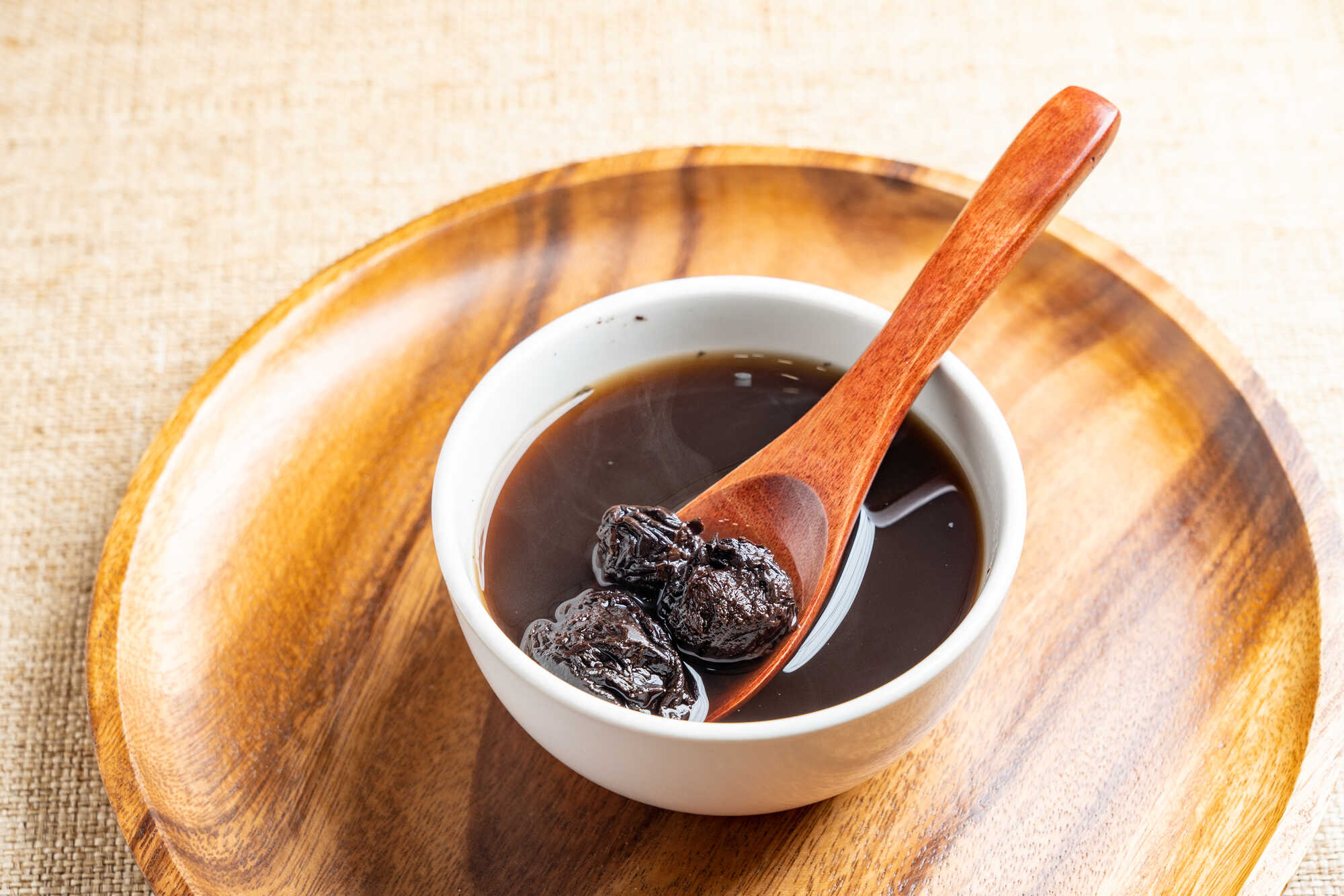
In early Taiwanese rural life, preserved mume products-salted mume and candied dried mume-were everyday snacks prized for their sour, briny bite and thirst-quenching qualities. The Chinese idiom "gazing at plums to quench one's thirst" also reflects the traditional association between the fruit's tartness and the sensation of stimulating saliva and relieving thirst. Brewed from smoked mume, wumei tang (smoked mume drink) has endured as one of Taiwan's most beloved summer refreshments.
Wumei (smoked dried mume fruit) is made from the near-ripe fruit of Prunus mume Siebold & Zucc.-mume fruit in its raw form. Green, unripe mume fruit is smoked or slow-dried over gentle heat, until black, shriveled, and intensely tart; the result is wumei, or smoked mume. The transformation deepens the flavor and preserves it for use in traditional Chinese medicine as well as in everyday food culture. The mume tree is native to central, southern, and southwestern China; Taiwan's orchards trace their origins to seedlings brought from Fujian and Guangdong. Records in the Taiwan Prefecture Gazetteer, compiled in 1684-the twenty-third year of the Kangxi Emperor's reign-already document the mume's presence on the island. By the Japanese colonial period, both cultivated orchards and wild varieties were recorded; growing regions gradually consolidated around Nantou County, Taitung County, and Kaohsiung City.
Creating depth with hawthorn, licorice, and osmanthus
The Compendium of Materia Medica describes wumei as "green mume smoked black," with a flavor profile characterized as sour, warming, neutral, astringent, and non-toxic. Traditional Chinese medicine texts credit it with properties that consolidate the lungs, astringe the intestines, promote fluid production, and ease intestinal parasites. Over the centuries, wumei crossed from the medicine cabinet into the kitchen-and eventually the drinking glass.
Wumei tang has a long pedigree. Historical accounts suggest it developed as a summer drink in Qing dynasty imperial kitchens before spreading into popular culture. A verse by the Qing-dynasty poet Hao Yixing in Dumen Zhuzhi Ci captures a vivid street scene: bronze bowls clinking as vendors hawked iced wumei tang through Beijing's alleyways. Today's recipes build on the classic base of wumei, often adding hawthorn, licorice, and osmanthus for layered complexity. In Taiwan, some shops and home cooks incorporate roselle, lending the brew a deeper crimson hue and a floral tartness.
Wumei tang is more than a summer cooler; it reflects the arc of Taiwan's mume industry and the ingenuity of everyday food culture. Each mume season, the harvest yields a range of preserved products: dried mume, crisp pickled mume, mume vinegar, and mume wine. Among them, smoked wumei remains a cornerstone-its sweet-sour, lingering finish carrying both seasonal memory and centuries of medicinal wisdom into modern life.