
'%20fill='%23a9976d'/%3e%3cpath%20id='Path_251'%20data-name='Path%20251'%20d='M8,35a1,1,0,0,1,1-1H23a1,1,0,0,1,0,2H9A1,1,0,0,1,8,35Z'%20transform='translate(-8%20-22)'%20fill='%23a9976d'/%3e%3cpath%20id='Path_252'%20data-name='Path%20252'%20d='M9,22a1,1,0,0,0,0,2h8a1,1,0,0,0,0-2Z'%20transform='translate(-8%20-16)'%20fill='%23a9976d'/%3e%3c/svg%3e)
'%20fill='%23a9976d'/%3e%3c/g%3e%3c/svg%3e)
'%3e%3cg%20id='Ellipse_27'%20data-name='Ellipse%2027'%20transform='translate(813%20250)'%20fill='none'%20stroke='%23ccac89'%20stroke-width='1'%3e%3ccircle%20cx='16'%20cy='16'%20r='16'%20stroke='none'/%3e%3ccircle%20cx='16'%20cy='16'%20r='15.5'%20fill='none'/%3e%3c/g%3e%3cg%20id='facebook'%20transform='translate(824.105%20258.296)'%3e%3cpath%20id='Path_243'%20data-name='Path%20243'%20d='M8.894.111V2.556H7.441a1.361,1.361,0,0,0-1.074.333,1.534,1.534,0,0,0-.278,1v1.75H8.8L8.441,8.38H6.089v7.028H3.255V8.38H.894V5.639H3.255V3.62A3.582,3.582,0,0,1,4.218.949,3.5,3.5,0,0,1,6.783,0,15.317,15.317,0,0,1,8.894.111Z'%20transform='translate(0%200)'%20fill='%23ccac89'/%3e%3c/g%3e%3c/g%3e%3c/svg%3e)

'%3e%3cg%20id='Ellipse_29'%20data-name='Ellipse%2029'%20transform='translate(901%20250)'%20fill='none'%20stroke='%23ccac89'%20stroke-width='1'%3e%3ccircle%20cx='16'%20cy='16'%20r='16'%20stroke='none'/%3e%3ccircle%20cx='16'%20cy='16'%20r='15.5'%20fill='none'/%3e%3c/g%3e%3cg%20id='link-45deg'%20transform='translate(902.607%20253.105)'%3e%3cg%20id='Group_479'%20data-name='Group%20479'%20transform='translate(7.393%205.896)'%3e%3cpath%20id='Path_241'%20data-name='Path%20241'%20d='M10.246,17.821,8.507,19.56a3.8,3.8,0,0,0,5.378,5.378L16.2,22.62a3.8,3.8,0,0,0-1.05-6.12l-.743.743a1.27,1.27,0,0,0-.2.252,2.535,2.535,0,0,1,1.091,4.23L12.99,24.042A2.536,2.536,0,0,1,9.4,20.455l1.005-1a5.093,5.093,0,0,1-.162-1.631Z'%20transform='translate(-7.393%20-12.02)'%20fill='%23ccac89'/%3e%3cpath%20id='Path_242'%20data-name='Path%20242'%20d='M18.236,9.327a3.8,3.8,0,0,0,1.05,6.12l.982-.984a2.535,2.535,0,0,1-1.136-4.241L21.448,7.9a2.536,2.536,0,1,1,3.587,3.587l-1.005,1a5.1,5.1,0,0,1,.162,1.631l1.739-1.739A3.8,3.8,0,1,0,20.553,7.01Z'%20transform='translate(-13.011%20-5.896)'%20fill='%23ccac89'/%3e%3c/g%3e%3c/g%3e%3c/g%3e%3c/svg%3e)
◤文.圖 / 看見台灣基金會編輯群
薑母鴨作為北部冬令食補的代表料理之一,起源可追溯至中國閩南福建泉州的「鹽鴨」,隨移民傳入台灣後,經本土化轉變。1980年代,有台灣業者開始加入麻油、米酒與中藥材,將原本偏乾的鹽鴨,改良為湯色深紅、酒薑香濃郁的台式薑母鴨。此料理多選用品種肉質結實耐燉的公紅面番鴨(學名疣鼻棲鴨,Cairina moschata,俗稱麝香鴨、番鴨、紅面鴨),以麻油爆香老薑後,放入鴨肉翻炒,鎖住鴨肉鮮汁,加入米酒和獨門中藥材,用砂鍋小火慢燉一到兩小時。
薑母鴨料理中的老薑(薑母)富含薑辣素與薑油酮,能溫中散寒、促進血液循環並具抗發炎效果,驅散體內寒氣。鴨肉性涼且低脂高蛋白,滋陰潤燥,恰可平衡薑母的溫熱。加上黨參、當歸等藥材的補氣養血作用,整鍋湯品補氣養血卻不燥熱,溫潤適口。
新北薑母鴨的多元風貌
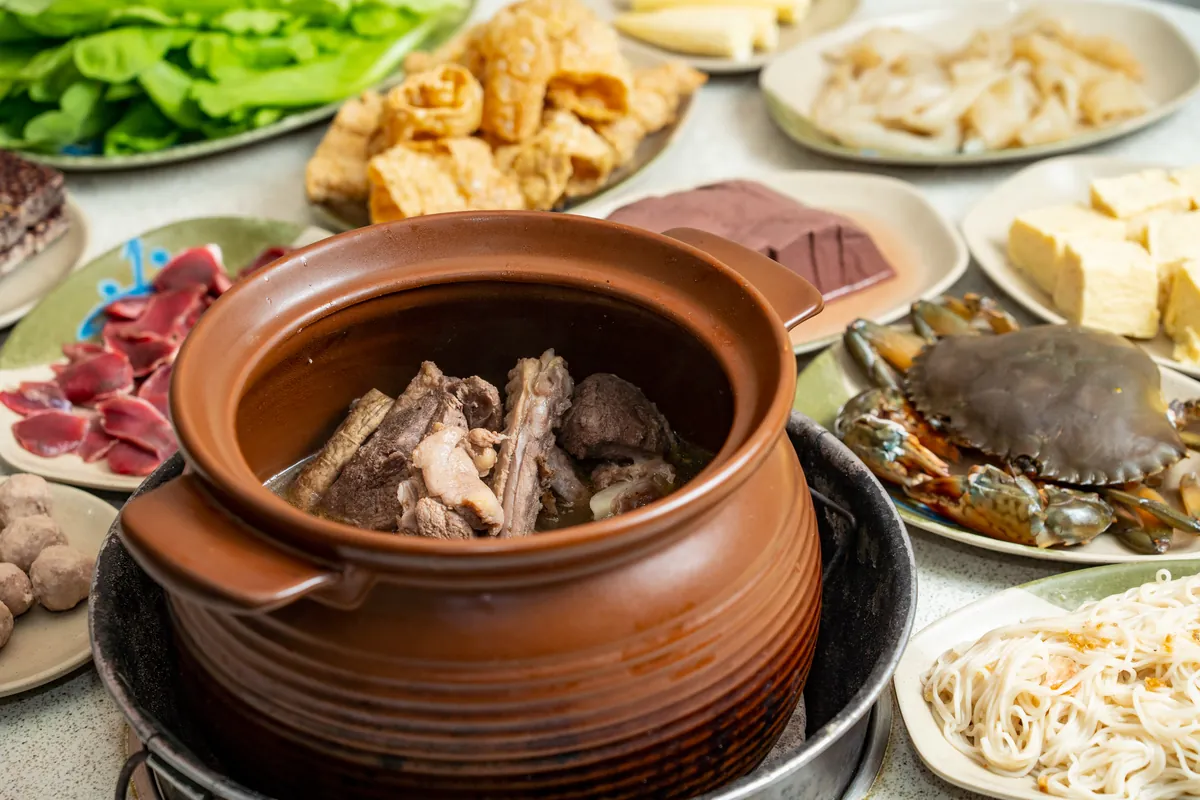
在新北市,薑母鴨已形成一股獨特的飲食文化。名店「霸味薑母鴨」以炭火慢燉聞名,湯頭濃厚飽滿,每逢冬天,總能吸引大排長龍的顧客,現已成為連鎖品牌,分店遍及全台。另一家名店「曾家薑母鴨」則以清爽藥膳風格見長,湯底帶枸杞淡雅香氣,且份量十足,成為聚餐時最受歡迎的選擇。此外,除了傳統的口味,台北市也有店家推出了「紅蟳薑母鴨」。紅蟳的鮮甜融入薑母鴨溫潤湯頭,不只多了海鮮的美味,其性寒的特點,也能巧妙地中和薑母鴨的燥性,使湯品風味更趨平衡。
有趣的是,這道料理還曾「逆向輸出」,回到了它的發源地。1990年代隨著台商返鄉經商,台式改良版薑母鴨被帶回中國閩南地區,形成文化交流的迴圈,也展現了台灣飲食文化的多元與活力。